 Add to Chrome
 Add to Firefox
 Add to Edge
Markerless Motion Capture in Routine Clinical Upper Limb Assessments: Validity and Insights Beyond Ordinal Scoring
Jul 26, 2026
The Action Research Arm Test (ARAT) is a widely-used upper limb outcome measure in neurorehabilitation, but its ordinal scoring is subjective and suffers from limited sensitivity and specificity. We evaluated whether artificial-intelligence (AI)-based markerless motion capture (MMC), embedded into ARAT assessments during clinical routine, accurately reconstructs upper limb movement and yields valid, objective kinematic metrics carrying clinically meaningful information beyond the ordinal score. Across 47 sessions from 20 mixed-neurological patients (1,174 ARAT tasks), biomechanical reconstruction was accurate and robust across impairment levels, and kinematic metrics showed the discrimination pattern expected of a construct-valid measure. In longitudinal case studies, the metrics added the specificity and sensitivity the ordinal score lacks: a domain decomposition exposed patient-specific recovery profiles underlying equal ARAT gains (specificity), and kinematic improvement continued to be detected after the ARAT had saturated (sensitivity). MMC in clinical routine can thus provide valid, objective, sensitive, and specific kinematic measurement complementing ordinal scoring.

Differentiable Biomechanics for Markerless Motion Capture in Upper Limb Stroke Rehabilitation: A Comparison with Optical Motion Capture
Nov 22, 2024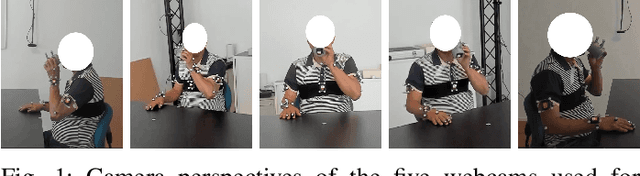
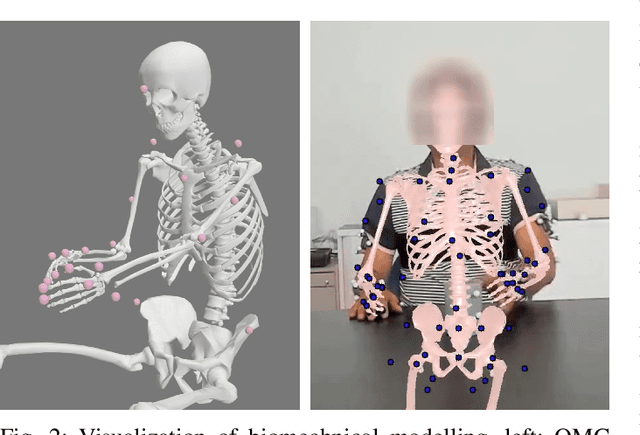
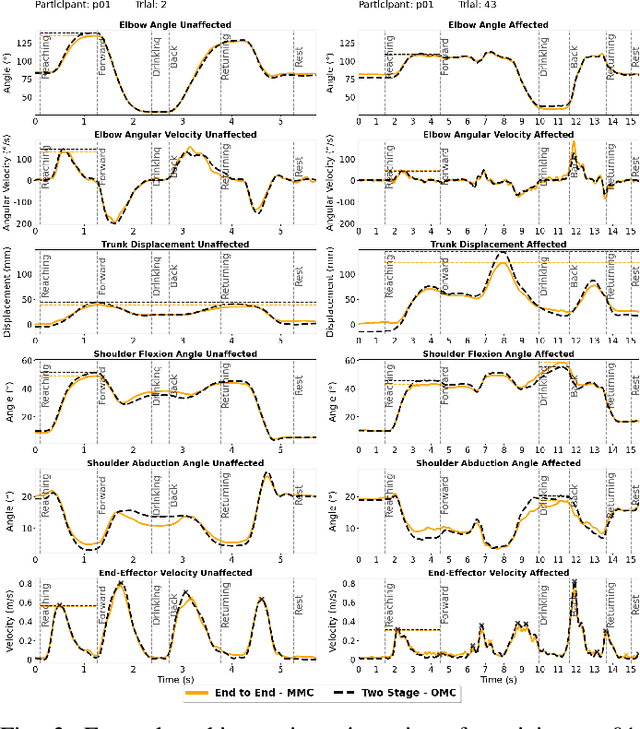
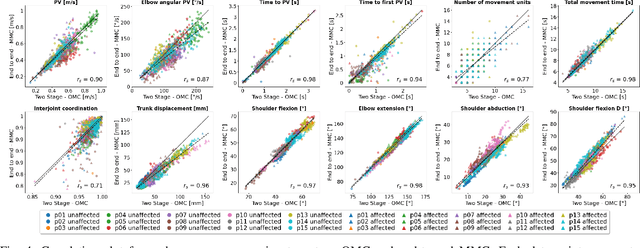
Marker-based Optical Motion Capture (OMC) paired with biomechanical modeling is currently considered the most precise and accurate method for measuring human movement kinematics. However, combining differentiable biomechanical modeling with Markerless Motion Capture (MMC) offers a promising approach to motion capture in clinical settings, requiring only minimal equipment, such as synchronized webcams, and minimal effort for data collection. This study compares key kinematic outcomes from biomechanically modeled MMC and OMC data in 15 stroke patients performing the drinking task, a functional task recommended for assessing upper limb movement quality. We observed a high level of agreement in kinematic trajectories between MMC and OMC, as indicated by high correlations (median r above 0.95 for the majority of kinematic trajectories) and median RMSE values ranging from 2-5 degrees for joint angles, 0.04 m/s for end-effector velocity, and 6 mm for trunk displacement. Trial-to-trial biases between OMC and MMC were consistent within participant sessions, with interquartile ranges of bias around 1-3 degrees for joint angles, 0.01 m/s in end-effector velocity, and approximately 3mm for trunk displacement. Our findings indicate that our MMC for arm tracking is approaching the accuracy of marker-based methods, supporting its potential for use in clinical settings. MMC could provide valuable insights into movement rehabilitation in stroke patients, potentially enhancing the effectiveness of rehabilitation strategies.