 Add to Chrome
 Add to Firefox
 Add to Edge
Encoded but Not Routed: Explaining the Table-Chart Gap in Scientific Claim Verification
Jun 01, 2026
Multimodal LLMs are increasingly used to assist scientific peer review, where a core requirement is verifying whether claims in a paper are supported by its evidence. Prior work has shown that models perform substantially better at this task when the evidence is a table than when it is a chart of the same underlying data. This raises the question of whether models fail to extract information from charts, or do they extract it but fail to use it when forming their prediction? We study this question through layer-wise linear probing and attention analysis on three open-weight VLMs over table and chart evidence, representing the same underlying data. We find consistent evidence for the latter. Chart information is encoded in the models' intermediate representations but does not reach the prediction position, a gap that is absent for tables and holds across all conditions tested. Attention analysis further reveals that this disconnect takes two architecturally distinct forms across model families. These findings reframe the table-chart gap as a failure of how encoded visual information is routed at prediction time, rather than a failure of encoding itself.

Is this Idea Novel? An Automated Benchmark for Judgment of Research Ideas
Mar 11, 2026Judging the novelty of research ideas is crucial for advancing science, enabling the identification of unexplored directions, and ensuring contributions meaningfully extend existing knowledge rather than reiterate minor variations. However, given the exponential growth of scientific literature, manually judging the novelty of research ideas through literature reviews is labor-intensive, subjective, and infeasible at scale. Therefore, recent efforts have proposed automated approaches for research idea novelty judgment. Yet, evaluation of these approaches remains largely inconsistent and is typically based on non-standardized human evaluations, hindering large-scale, comparable evaluations. To address this, we introduce RINoBench, the first comprehensive benchmark for large-scale evaluation of research idea novelty judgments. It comprises 1,381 research ideas derived from and judged by human experts as well as nine automated evaluation metrics designed to assess both rubric-based novelty scores and textual justifications of novelty judgments. Using this benchmark, we evaluate several state-of-the-art large language models (LLMs) on their ability to judge the novelty of research ideas. Our findings reveal that while LLM-generated reasoning closely mirrors human rationales, this alignment does not reliably translate into accurate novelty judgments, which diverge significantly from human gold standard judgments - even among leading reasoning-capable models. Data and code available at: https://github.com/TimSchopf/RINoBench.
Efficient Few-shot Learning for Multi-label Classification of Scientific Documents with Many Classes
Oct 08, 2024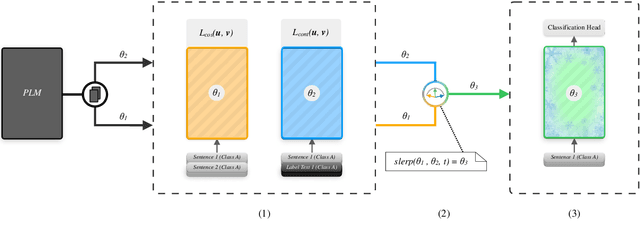
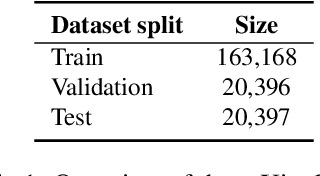
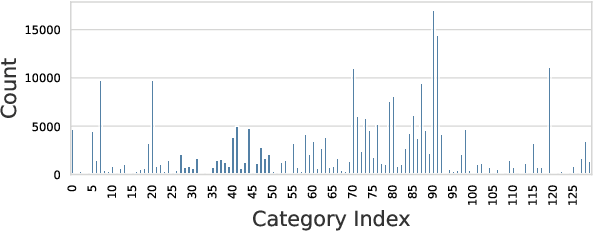
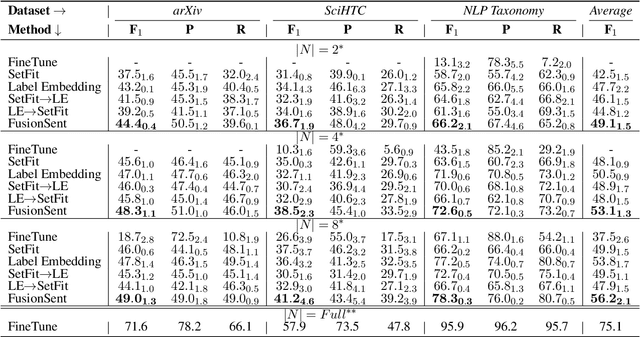
Scientific document classification is a critical task and often involves many classes. However, collecting human-labeled data for many classes is expensive and usually leads to label-scarce scenarios. Moreover, recent work has shown that sentence embedding model fine-tuning for few-shot classification is efficient, robust, and effective. In this work, we propose FusionSent (Fusion-based Sentence Embedding Fine-tuning), an efficient and prompt-free approach for few-shot classification of scientific documents with many classes. FusionSent uses available training examples and their respective label texts to contrastively fine-tune two different sentence embedding models. Afterward, the parameters of both fine-tuned models are fused to combine the complementary knowledge from the separate fine-tuning steps into a single model. Finally, the resulting sentence embedding model is frozen to embed the training instances, which are then used as input features to train a classification head. Our experiments show that FusionSent significantly outperforms strong baselines by an average of $6.0$ $F_{1}$ points across multiple scientific document classification datasets. In addition, we introduce a new dataset for multi-label classification of scientific documents, which contains 183,565 scientific articles and 130 classes from the arXiv category taxonomy. Code and data are available at https://github.com/sebischair/FusionSent.
An Improved Method for Class-specific Keyword Extraction: A Case Study in the German Business Registry
Jul 19, 2024
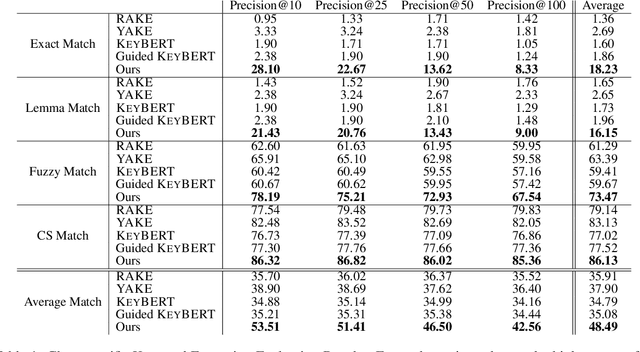
The task of $\textit{keyword extraction}$ is often an important initial step in unsupervised information extraction, forming the basis for tasks such as topic modeling or document classification. While recent methods have proven to be quite effective in the extraction of keywords, the identification of $\textit{class-specific}$ keywords, or only those pertaining to a predefined class, remains challenging. In this work, we propose an improved method for class-specific keyword extraction, which builds upon the popular $\textbf{KeyBERT}$ library to identify only keywords related to a class described by $\textit{seed keywords}$. We test this method using a dataset of German business registry entries, where the goal is to classify each business according to an economic sector. Our results reveal that our method greatly improves upon previous approaches, setting a new standard for $\textit{class-specific}$ keyword extraction.
NLP-KG: A System for Exploratory Search of Scientific Literature in Natural Language Processing
Jun 21, 2024Scientific literature searches are often exploratory, whereby users are not yet familiar with a particular field or concept but are interested in learning more about it. However, existing systems for scientific literature search are typically tailored to keyword-based lookup searches, limiting the possibilities for exploration. We propose NLP-KG, a feature-rich system designed to support the exploration of research literature in unfamiliar natural language processing (NLP) fields. In addition to a semantic search, NLP-KG allows users to easily find survey papers that provide a quick introduction to a field of interest. Further, a Fields of Study hierarchy graph enables users to familiarize themselves with a field and its related areas. Finally, a chat interface allows users to ask questions about unfamiliar concepts or specific articles in NLP and obtain answers grounded in knowledge retrieved from scientific publications. Our system provides users with comprehensive exploration possibilities, supporting them in investigating the relationships between different fields, understanding unfamiliar concepts in NLP, and finding relevant research literature. Demo, video, and code are available at: https://github.com/NLP-Knowledge-Graph/NLP-KG-WebApp.
Enterprise Use Cases Combining Knowledge Graphs and Natural Language Processing
Apr 01, 2024Knowledge management is a critical challenge for enterprises in today's digital world, as the volume and complexity of data being generated and collected continue to grow incessantly. Knowledge graphs (KG) emerged as a promising solution to this problem by providing a flexible, scalable, and semantically rich way to organize and make sense of data. This paper builds upon a recent survey of the research literature on combining KGs and Natural Language Processing (NLP). Based on selected application scenarios from enterprise context, we discuss synergies that result from such a combination. We cover various approaches from the three core areas of KG construction, reasoning as well as KG-based NLP tasks. In addition to explaining innovative enterprise use cases, we assess their maturity in terms of practical applicability and conclude with an outlook on emergent application areas for the future.
Efficient Domain Adaptation of Sentence Embeddings using Adapters
Jul 22, 2023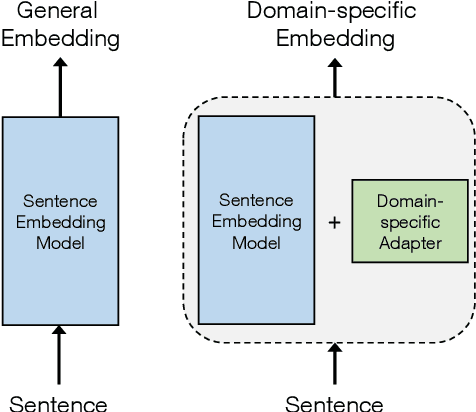
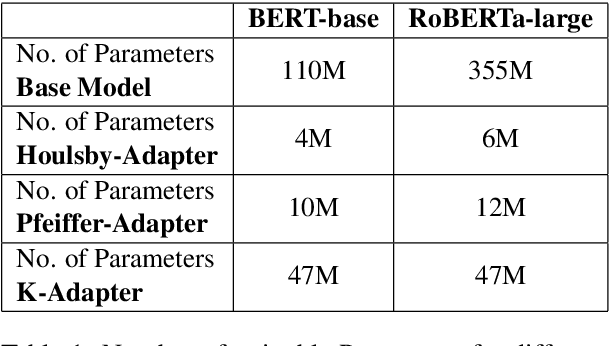
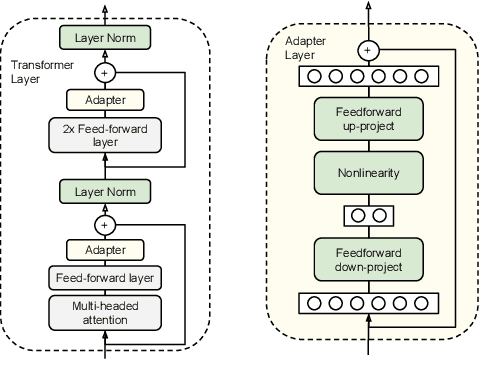
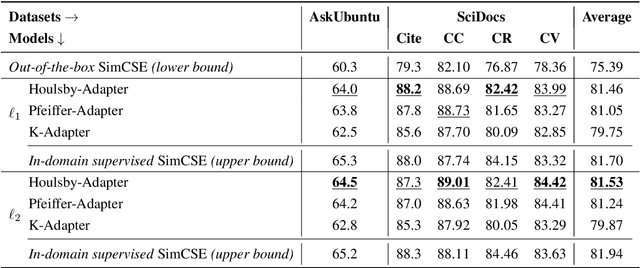
Sentence embeddings enable us to capture the semantic similarity of short texts. Most sentence embedding models are trained for general semantic textual similarity (STS) tasks. Therefore, to use sentence embeddings in a particular domain, the model must be adapted to it in order to achieve good results. Usually, this is done by fine-tuning the entire sentence embedding model for the domain of interest. While this approach yields state-of-the-art results, all of the model's weights are updated during fine-tuning, making this method resource-intensive. Therefore, instead of fine-tuning entire sentence embedding models for each target domain individually, we propose to train lightweight adapters. These domain-specific adapters do not require fine-tuning all underlying sentence embedding model parameters. Instead, we only train a small number of additional parameters while keeping the weights of the underlying sentence embedding model fixed. Training domain-specific adapters allows always using the same base model and only exchanging the domain-specific adapters to adapt sentence embeddings to a specific domain. We show that using adapters for parameter-efficient domain adaptation of sentence embeddings yields competitive performance within 1% of a domain-adapted, entirely fine-tuned sentence embedding model while only training approximately 3.6% of the parameters.
AspectCSE: Sentence Embeddings for Aspect-based Semantic Textual Similarity using Contrastive Learning and Structured Knowledge
Jul 22, 2023Generic sentence embeddings provide a coarse-grained approximation of semantic textual similarity but ignore specific aspects that make texts similar. Conversely, aspect-based sentence embeddings provide similarities between texts based on certain predefined aspects. Thus, similarity predictions of texts are more targeted to specific requirements and more easily explainable. In this paper, we present AspectCSE, an approach for aspect-based contrastive learning of sentence embeddings. Results indicate that AspectCSE achieves an average improvement of 3.97% on information retrieval tasks across multiple aspects compared to the previous best results. We also propose using Wikidata knowledge graph properties to train models of multi-aspect sentence embeddings in which multiple specific aspects are simultaneously considered during similarity predictions. We demonstrate that multi-aspect embeddings outperform single-aspect embeddings on aspect-specific information retrieval tasks. Finally, we examine the aspect-based sentence embedding space and demonstrate that embeddings of semantically similar aspect labels are often close, even without explicit similarity training between different aspect labels.
Exploring the Landscape of Natural Language Processing Research
Jul 20, 2023
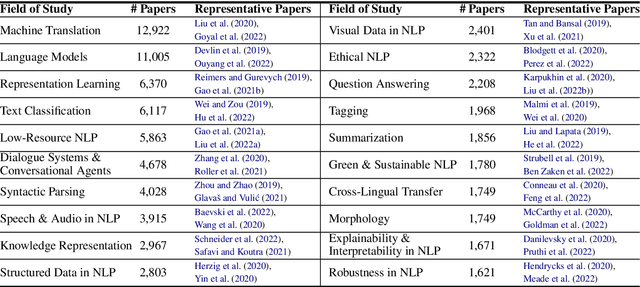
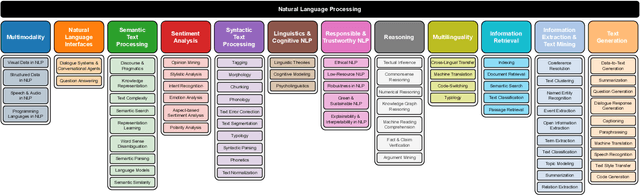
As an efficient approach to understand, generate, and process natural language texts, research in natural language processing (NLP) has exhibited a rapid spread and wide adoption in recent years. Given the increasing amount of research work in this area, several NLP-related approaches have been surveyed in the research community. However, a comprehensive study that categorizes established topics, identifies trends, and outlines areas for future research remains absent to this day. Contributing to closing this gap, we have systematically classified and analyzed research papers included in the ACL Anthology. As a result, we present a structured overview of the research landscape, provide a taxonomy of fields-of-study in NLP, analyze recent developments in NLP, summarize our findings, and highlight directions for future work.
Evaluating Unsupervised Text Classification: Zero-shot and Similarity-based Approaches
Nov 29, 2022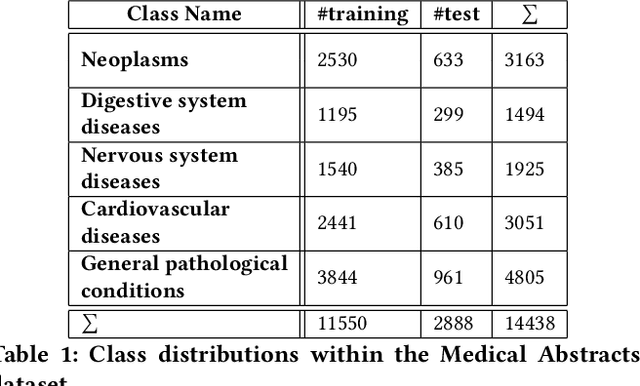
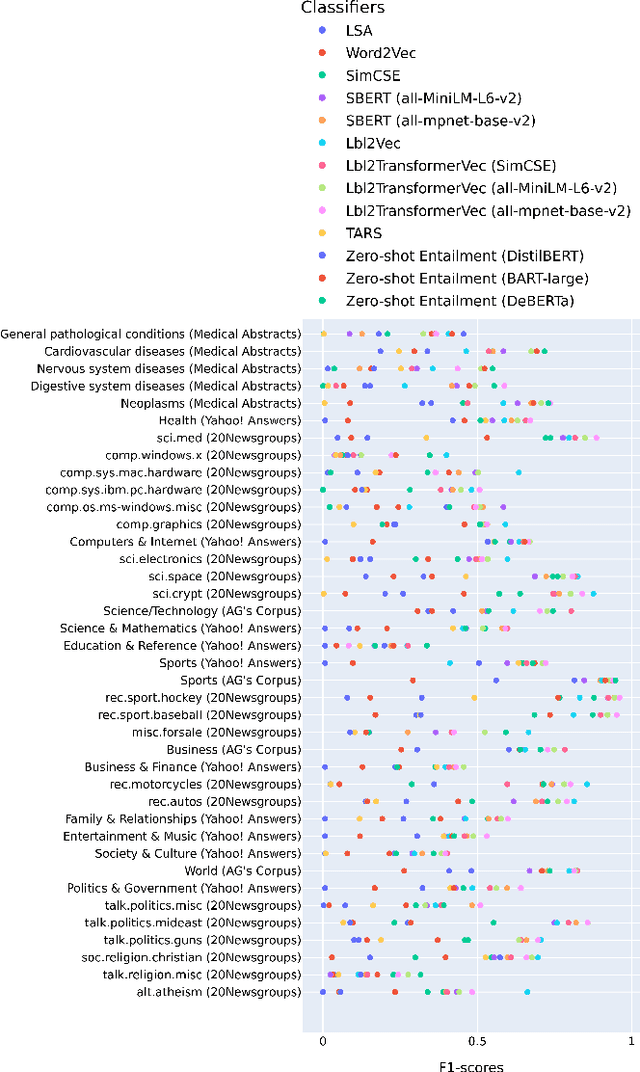
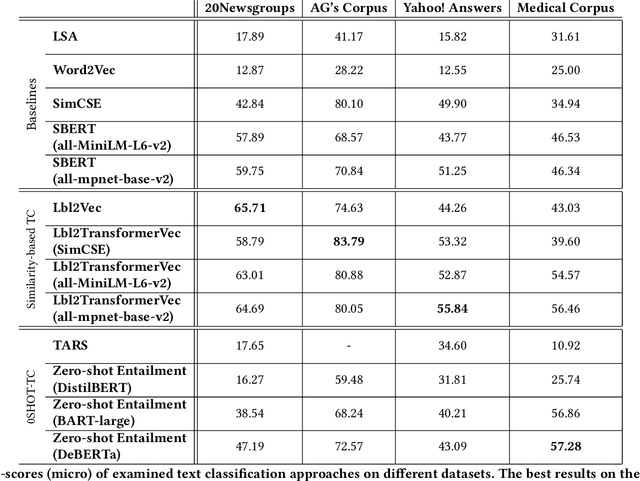
Text classification of unseen classes is a challenging Natural Language Processing task and is mainly attempted using two different types of approaches. Similarity-based approaches attempt to classify instances based on similarities between text document representations and class description representations. Zero-shot text classification approaches aim to generalize knowledge gained from a training task by assigning appropriate labels of unknown classes to text documents. Although existing studies have already investigated individual approaches to these categories, the experiments in literature do not provide a consistent comparison. This paper addresses this gap by conducting a systematic evaluation of different similarity-based and zero-shot approaches for text classification of unseen classes. Different state-of-the-art approaches are benchmarked on four text classification datasets, including a new dataset from the medical domain. Additionally, novel SimCSE and SBERT-based baselines are proposed, as other baselines used in existing work yield weak classification results and are easily outperformed. Finally, the novel similarity-based Lbl2TransformerVec approach is presented, which outperforms previous state-of-the-art approaches in unsupervised text classification. Our experiments show that similarity-based approaches significantly outperform zero-shot approaches in most cases. Additionally, using SimCSE or SBERT embeddings instead of simpler text representations increases similarity-based classification results even further.