 Add to Chrome
 Add to Firefox
 Add to Edge
The Loss Is Not Enough: Sampling Conditions and Inductive Bias in Contrastive Representation Learning
Jun 02, 2026
Contrastive learning has become a leading paradigm for self-supervised representation learning, yet the conditions under which it recovers meaningful latent geometry remain incompletely understood. We develop a measure-theoretic framework formalizing the diversity condition, a support requirement on positive-pair sampling that is necessary for isometric latent recovery. We show that the standard full-support von Mises-Fisher setting implies the satisfaction of the diversity condition and as a consequence global contrastive loss minimizers recover latent geometry up to orthogonal transformation, while restricted conditionals can make non-orthogonal maps attain strictly lower asymptotic contrastive loss. We introduce a support-corrected Information Noise Contrastive Estimation (InfoNCE) variant as a theoretical fix: this correction makes orthogonal latent space recovery achievable but does not uniquely select it. Experiments on synthetic benchmarks validate the identifiability predictions, and CIFAR-10 experiments are consistent with the qualitative prediction that architectural inductive bias becomes more important when sampling diversity is limited. Together, our results clarify how sampling mechanisms and encoder inductive bias interact in contrastive representation learning.

Generating Multi-Modal and Multi-Attribute Single-Cell Counts with CFGen
Jul 16, 2024Generative modeling of single-cell RNA-seq data has shown invaluable potential in community-driven tasks such as trajectory inference, batch effect removal and gene expression generation. However, most recent deep models generating synthetic single cells from noise operate on pre-processed continuous gene expression approximations, ignoring the inherently discrete and over-dispersed nature of single-cell data, which limits downstream applications and hinders the incorporation of robust noise models. Moreover, crucial aspects of deep-learning-based synthetic single-cell generation remain underexplored, such as controllable multi-modal and multi-label generation and its role in the performance enhancement of downstream tasks. This work presents Cell Flow for Generation (CFGen), a flow-based conditional generative model for multi-modal single-cell counts, which explicitly accounts for the discrete nature of the data. Our results suggest improved recovery of crucial biological data characteristics while accounting for novel generative tasks such as conditioning on multiple attributes and boosting rare cell type classification via data augmentation. By showcasing CFGen on a diverse set of biological datasets and settings, we provide evidence of its value to the fields of computational biology and deep generative models.
Sparsity in Continuous-Depth Neural Networks
Oct 26, 2022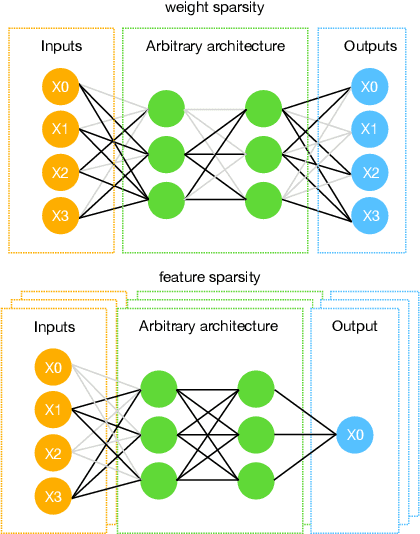
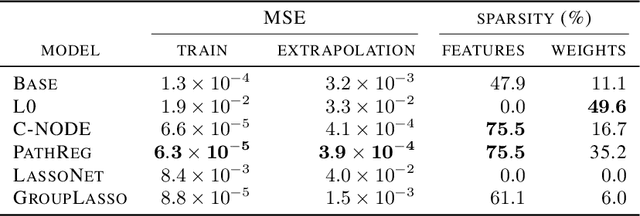
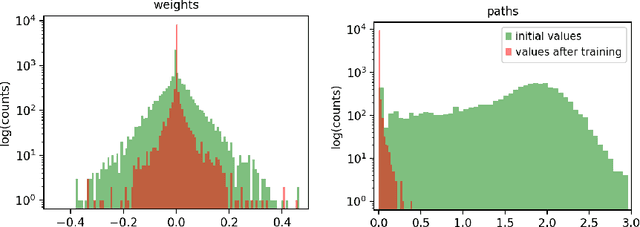
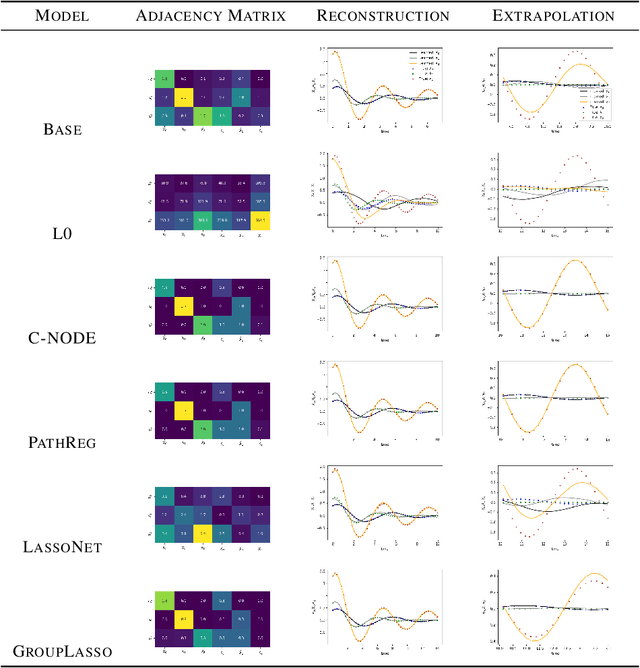
Neural Ordinary Differential Equations (NODEs) have proven successful in learning dynamical systems in terms of accurately recovering the observed trajectories. While different types of sparsity have been proposed to improve robustness, the generalization properties of NODEs for dynamical systems beyond the observed data are underexplored. We systematically study the influence of weight and feature sparsity on forecasting as well as on identifying the underlying dynamical laws. Besides assessing existing methods, we propose a regularization technique to sparsify "input-output connections" and extract relevant features during training. Moreover, we curate real-world datasets consisting of human motion capture and human hematopoiesis single-cell RNA-seq data to realistically analyze different levels of out-of-distribution (OOD) generalization in forecasting and dynamics identification respectively. Our extensive empirical evaluation on these challenging benchmarks suggests that weight sparsity improves generalization in the presence of noise or irregular sampling. However, it does not prevent learning spurious feature dependencies in the inferred dynamics, rendering them impractical for predictions under interventions, or for inferring the true underlying dynamics. Instead, feature sparsity can indeed help with recovering sparse ground-truth dynamics compared to unregularized NODEs.