 Add to Chrome
 Add to Firefox
 Add to Edge
RHINO-MAG: Recursive H-Field Inference based on Observed Magnetic Flux under Dynamic Excitation
Mar 31, 2026
Driven by the MagNet Challenge 2025 (MC2), increased research interest is directed towards modeling transient magnetic fields within ferrite material. An accurate time-resolved and temperature-aware H-field prediction is essential for optimizing magnetic components in applications with quasi-stationary / non-stationary excitation waveforms. Within the scope of this investigation, a selection of model structures with varying degrees of physically motivated structure are compared. Based on a Pareto investigation, a rather black-box gated recurrent unit (GRU) model structure with a graceful initialization setup is found to offer the most attractive model size vs. model accuracy trade-off, while the physics-inspired models performed worse. For a GRU-based model with only 325 parameters, a sequence relative error of 8.02 % and a normalized energy relative error of 1.07 % averaged across five different materials are achieved on unseen test data. With this excellent parameter efficiency, the proposed model won the first place in the performance category of the MC2.

HARDCORE: H-field and power loss estimation for arbitrary waveforms with residual, dilated convolutional neural networks in ferrite cores
Jan 23, 2024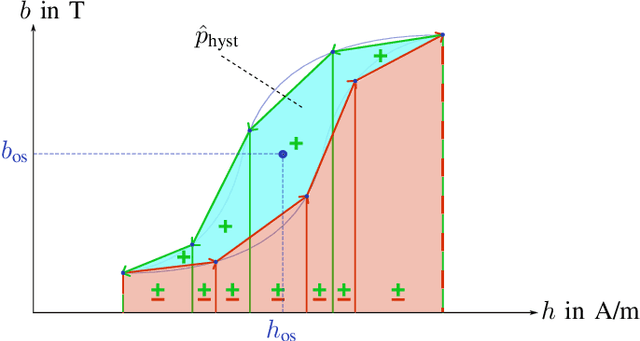
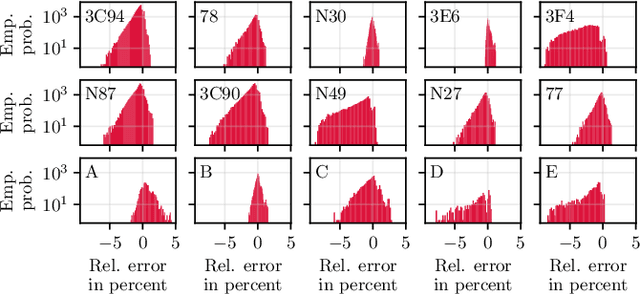
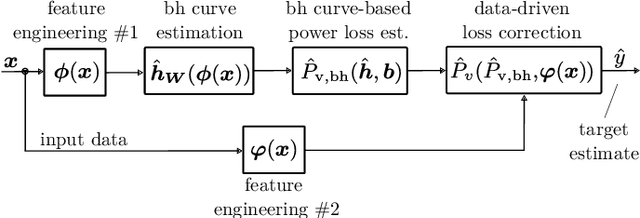
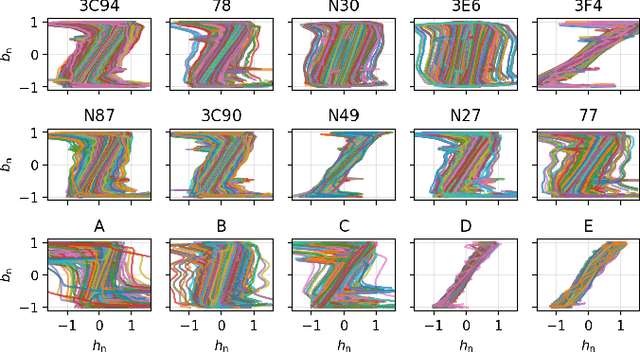
The MagNet Challenge 2023 calls upon competitors to develop data-driven models for the material-specific, waveform-agnostic estimation of steady-state power losses in toroidal ferrite cores. The following HARDCORE (H-field and power loss estimation for Arbitrary waveforms with Residual, Dilated convolutional neural networks in ferrite COREs) approach shows that a residual convolutional neural network with physics-informed extensions can serve this task efficiently when trained on observational data beforehand. One key solution element is an intermediate model layer which first reconstructs the bh curve and then estimates the power losses based on the curve's area rendering the proposed topology physically interpretable. In addition, emphasis was placed on expert-based feature engineering and information-rich inputs in order to enable a lean model architecture. A model is trained from scratch for each material, while the topology remains the same. A Pareto-style trade-off between model size and estimation accuracy is demonstrated, which yields an optimum at as low as 1755 parameters and down to below 8\,\% for the 95-th percentile of the relative error for the worst-case material with sufficient samples.