 Add to Chrome
 Add to Firefox
 Add to Edge
STR Robot: Design of an Autonomous Mobile Robot from Simulation to Reality
May 27, 2026
With the rapid development of simulation tools, the development and validation of autonomous robotic systems have become more efficient before real-world deployment. This paper presents a simulation-to-real implementation of an autonomous mobile robot based on an existing mechanical platform. Instead of focusing on mechanical design, our work concentrates on the development of the onboard control, self-localization, and autonomous navigation system. The proposed robot is equipped with onboard sensing and computation to estimate its pose and navigate autonomously in the environment. The overall framework is first developed and tested in simulation, and then deployed on the real robot for experimental evaluation. The results demonstrate the feasibility of the proposed approach and show that simulation provides an effective foundation for developing reliable autonomous mobile robot systems. The source code will be released at https://ntdathp.github.io/outdoor-robot-web.

ULOC: Learning to Localize in Complex Large-Scale Environments with Ultra-Wideband Ranges
Sep 17, 2024

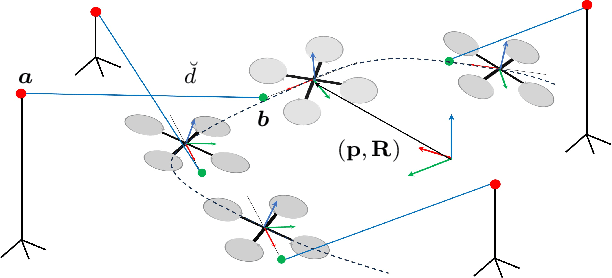
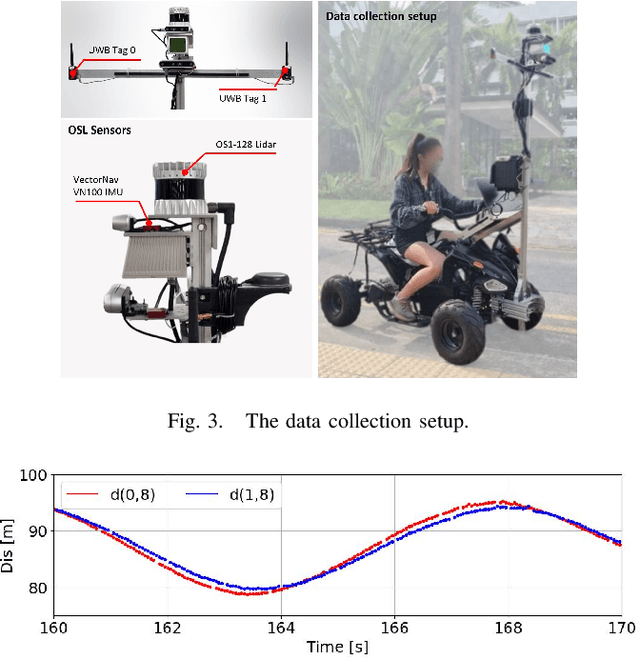
While UWB-based methods can achieve high localization accuracy in small-scale areas, their accuracy and reliability are significantly challenged in large-scale environments. In this paper, we propose a learning-based framework named ULOC for Ultra-Wideband (UWB) based localization in such complex large-scale environments. First, anchors are deployed in the environment without knowledge of their actual position. Then, UWB observations are collected when the vehicle travels in the environment. At the same time, map-consistent pose estimates are developed from registering (onboard self-localization) data with the prior map to provide the training labels. We then propose a network based on MAMBA that learns the ranging patterns of UWBs over a complex large-scale environment. The experiment demonstrates that our solution can ensure high localization accuracy on a large scale compared to the state-of-the-art. We release our source code to benefit the community at https://github.com/brytsknguyen/uloc.