 Add to Chrome
 Add to Firefox
 Add to Edge
Structured Prompt Optimization Meets Reinforcement Learning for Global and Local Interpretability over Complex Text
May 27, 2026
LLMs have advanced text classification, yet existing paradigms face a trade-off: supervised (label only) fine-tuning is scalable but offers limited reasoning on complex text and lacks broader model transparency, while discrete prompt optimization offers human-readable instructions but struggles with performance and scalability. We introduce eXTC (eXplainable Text Classifier) with three progressive stages: (1) learning a Standard Operating Procedure (SOP, or rulebook) in natural language via a new Structured Prompt Optimization algorithm; (2) SOP-grounded reasoning distillation from a large teacher LLM into a compact LM; and (3) expanding reasoning capabilities beyond the initial SOP via reinforcement learning. This design enables eXTC to provide (i) fast inference via a compact LM, with (ii) inference-time local reasoning traces, alongside a global, modular explanation of its learned domain rules, while (iii) significantly outperforming existing paradigms across diverse benchmarks in both classification performance and explanation quality, with stage-by-stage gains.

SoK: Understanding (New) Security Issues Across AI4Code Use Cases
Dec 20, 2025AI-for-Code (AI4Code) systems are reshaping software engineering, with tools like GitHub Copilot accelerating code generation, translation, and vulnerability detection. Alongside these advances, however, security risks remain pervasive: insecure outputs, biased benchmarks, and susceptibility to adversarial manipulation undermine their reliability. This SoK surveys the landscape of AI4Code security across three core applications, identifying recurring gaps: benchmark dominance by Python and toy problems, lack of standardized security datasets, data leakage in evaluation, and fragile adversarial robustness. A comparative study of six state-of-the-art models illustrates these challenges: insecure patterns persist in code generation, vulnerability detection is brittle to semantic-preserving attacks, fine-tuning often misaligns security objectives, and code translation yields uneven security benefits. From this analysis, we distill three forward paths: embedding secure-by-default practices in code generation, building robust and comprehensive detection benchmarks, and leveraging translation as a route to security-enhanced languages. We call for a shift toward security-first AI4Code, where vulnerability mitigation and robustness are embedded throughout the development life cycle.
LLM-Driven Multi-step Translation from C to Rust using Static Analysis
Mar 16, 2025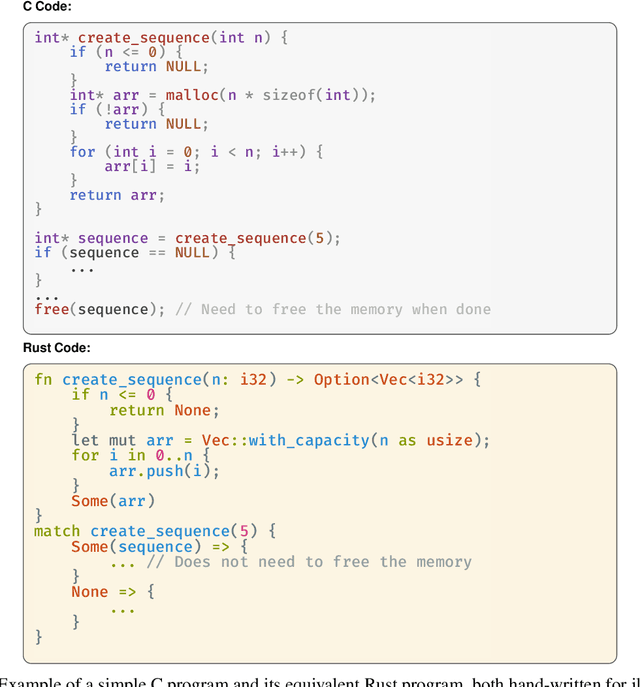

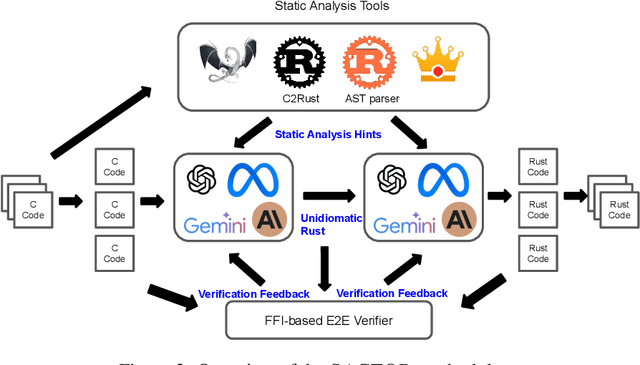
Translating software written in legacy languages to modern languages, such as C to Rust, has significant benefits in improving memory safety while maintaining high performance. However, manual translation is cumbersome, error-prone, and produces unidiomatic code. Large language models (LLMs) have demonstrated promise in producing idiomatic translations, but offer no correctness guarantees as they lack the ability to capture all the semantics differences between the source and target languages. To resolve this issue, we propose SACTOR, an LLM-driven C-to-Rust zero-shot translation tool using a two-step translation methodology: an "unidiomatic" step to translate C into Rust while preserving semantics, and an "idiomatic" step to refine the code to follow Rust's semantic standards. SACTOR utilizes information provided by static analysis of the source C program to address challenges such as pointer semantics and dependency resolution. To validate the correctness of the translated result from each step, we use end-to-end testing via the foreign function interface to embed our translated code segment into the original code. We evaluate the translation of 200 programs from two datasets and two case studies, comparing the performance of GPT-4o, Claude 3.5 Sonnet, Gemini 2.0 Flash, Llama 3.3 70B and DeepSeek-R1 in SACTOR. Our results demonstrate that SACTOR achieves high correctness and improved idiomaticity, with the best-performing model (DeepSeek-R1) reaching 93% and (GPT-4o, Claude 3.5, DeepSeek-R1) reaching 84% correctness (on each dataset, respectively), while producing more natural and Rust-compliant translations compared to existing methods.