 Add to Chrome
 Add to Firefox
 Add to Edge
CART Random Forests as Sequential Allocation over Random Opportunity Sets: A Stochastic-Control Theory of Ensemble Risk
May 26, 2026
CART random forests are among the most widely used modern predictive methods, with well-documented empirical success. Yet, at the mechanistic level, the algorithm is often treated as a black box because of its complexity. In this paper, we develop a stochastic-control perspective on feature-subsampled CART random forests, named CART random opportunity-set allocation (CART-ROSA). At each node, the random subset of features is interpreted as a random feasible action set, and the CART split rule as a masked-action allocation policy. This policy induces a controlled stochastic process over informative split-count states, whose terminal law determines both single-tree error and cross-tree interaction terms in the forest mean squared error (MSE). Such representation opens the black box of CART-forests by separating two design levers: the informative-opportunity rate induced by feature subsampling, and the contraction strength from the within-mask split policy. We establish that the CART policy is locally stabilizing: it contracts imbalances in informative split allocations and concentrates terminal tree geometry. At the system level, however, it can be globally suboptimal for the forest objective. Specializing to the linear model, we derive the MSE risk expansion explicitly. Our results show how an operations-research perspective makes tractable a theoretical gap difficult to access from the standard algorithmic description of CART forests.

Exogenous Randomness Empowering Random Forests
Nov 12, 2024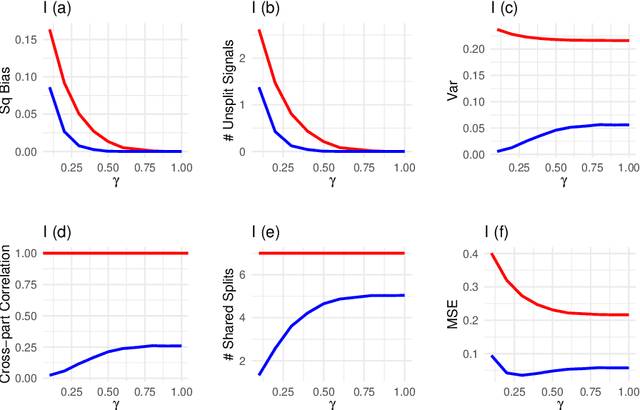
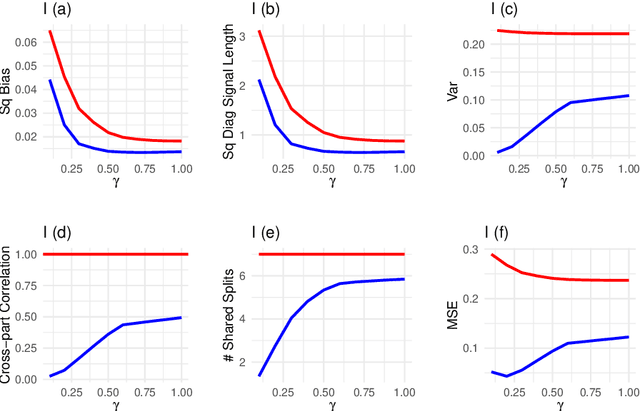
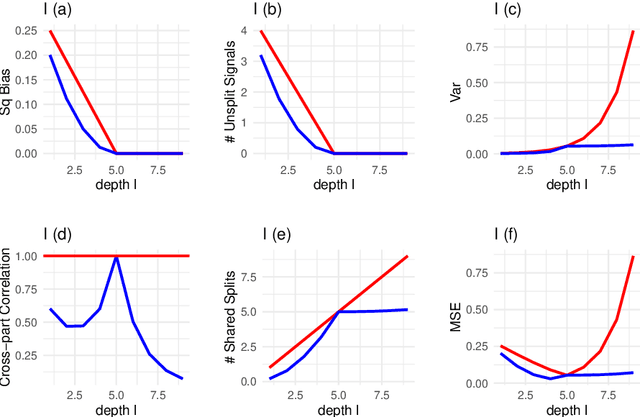
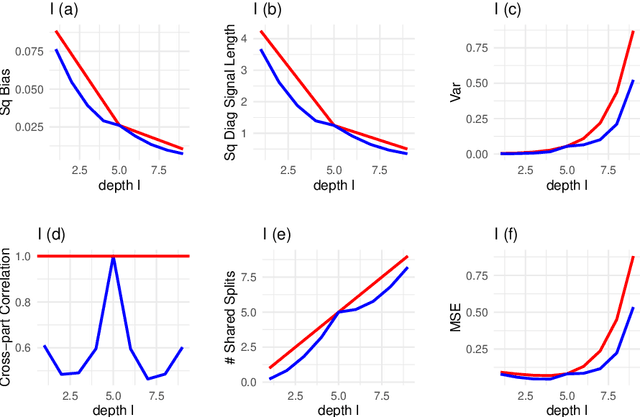
We offer theoretical and empirical insights into the impact of exogenous randomness on the effectiveness of random forests with tree-building rules independent of training data. We formally introduce the concept of exogenous randomness and identify two types of commonly existing randomness: Type I from feature subsampling, and Type II from tie-breaking in tree-building processes. We develop non-asymptotic expansions for the mean squared error (MSE) for both individual trees and forests and establish sufficient and necessary conditions for their consistency. In the special example of the linear regression model with independent features, our MSE expansions are more explicit, providing more understanding of the random forests' mechanisms. It also allows us to derive an upper bound on the MSE with explicit consistency rates for trees and forests. Guided by our theoretical findings, we conduct simulations to further explore how exogenous randomness enhances random forest performance. Our findings unveil that feature subsampling reduces both the bias and variance of random forests compared to individual trees, serving as an adaptive mechanism to balance bias and variance. Furthermore, our results reveal an intriguing phenomenon: the presence of noise features can act as a "blessing" in enhancing the performance of random forests thanks to feature subsampling.