 Add to Chrome
 Add to Firefox
 Add to Edge
Scenario-Adaptive MU-MIMO OFDM Semantic Communication With Asymmetric Neural Network
Feb 14, 2026
Semantic Communication (SemCom) has emerged as a promising paradigm for 6G networks, aiming to extract and transmit task-relevant information rather than minimizing bit errors. However, applying SemCom to realistic downlink Multi-User Multi-Input Multi-Output (MU-MIMO) Orthogonal Frequency Division Multiplexing (OFDM) systems remains challenging due to severe Multi-User Interference (MUI) and frequency-selective fading. Existing Deep Joint Source-Channel Coding (DJSCC) schemes, primarily designed for point-to-point links, suffer from performance saturation in multi-user scenarios. To address these issues, we propose a scenario-adaptive MU-MIMO SemCom framework featuring an asymmetric architecture tailored for downlink transmission. At the transmitter, we introduce a scenario-aware semantic encoder that dynamically adjusts feature extraction based on Channel State Information (CSI) and Signal-to-Noise Ratio (SNR), followed by a neural precoding network designed to mitigate MUI in the semantic domain. At the receiver, a lightweight decoder equipped with a novel pilot-guided attention mechanism is employed to implicitly perform channel equalization and feature calibration using reference pilot symbols. Extensive simulation results over 3GPP channel models demonstrate that the proposed framework significantly outperforms DJSCC and traditional Separate Source-Channel Coding (SSCC) schemes in terms of Peak Signal-to-Noise Ratio (PSNR) and classification accuracy, particularly in low-SNR regimes, while maintaining low latency and computational cost on edge devices.

Knowledge-Base based Semantic Image Transmission Using CLIP
Apr 01, 2025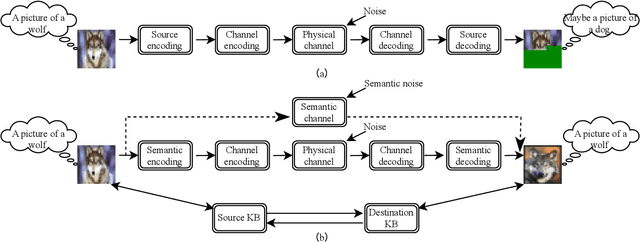
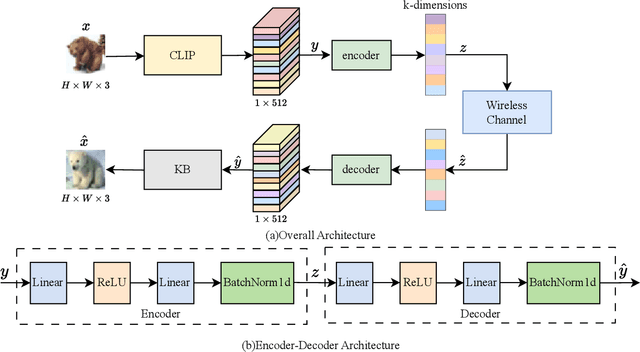
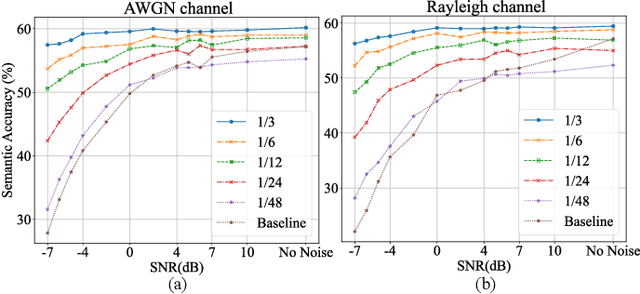

This paper proposes a novel knowledge-Base (KB) assisted semantic communication framework for image transmission. At the receiver, a Facebook AI Similarity Search (FAISS) based vector database is constructed by extracting semantic embeddings from images using the Contrastive Language-Image Pre-Training (CLIP) model. During transmission, the transmitter first extracts a 512-dimensional semantic feature using the CLIP model, then compresses it with a lightweight neural network for transmission. After receiving the signal, the receiver reconstructs the feature back to 512 dimensions and performs similarity matching from the KB to retrieve the most semantically similar image. Semantic transmission success is determined by category consistency between the transmitted and retrieved images, rather than traditional metrics like Peak Signal-to-Noise Ratio (PSNR). The proposed system prioritizes semantic accuracy, offering a new evaluation paradigm for semantic-aware communication systems. Experimental validation on CIFAR100 demonstrates the effectiveness of the framework in achieving semantic image transmission.