 Add to Chrome
 Add to Firefox
 Add to Edge
Curriculum Reinforcement Learning Can Incentivize Reasoning Capacity in LLMs Beyond the Base Model
Jun 21, 2026
Reinforcement learning with verifiable rewards (RLVR) is widely viewed as a promising path toward continuously improving large language models. Recent works, however, suggest that mainstream RLVR often reallocates sampling probabilities among trajectories already present in the base model: it can improve sampling efficiency, reflected by higher pass@1 scores, but yields limited gains, and can even decrease pass@k scores when k is large, and therefore may fail to expand the base model's reasoning capacity boundary. In this paper, we present a boundary-aware Curriculum RL approach to move beyond the base model's reasoning capacity boundary. Our approach first uses pass@k sampling to locate the current reasoning capacity boundary, then applies targeted teacher guidance to examples near or beyond that boundary, and finally uses RL to consolidate the newly introduced reasoning patterns. Across Qwen, Llama, and DeepSeek base models, boundary-aware Curriculum RL improves both pass@1 scores and pass@256 scores, with pass@1 reflecting one-attempt performance and pass@256 serving as an empirical proxy for the reasoning capacity boundary. In our experiments, average pass@256 improves by 9.8 percentage points over the base models and by 10.3 percentage points over Vanilla RLVR. These results suggest that boundary-aware Curriculum RL can provide a scalable route for LLMs to continuously improve beyond the base model's empirical reasoning capacity boundary.

RegionMed-CLIP: A Region-Aware Multimodal Contrastive Learning Pre-trained Model for Medical Image Understanding
Aug 07, 2025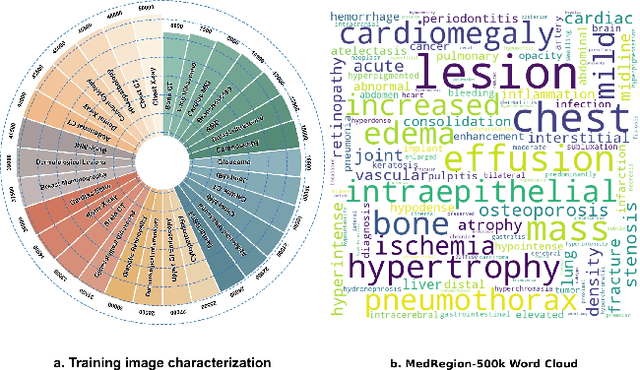
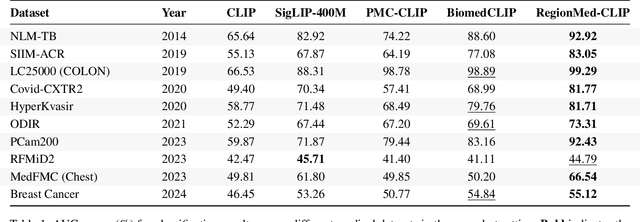
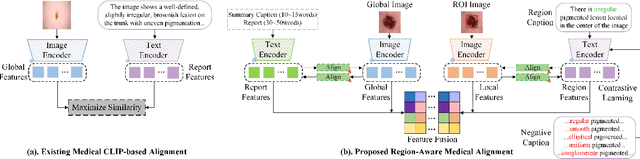
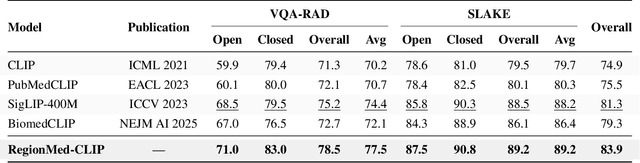
Medical image understanding plays a crucial role in enabling automated diagnosis and data-driven clinical decision support. However, its progress is impeded by two primary challenges: the limited availability of high-quality annotated medical data and an overreliance on global image features, which often miss subtle but clinically significant pathological regions. To address these issues, we introduce RegionMed-CLIP, a region-aware multimodal contrastive learning framework that explicitly incorporates localized pathological signals along with holistic semantic representations. The core of our method is an innovative region-of-interest (ROI) processor that adaptively integrates fine-grained regional features with the global context, supported by a progressive training strategy that enhances hierarchical multimodal alignment. To enable large-scale region-level representation learning, we construct MedRegion-500k, a comprehensive medical image-text corpus that features extensive regional annotations and multilevel clinical descriptions. Extensive experiments on image-text retrieval, zero-shot classification, and visual question answering tasks demonstrate that RegionMed-CLIP consistently exceeds state-of-the-art vision language models by a wide margin. Our results highlight the critical importance of region-aware contrastive pre-training and position RegionMed-CLIP as a robust foundation for advancing multimodal medical image understanding.