 Add to Chrome
 Add to Firefox
 Add to Edge
Bivariate Causal Discovery Using Rate-Distortion MDL: An Information Dimension Approach
Apr 07, 2026
Approaches to bivariate causal discovery based on the minimum description length (MDL) principle approximate the (uncomputable) Kolmogorov complexity of the models in each causal direction, selecting the one with the lower total complexity. The premise is that nature's mechanisms are simpler in their true causal order. Inherently, the description length (complexity) in each direction includes the description of the cause variable and that of the causal mechanism. In this work, we argue that current state-of-the-art MDL-based methods do not correctly address the problem of estimating the description length of the cause variable, effectively leaving the decision to the description length of the causal mechanism. Based on rate-distortion theory, we propose a new way to measure the description length of the cause, corresponding to the minimum rate required to achieve a distortion level representative of the underlying distribution. This distortion level is deduced using rules from histogram-based density estimation, while the rate is computed using the related concept of information dimension, based on an asymptotic approximation. Combining it with a traditional approach for the causal mechanism, we introduce a new bivariate causal discovery method, termed rate-distortion MDL (RDMDL). We show experimentally that RDMDL achieves competitive performance on the Tübingen dataset. All the code and experiments are publicly available at github.com/tiagobrogueira/Causal-Discovery-In-Exchangeable-Data.

Rethinking Causal Discovery Through the Lens of Exchangeability
Dec 10, 2025Causal discovery methods have traditionally been developed under two distinct regimes: independent and identically distributed (i.i.d.) and timeseries data, each governed by separate modelling assumptions. In this paper, we argue that the i.i.d. setting can and should be reframed in terms of exchangeability, a strictly more general symmetry principle. We present the implications of this reframing, alongside two core arguments: (1) a conceptual argument, based on extending the dependency of experimental causal inference on exchangeability to causal discovery; and (2) an empirical argument, showing that many existing i.i.d. causal-discovery methods are predicated on exchangeability assumptions, and that the sole extensive widely-used real-world "i.i.d." benchmark (the Tübingen dataset) consists mainly of exchangeable (and not i.i.d.) examples. Building on this insight, we introduce a novel synthetic dataset that enforces only the exchangeability assumption, without imposing the stronger i.i.d. assumption. We show that our exchangeable synthetic dataset mirrors the statistical structure of the real-world "i.i.d." dataset more closely than all other i.i.d. synthetic datasets. Furthermore, we demonstrate the predictive capability of this dataset by proposing a neural-network-based causal-discovery algorithm trained exclusively on our synthetic dataset, and which performs similarly to other state-of-the-art i.i.d. methods on the real-world benchmark.
LxCIM: a new rank-based binary classifier performance metric invariant to local exchange of classes
Dec 10, 2025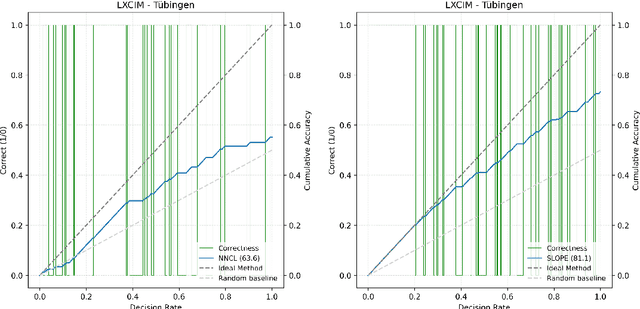
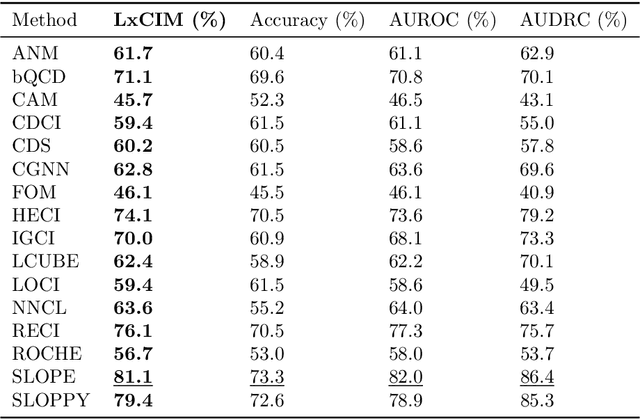
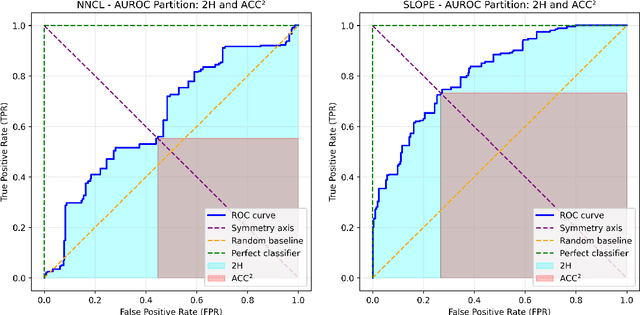
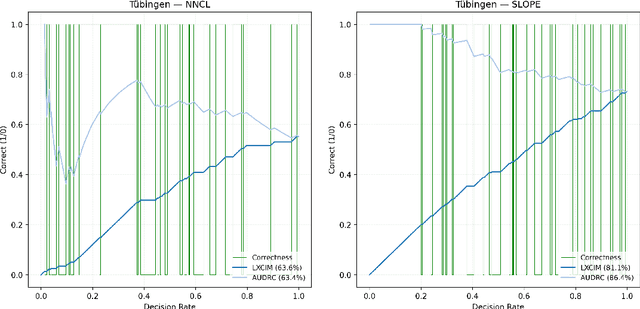
Binary classification is one of the oldest, most prevalent, and studied problems in machine learning. However, the metrics used to evaluate model performance have received comparatively little attention. The area under the receiver operating characteristic curve (AUROC) has long been a standard choice for model comparison. Despite its advantages, AUROC is not always ideal, particularly for problems that are invariant to local exchange of classes (LxC), a new form of metric invariance introduced in this work. To address this limitation, we propose LxCIM (LxC-invariant metric), which is not only rank-based and invariant under local exchange of classes, but also intuitive, logically consistent, and always computable, while enabling more detailed analysis through the cumulative accuracy-decision rate curve. Moreover, LxCIM exhibits clear theoretical connections to AUROC, accuracy, and the area under the accuracy-decision rate curve (AUDRC). These relationships allow for multiple complementary interpretations: as a symmetric form of AUROC, a rank-based analogue of accuracy, or a more representative and more interpretable variant of AUDRC. Finally, we demonstrate the direct applicability of LxCIM to the bivariate causal discovery problem (which exhibits invariance to local exchange of classes) and show how it addresses the acknowledged limitations of existing metrics used in this field. All code and implementation details are publicly available at github.com/tiagobrogueira/Causal-Discovery-In-Exchangeable-Data.