 Add to Chrome
 Add to Firefox
 Add to Edge
Overcoming Anchoring Bias: The Potential of AI and XAI-based Decision Support
May 08, 2024
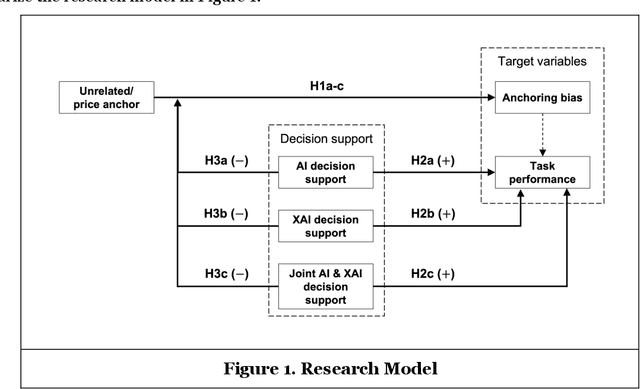
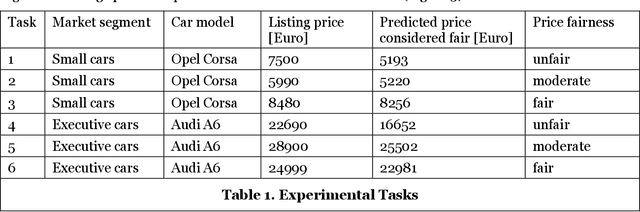
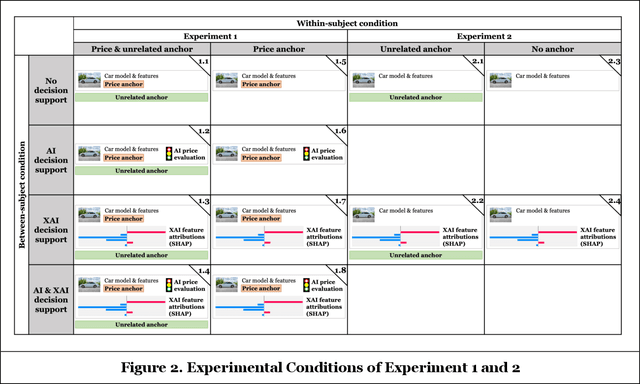
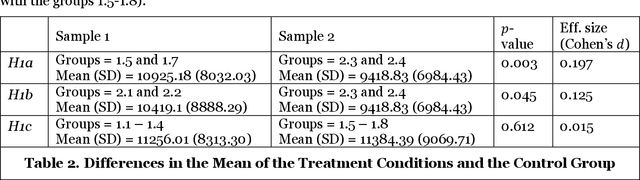
Information systems (IS) are frequently designed to leverage the negative effect of anchoring bias to influence individuals' decision-making (e.g., by manipulating purchase decisions). Recent advances in Artificial Intelligence (AI) and the explanations of its decisions through explainable AI (XAI) have opened new opportunities for mitigating biased decisions. So far, the potential of these technological advances to overcome anchoring bias remains widely unclear. To this end, we conducted two online experiments with a total of N=390 participants in the context of purchase decisions to examine the impact of AI and XAI-based decision support on anchoring bias. Our results show that AI alone and its combination with XAI help to mitigate the negative effect of anchoring bias. Ultimately, our findings have implications for the design of AI and XAI-based decision support and IS to overcome cognitive biases.

Meta-Regression Analysis of Errors in Short-Term Electricity Load Forecasting
May 29, 2023Forecasting electricity demand plays a critical role in ensuring reliable and cost-efficient operation of the electricity supply. With the global transition to distributed renewable energy sources and the electrification of heating and transportation, accurate load forecasts become even more important. While numerous empirical studies and a handful of review articles exist, there is surprisingly little quantitative analysis of the literature, most notably none that identifies the impact of factors on forecasting performance across the entirety of empirical studies. In this article, we therefore present a Meta-Regression Analysis (MRA) that examines factors that influence the accuracy of short-term electricity load forecasts. We use data from 421 forecast models published in 59 studies. While the grid level (esp. individual vs. aggregated vs. system), the forecast granularity, and the algorithms used seem to have a significant impact on the MAPE, bibliometric data, dataset sizes, and prediction horizon show no significant effect. We found the LSTM approach and a combination of neural networks with other approaches to be the best forecasting methods. The results help practitioners and researchers to make meaningful model choices. Yet, this paper calls for further MRA in the field of load forecasting to close the blind spots in research and practice of load forecasting.
* 8 pages, 3 figures, 7 tables
Augmented cross-selling through explainable AI -- a case from energy retailing
Aug 24, 2022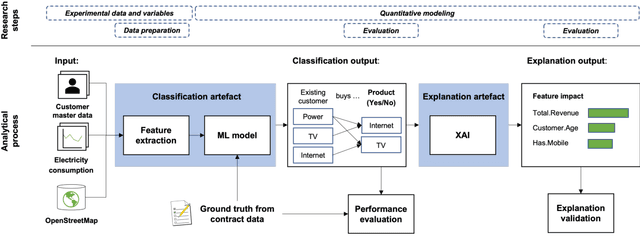
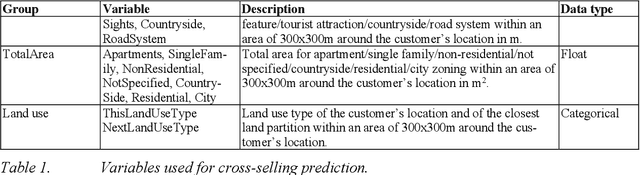
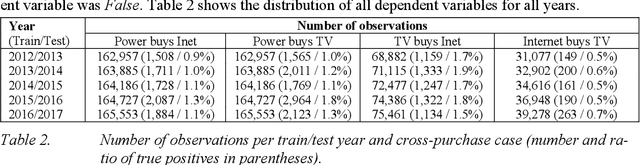
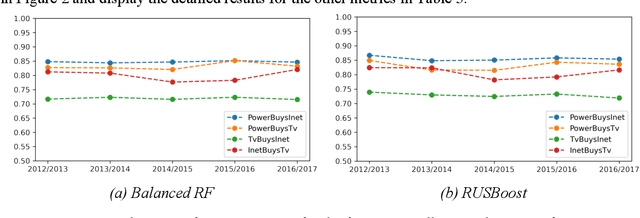
The advance of Machine Learning (ML) has led to a strong interest in this technology to support decision making. While complex ML models provide predictions that are often more accurate than those of traditional tools, such models often hide the reasoning behind the prediction from their users, which can lead to lower adoption and lack of insight. Motivated by this tension, research has put forth Explainable Artificial Intelligence (XAI) techniques that uncover patterns discovered by ML. Despite the high hopes in both ML and XAI, there is little empirical evidence of the benefits to traditional businesses. To this end, we analyze data on 220,185 customers of an energy retailer, predict cross-purchases with up to 86% correctness (AUC), and show that the XAI method SHAP provides explanations that hold for actual buyers. We further outline implications for research in information systems, XAI, and relationship marketing.