 Add to Chrome
 Add to Firefox
 Add to Edge
Minimax Limits of k-Fold Cross-Validation via Majority
May 25, 2026
We study the mean-squared error of $k$-fold cross-validation as a risk estimator, with particular emphasis on how its accuracy depends on the number of folds $k$. Despite the widespread use of cross-validation, principled guidance for choosing $k$ is largely absent, mainly due to the complex dependence between fold-wise error estimates. To obtain sharp and interpretable results, we focus on the majority algorithm in binary classification, a minimal yet nontrivial empirical risk minimization procedure. We provide a fine-grained analysis of its cross-validation behavior, showing that even this simple algorithm exhibits subtle and delicate phenomena for which existing theory provides loose and even vacuous bounds. Leveraging this analysis, we introduce a minimax framework for cross-validation risk estimation and prove that no empirical risk minimization algorithm can achieve an $O(1/n)$ minimax mean-squared error when the number of folds grows with the number of samples $n$; instead, a lower bound of order $Ω(\sqrt{k}/n)$ is unavoidable. Our results reveal fundamental limitations of cross-validation as a data-reuse strategy, clarify gaps and inaccuracies in prior theoretical work, and position the majority algorithm as a natural benchmark that any tight analysis of cross-validation should be able to explain.

The Structure of Cross-Validation Error: Stability, Covariance, and Minimax Limits
Nov 05, 2025Despite ongoing theoretical research on cross-validation (CV), many theoretical questions about CV remain widely open. This motivates our investigation into how properties of algorithm-distribution pairs can affect the choice for the number of folds in $k$-fold cross-validation. Our results consist of a novel decomposition of the mean-squared error of cross-validation for risk estimation, which explicitly captures the correlations of error estimates across overlapping folds and includes a novel algorithmic stability notion, squared loss stability, that is considerably weaker than the typically required hypothesis stability in other comparable works. Furthermore, we prove: 1. For every learning algorithm that minimizes empirical error, a minimax lower bound on the mean-squared error of $k$-fold CV estimating the population risk $L_\mathcal{D}$: \[ \min_{k \mid n}\; \max_{\mathcal{D}}\; \mathbb{E}\!\left[\big(\widehat{L}_{\mathrm{CV}}^{(k)} - L_{\mathcal{D}}\big)^{2}\right] \;=\; \Omega\!\big(\sqrt{k}/n\big), \] where $n$ is the sample size and $k$ the number of folds. This shows that even under idealized conditions, for large values of $k$, CV cannot attain the optimum of order $1/n$ achievable by a validation set of size $n$, reflecting an inherent penalty caused by dependence between folds. 2. Complementing this, we exhibit learning rules for which \[ \max_{\mathcal{D}}\; \mathbb{E}\!\left[\big(\widehat{L}_{\mathrm{CV}}^{(k)} - L_{\mathcal{D}}\big)^{2}\right] \;=\; \Omega(k/n), \] matching (up to constants) the accuracy of a hold-out estimator of a single fold of size $n/k$. Together these results delineate the fundamental trade-off in resampling-based risk estimation: CV cannot fully exploit all $n$ samples for unbiased risk evaluation, and its minimax performance is pinned between the $k/n$ and $\sqrt{k}/n$ regimes.
Which Algorithms Have Tight Generalization Bounds?
Oct 02, 2024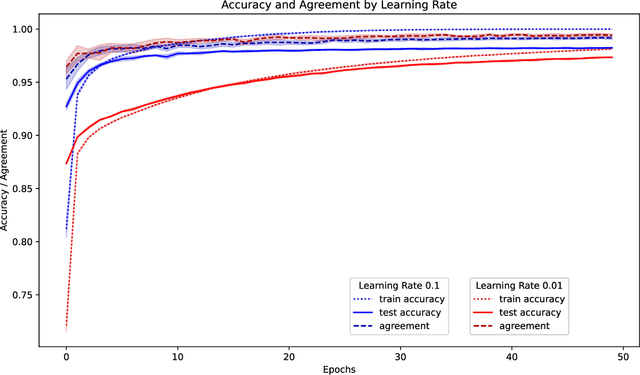
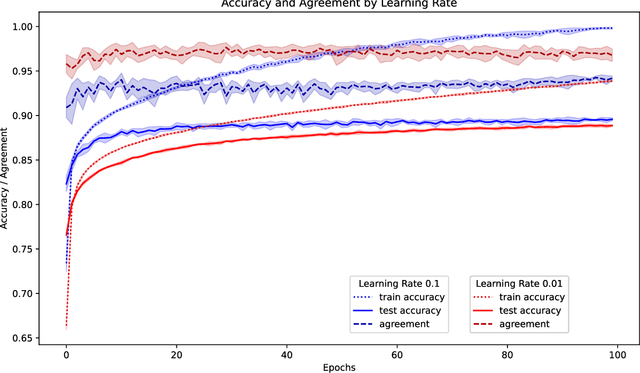
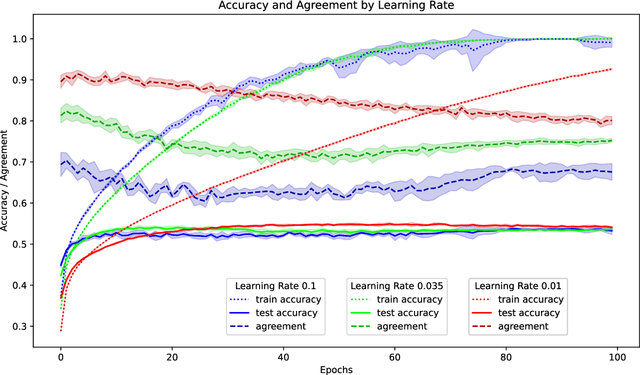
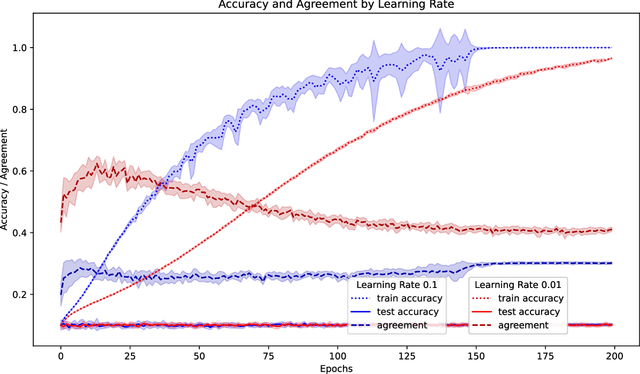
We study which machine learning algorithms have tight generalization bounds. First, we present conditions that preclude the existence of tight generalization bounds. Specifically, we show that algorithms that have certain inductive biases that cause them to be unstable do not admit tight generalization bounds. Next, we show that algorithms that are sufficiently stable do have tight generalization bounds. We conclude with a simple characterization that relates the existence of tight generalization bounds to the conditional variance of the algorithm's loss.
Fantastic Generalization Measures are Nowhere to be Found
Sep 24, 2023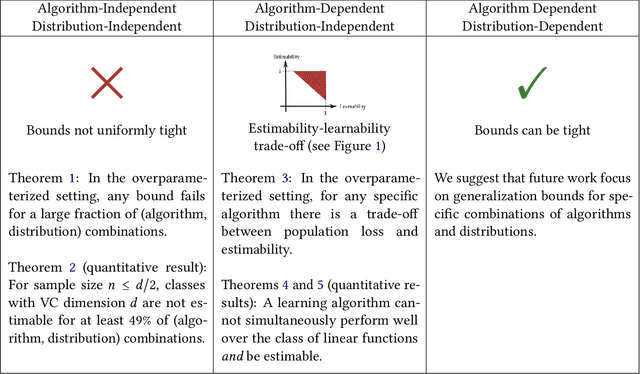
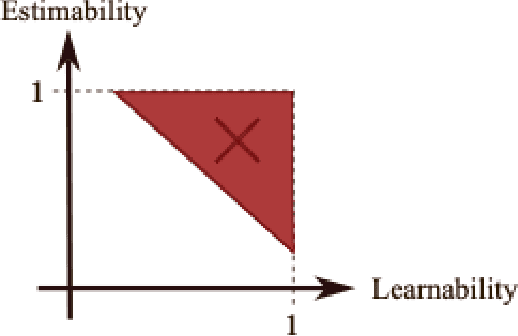
Numerous generalization bounds have been proposed in the literature as potential explanations for the ability of neural networks to generalize in the overparameterized setting. However, none of these bounds are tight. For instance, in their paper ``Fantastic Generalization Measures and Where to Find Them'', Jiang et al. (2020) examine more than a dozen generalization bounds, and show empirically that none of them imply guarantees that can explain the remarkable performance of neural networks. This raises the question of whether tight generalization bounds are at all possible. We consider two types of generalization bounds common in the literature: (1) bounds that depend on the training set and the output of the learning algorithm. There are multiple bounds of this type in the literature (e.g., norm-based and margin-based bounds), but we prove mathematically that no such bound can be uniformly tight in the overparameterized setting; (2) bounds that depend on the training set and on the learning algorithm (e.g., stability bounds). For these bounds, we show a trade-off between the algorithm's performance and the bound's tightness. Namely, if the algorithm achieves good accuracy on certain distributions in the overparameterized setting, then no generalization bound can be tight for it. We conclude that generalization bounds in the overparameterized setting cannot be tight without suitable assumptions on the population distribution.