 Add to Chrome
 Add to Firefox
 Add to Edge
Autoregressive Synthesis of Sparse and Semi-Structured Mixed-Type Data
Mar 02, 2026
Synthetic data generation is a critical capability for data sharing, privacy compliance, system benchmarking and test data provisioning. Existing methods assume dense, fixed-schema tabular data, yet this assumption is increasingly at odds with modern data systems - from document databases, REST APIs to data lakes - which store and exchange data in sparse, semi-structured formats like JSON. Applying existing tabular methods to such data requires flattening of nested data into wide, sparse tables which scales poorly. We present Origami, an autoregressive transformer-based architecture that tokenizes data records, including nested objects and variable length arrays, into sequences of key, value and structural tokens. This representation natively handles sparsity, mixed types and hierarchical structure without flattening or imputation. Origami outperforms baselines spanning GAN, VAE, diffusion and autoregressive architectures on fidelity, utility and detection metrics across nearly all settings, while maintaining high privacy scores. On semi-structured datasets with up to 38% sparsity, baseline synthesizers either fail to scale or degrade substantially, while Origami maintains high-fidelity synthesis that is harder to distinguish from real data. To the best of our knowledge, Origami is the first architecture capable of natively modeling and generating semi-structured data end-to-end.

ORIGAMI: A generative transformer architecture for predictions from semi-structured data
Dec 23, 2024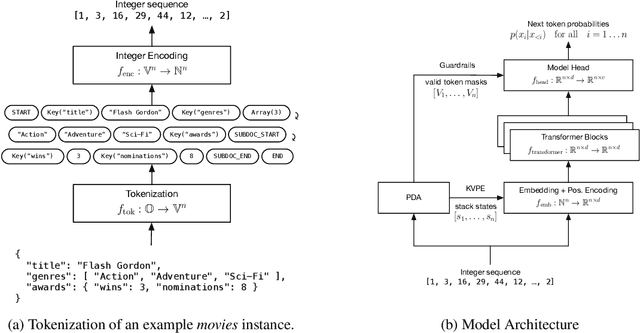
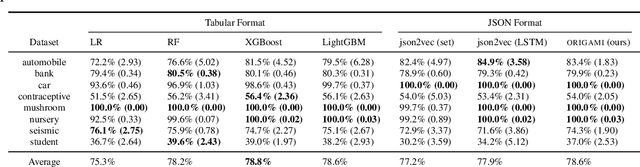
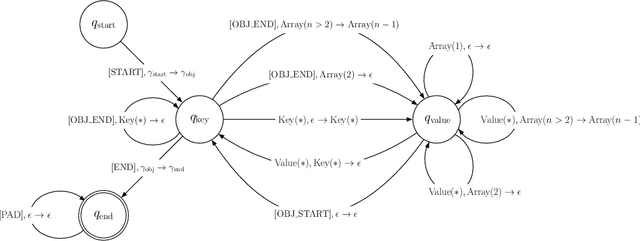

Despite the popularity and widespread use of semi-structured data formats such as JSON, end-to-end supervised learning applied directly to such data remains underexplored. We present ORIGAMI (Object RepresentatIon via Generative Autoregressive ModellIng), a transformer-based architecture that directly processes nested key/value pairs while preserving their hierarchical semantics. Our key technical contributions include: (1) a structure-preserving tokenizer, (2) a novel key/value position encoding scheme, and (3) a grammar-constrained training and inference framework that ensures valid outputs and accelerates training convergence. These enhancements enable efficient end-to-end modeling of semi-structured data. By reformulating classification as next-token prediction, ORIGAMI naturally handles both single-label and multi-label tasks without architectural modifications. Empirical evaluation across diverse domains demonstrates ORIGAMI's effectiveness: On standard tabular benchmarks converted to JSON, ORIGAMI remains competitive with classical and state-of-the-art approaches. On native JSON datasets, we outperform baselines on multi-label classification and specialized models such as convolutional and graph neural networks on a code classification task. Through extensive ablation studies, we validate the impact of each architectural component and establish ORIGAMI as a robust framework for end-to-end learning on semi-structured data.