 Add to Chrome
 Add to Firefox
 Add to Edge
MMLSv2: A Multimodal Dataset for Martian Landslide Detection in Remote Sensing Imagery
Feb 08, 2026
We present MMLSv2, a dataset for landslide segmentation on Martian surfaces. MMLSv2 consists of multimodal imagery with seven bands: RGB, digital elevation model, slope, thermal inertia, and grayscale channels. MMLSv2 comprises 664 images distributed across training, validation, and test splits. In addition, an isolated test set of 276 images from a geographically disjoint region from the base dataset is released to evaluate spatial generalization. Experiments conducted with multiple segmentation models show that the dataset supports stable training and achieves competitive performance, while still posing challenges in fragmented, elongated, and small-scale landslide regions. Evaluation on the isolated test set leads to a noticeable performance drop, indicating increased difficulty and highlighting its value for assessing model robustness and generalization beyond standard in-distribution settings. Dataset will be available at: https://github.com/MAIN-Lab/MMLS_v2

GAF-NAU: Gramian Angular Field encoded Neighborhood Attention U-Net for Pixel-Wise Hyperspectral Image Classification
Apr 21, 2022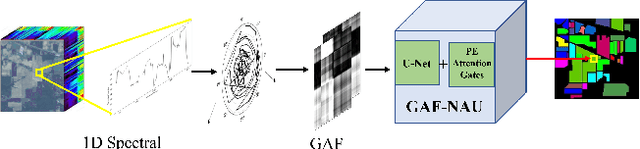

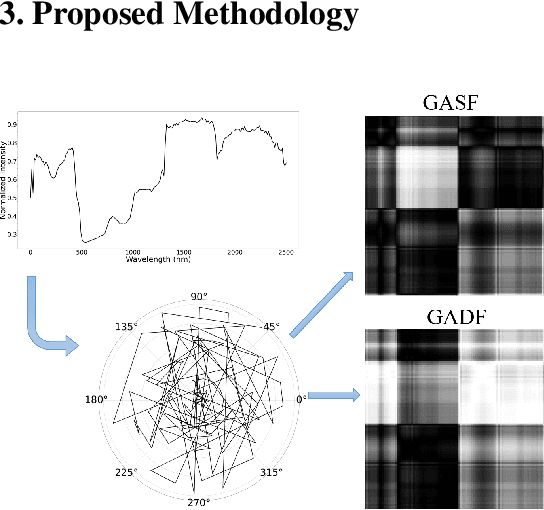

Hyperspectral image (HSI) classification is the most vibrant area of research in the hyperspectral community due to the rich spectral information contained in HSI can greatly aid in identifying objects of interest. However, inherent non-linearity between materials and the corresponding spectral profiles brings two major challenges in HSI classification: interclass similarity and intraclass variability. Many advanced deep learning methods have attempted to address these issues from the perspective of a region/patch-based approach, instead of a pixel-based alternate. However, the patch-based approaches hypothesize that neighborhood pixels of a target pixel in a fixed spatial window belong to the same class. And this assumption is not always true. To address this problem, we herein propose a new deep learning architecture, namely Gramian Angular Field encoded Neighborhood Attention U-Net (GAF-NAU), for pixel-based HSI classification. The proposed method does not require regions or patches centered around a raw target pixel to perform 2D-CNN based classification, instead, our approach transforms 1D pixel vector in HSI into 2D angular feature space using Gramian Angular Field (GAF) and then embed it to a new neighborhood attention network to suppress irrelevant angular feature while emphasizing on pertinent features useful for HSI classification task. Evaluation results on three publicly available HSI datasets demonstrate the superior performance of the proposed model.