 Add to Chrome
 Add to Firefox
 Add to Edge
LoBoost: Fast Model-Native Local Conformal Prediction for Gradient-Boosted Trees
Feb 25, 2026
Gradient-boosted decision trees are among the strongest off-the-shelf predictors for tabular regression, but point predictions alone do not quantify uncertainty. Conformal prediction provides distribution-free marginal coverage, yet split conformal uses a single global residual quantile and can be poorly adaptive under heteroscedasticity. Methods that improve adaptivity typically fit auxiliary nuisance models or introduce additional data splits/partitions to learn the conformal score, increasing cost and reducing data efficiency. We propose LoBoost, a model-native local conformal method that reuses the fitted ensemble's leaf structure to define multiscale calibration groups. Each input is encoded by its sequence of visited leaves; at resolution level k, we group points by matching prefixes of leaf indices across the first k trees and calibrate residual quantiles within each group. LoBoost requires no retraining, auxiliary models, or extra splitting beyond the standard train/calibration split. Experiments show competitive interval quality, improved test MSE on most datasets, and large calibration speedups.

PersonalizedUS: Interpretable Breast Cancer Risk Assessment with Local Coverage Uncertainty Quantification
Aug 28, 2024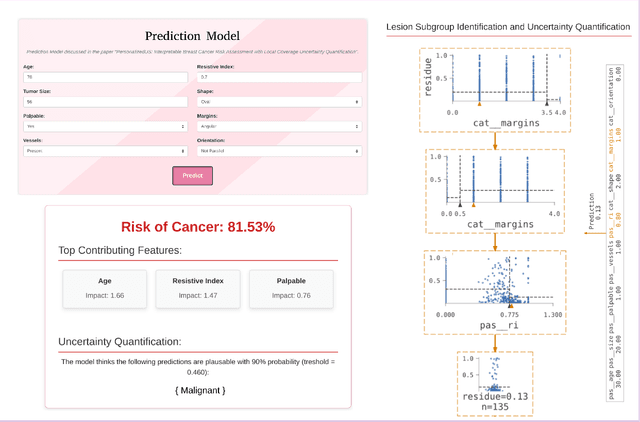


Correctly assessing the malignancy of breast lesions identified during ultrasound examinations is crucial for effective clinical decision-making. However, the current "golden standard" relies on manual BI-RADS scoring by clinicians, often leading to unnecessary biopsies and a significant mental health burden on patients and their families. In this paper, we introduce PersonalizedUS, an interpretable machine learning system that leverages recent advances in conformal prediction to provide precise and personalized risk estimates with local coverage guarantees and sensitivity, specificity, and predictive values above 0.9 across various threshold levels. In particular, we identify meaningful lesion subgroups where distribution-free, model-agnostic conditional coverage holds, with approximately 90% of our prediction sets containing only the ground truth in most lesion subgroups, thus explicitly characterizing for which patients the model is most suitably applied. Moreover, we make available a curated tabular dataset of 1936 biopsied breast lesions from a recent observational multicenter study and benchmark the performance of several state-of-the-art learning algorithms. We also report a successful case study of the deployed system in the same multicenter context. Concrete clinical benefits include up to a 65% reduction in requested biopsies among BI-RADS 4a and 4b lesions, with minimal to no missed cancer cases.