 Add to Chrome
 Add to Firefox
 Add to Edge
CAPRMIL: Context-Aware Patch Representations for Multiple Instance Learning
Dec 16, 2025
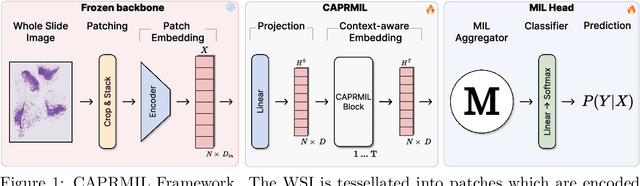
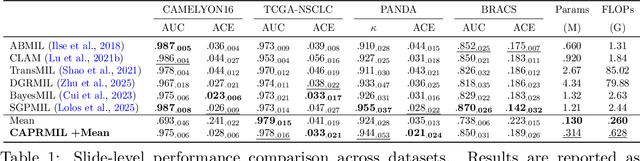
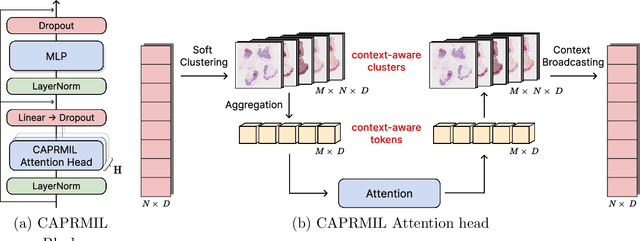

In computational pathology, weak supervision has become the standard for deep learning due to the gigapixel scale of WSIs and the scarcity of pixel-level annotations, with Multiple Instance Learning (MIL) established as the principal framework for slide-level model training. In this paper, we introduce a novel setting for MIL methods, inspired by proceedings in Neural Partial Differential Equation (PDE) Solvers. Instead of relying on complex attention-based aggregation, we propose an efficient, aggregator-agnostic framework that removes the complexity of correlation learning from the MIL aggregator. CAPRMIL produces rich context-aware patch embeddings that promote effective correlation learning on downstream tasks. By projecting patch features -- extracted using a frozen patch encoder -- into a small set of global context/morphology-aware tokens and utilizing multi-head self-attention, CAPRMIL injects global context with linear computational complexity with respect to the bag size. Paired with a simple Mean MIL aggregator, CAPRMIL matches state-of-the-art slide-level performance across multiple public pathology benchmarks, while reducing the total number of trainable parameters by 48%-92.8% versus SOTA MILs, lowering FLOPs during inference by 52%-99%, and ranking among the best models on GPU memory efficiency and training time. Our results indicate that learning rich, context-aware instance representations before aggregation is an effective and scalable alternative to complex pooling for whole-slide analysis. Our code is available at https://github.com/mandlos/CAPRMIL

A holistic perception system of internal and external monitoring for ground autonomous vehicles: AutoTRUST paradigm
Aug 25, 2025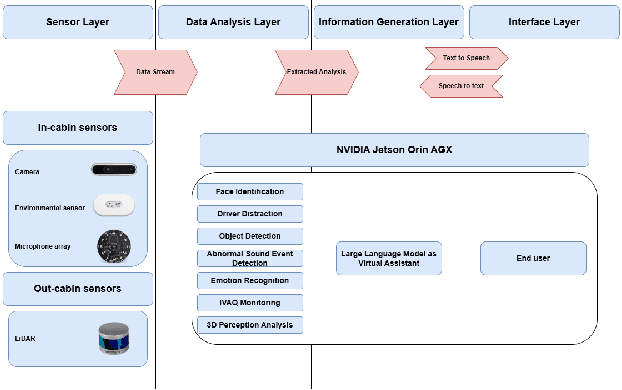
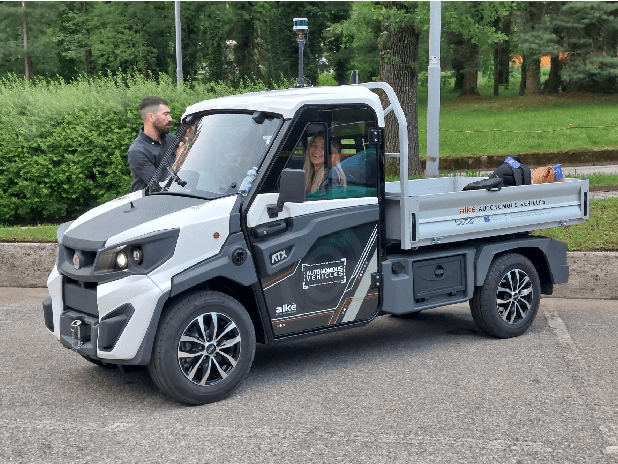
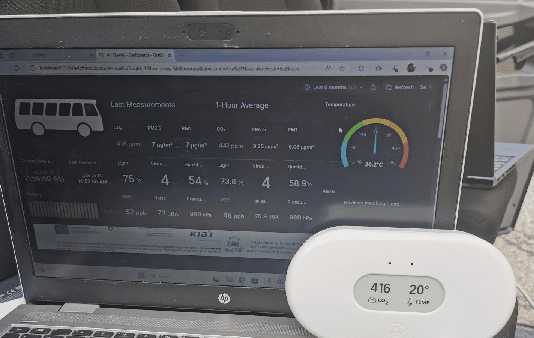
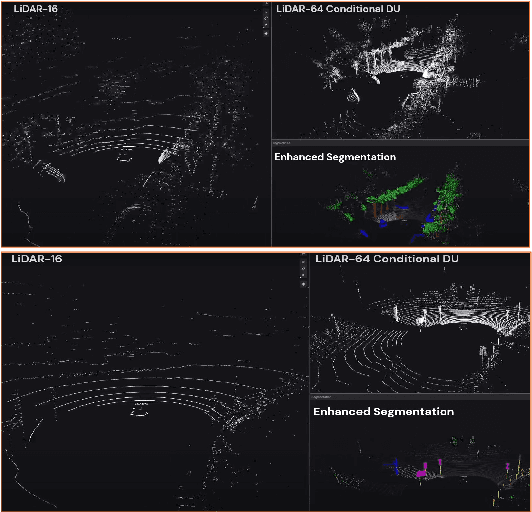
This paper introduces a holistic perception system for internal and external monitoring of autonomous vehicles, with the aim of demonstrating a novel AI-leveraged self-adaptive framework of advanced vehicle technologies and solutions that optimize perception and experience on-board. Internal monitoring system relies on a multi-camera setup designed for predicting and identifying driver and occupant behavior through facial recognition, exploiting in addition a large language model as virtual assistant. Moreover, the in-cabin monitoring system includes AI-empowered smart sensors that measure air-quality and perform thermal comfort analysis for efficient on and off-boarding. On the other hand, external monitoring system perceives the surrounding environment of vehicle, through a LiDAR-based cost-efficient semantic segmentation approach, that performs highly accurate and efficient super-resolution on low-quality raw 3D point clouds. The holistic perception framework is developed in the context of EU's Horizon Europe programm AutoTRUST, and has been integrated and deployed on a real electric vehicle provided by ALKE. Experimental validation and evaluation at the integration site of Joint Research Centre at Ispra, Italy, highlights increased performance and efficiency of the modular blocks of the proposed perception architecture.