 Add to Chrome
 Add to Firefox
 Add to Edge
Standard Condition Number-Based Detection for MIMO ISAC Systems under Noise Uncertainty
Mar 12, 2026
This paper presents a unified analytical and optimization framework for Standard Condition Number (SCN)-based detection in MIMO Integrated Sensing and Communication (ISAC) systems operating under noise uncertainty. Conventional detectors such as the Likelihood Ratio Test (LRT) and Energy Detector (ED) suffer from false-alarm inflation when interference or jamming alters the noise covariance. To overcome this limitation, the SCN detector, defined as the ratio of the largest to smallest eigenvalues of the sample covariance matrix is analytically characterized for the first time in an ISAC setting. Closed-form expressions for the false-alarm and detection probabilities are derived using random matrix theory for a two-antenna sensing receiver and generalized to arbitrary MIMO dimensions. The analysis proves that the SCN maintains a constant false alarm rate (CFAR) property and remains resilient to covariance mismatch, providing theoretical justification for its robustness in dynamic environments. Leveraging these results, a tractable ISAC power-allocation problem is formulated to minimize total detection error subject to communication rate and power constraints, yielding an interpretable sequential solution. Numerical evaluations verify the theory and demonstrate that the proposed SCN detector consistently outperforms LRT and eigenvalue-based benchmarks, particularly under strong interference and jamming typical of modern multiuser networks.

Signal Detection in Colored Noise Using the Condition Number of $F$-Matrices
Nov 26, 2024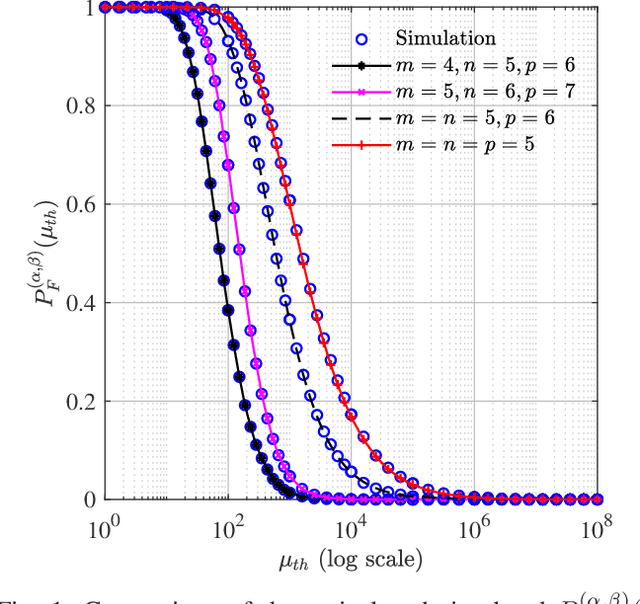
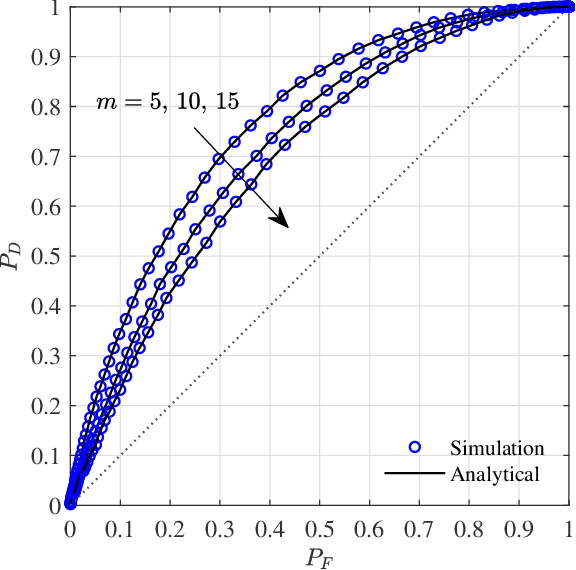
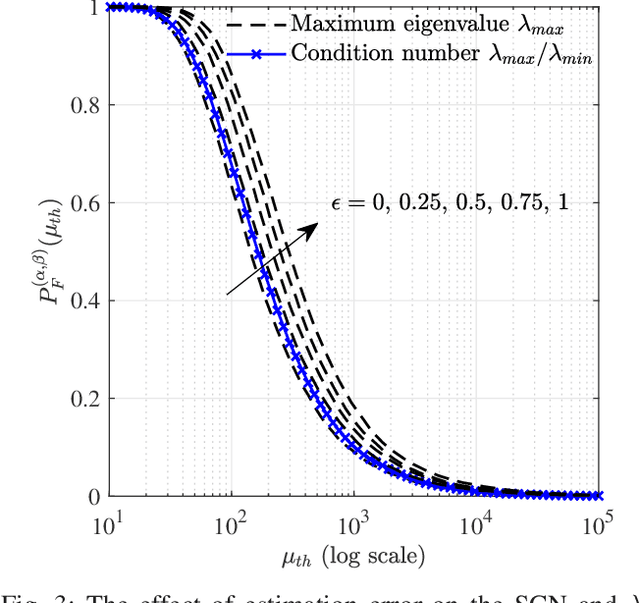
Signal detection in colored noise with an unknown covariance matrix has numerous applications across various scientific and engineering disciplines. The analysis focuses on the square of the condition number \(\kappa^2(\cdot)\), defined as the ratio of the largest to smallest eigenvalue \((\lambda_{\text{max}}/\lambda_{\text{min}})\) of the whitened sample covariance matrix \(\bm{\widehat{\Psi}}\), constructed from \(p\) signal-plus-noise samples and \(n\) noise-only samples, both \(m\)-dimensional. This statistic is denoted as \(\kappa^2(\bm{\widehat{\Psi}})\). A finite-dimensional characterization of the false alarm probability for this statistic under the null and alternative hypotheses has been an open problem. Therefore, in this work, we address this by deriving the cumulative distribution function (c.d.f.) of \(\kappa^2(\bm{\widehat{\Psi}})\) using the powerful orthogonal polynomial approach in random matrix theory. These c.d.f. expressions have been used to statistically characterize the performance of \(\kappa^2(\bm{\widehat{\Psi}})\).