 Add to Chrome
 Add to Firefox
 Add to Edge
Rhythm-Structured Predictive Learning for Remote Photoplethysmography
Jun 30, 2026
Remote photoplethysmography (rPPG) estimates physiological signals from facial videos by analyzing subtle pulse induced skin color variations. Despite recent progress, existing self-supervised rPPG methods mainly reconstruct masked pixels or low-level visual representations, which can bias the model toward facial appearance rather than latent physiological dy namics. Moreover, most recent Mamba-based approaches scan facial video tokens only in chronological order, limiting their ability to exploit the cyclic structure of pulse signals. To ad dress these limitations, we propose RhythmJEPA, a rhythm structured joint-embedding predictive learning framework for rPPG. Instead of reconstructing RGB frames, RhythmJEPA predicts latent teacher representations from masked facial videos, thereby encouraging physiology-aware representation learning in the embedding space. To explicitly model pulse-related tem poral structure, we introduce a Cyclic Rhythm-State Plan ner (CRSP), which estimates frame-wise latent physiological states and decodes the most plausible cyclic state path via dynamic programming with a constrained transition grammar. Guided by the decoded states, we further design a Dual Order Mamba Encoder (DOM), which combines conventional chronological scanning with state-ordered scanning to capture both local temporal continuity and long-range rhythm-consistent dependencies. Finally, a lightweight Spatial Pulse Mixer (SPM) extracts compact pulse-sensitive facial tokens with a favorable balance between complexity and performance. Experiments on PURE, UBFC-rPPG, and MMPD show competitive performance over representative rPPG methods. The codes are available at https://github.com/deconasser/RhythmJEPA.

HOT: Harmonic-Constrained Optimal Transport for Remote Photoplethysmography Domain Adaptation
Apr 02, 2026Remote photoplethysmography (rPPG) enables non-contact physiological measurement from facial videos; however, its practical deployment is often hindered by substantial performance degradation under domain shift. While recent deep learning-based rPPG methods have achieved strong performance on individual datasets, they frequently overfit to appearance-related factors, such as illumination, camera characteristics, and color response, that vary significantly across domains. To address this limitation, we introduce frequency domain adaptation (FDA) as a principled strategy for modeling appearance variation in rPPG. By transferring low-frequency spectral components that encode domain-dependent appearance characteristics, FDA encourages rPPG models to learn invariance to appearance variations while retaining cardiac-induced signals. To further support physiologically consistent alignment under such appearance variation, we propose Harmonic-Constrained Optimal Transport (HOT), which leverages the harmonic property of cardiac signals to guide alignment between original and FDA-transferred representations. Extensive cross-dataset experiments demonstrate that the proposed FDA and HOT framework effectively enhances the robustness and generalization of rPPG models across diverse datasets.
BTS-rPPG: Orthogonal Butterfly Temporal Shifting for Remote Photoplethysmography
Apr 02, 2026Remote photoplethysmography (rPPG) enables contactless physiological sensing from facial videos by analyzing subtle appearance variations induced by blood circulation. However, modeling the temporal dynamics of these signals remains challenging, as many deep learning methods rely on temporal shifting or convolutional operators that aggregate information primarily from neighboring frames, resulting in predominantly local temporal modeling and limited temporal receptive fields. To address this limitation, we propose BTS-rPPG, a temporal modeling framework based on Orthogonal Butterfly Temporal Shifting (BTS). Inspired by the butterfly communication pattern in the Fast Fourier Transform (FFT), BTS establishes structured frame interactions via an XOR-based butterfly pairing schedule, progressively expanding the temporal receptive field and enabling efficient propagation of information across distant frames. Furthermore, we introduce an orthogonal feature transfer mechanism (OFT) that filters the source feature with respect to the target context before temporal shifting, retaining only the orthogonal component for cross-frame transmission. This reduces redundant feature propagation and encourages complementary temporal interaction. Extensive experiments on multiple benchmark datasets demonstrate that BTS-rPPG improves long-range temporal modeling of physiological dynamics and consistently outperforms existing temporal modeling strategies for rPPG estimation.
Reperio-rPPG: Relational Temporal Graph Neural Networks for Periodicity Learning in Remote Physiological Measurement
Nov 08, 2025Remote photoplethysmography (rPPG) is an emerging contactless physiological sensing technique that leverages subtle color variations in facial videos to estimate vital signs such as heart rate and respiratory rate. This non-invasive method has gained traction across diverse domains, including telemedicine, affective computing, driver fatigue detection, and health monitoring, owing to its scalability and convenience. Despite significant progress in remote physiological signal measurement, a crucial characteristic - the intrinsic periodicity - has often been underexplored or insufficiently modeled in previous approaches, limiting their ability to capture fine-grained temporal dynamics under real-world conditions. To bridge this gap, we propose Reperio-rPPG, a novel framework that strategically integrates Relational Convolutional Networks with a Graph Transformer to effectively capture the periodic structure inherent in physiological signals. Additionally, recognizing the limited diversity of existing rPPG datasets, we further introduce a tailored CutMix augmentation to enhance the model's generalizability. Extensive experiments conducted on three widely used benchmark datasets - PURE, UBFC-rPPG, and MMPD - demonstrate that Reperio-rPPG not only achieves state-of-the-art performance but also exhibits remarkable robustness under various motion (e.g., stationary, rotation, talking, walking) and illumination conditions (e.g., nature, low LED, high LED). The code is publicly available at https://github.com/deconasser/Reperio-rPPG.
Defeating Opaque Predicates Statically through Machine Learning and Binary Analysis
Sep 04, 2019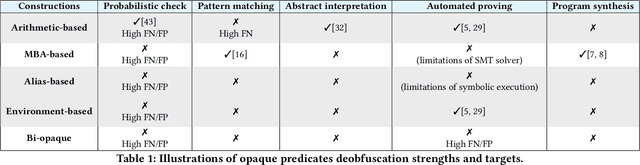
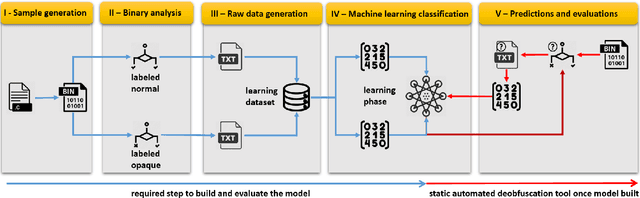
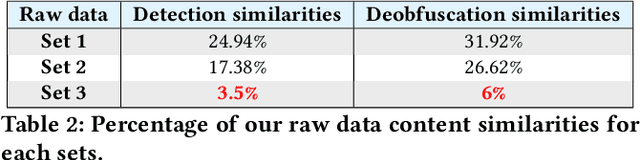
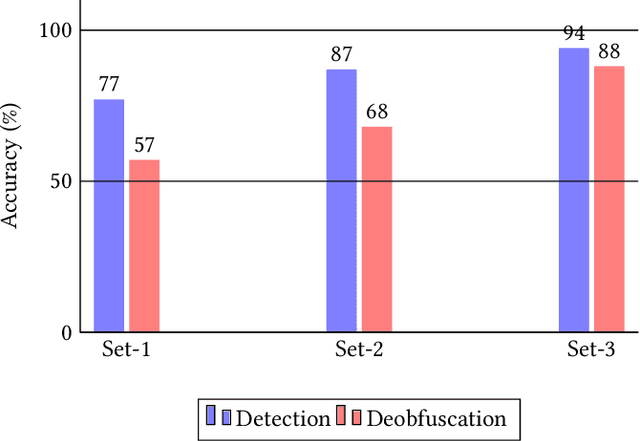
We present a new approach that bridges binary analysis techniques with machine learning classification for the purpose of providing a static and generic evaluation technique for opaque predicates, regardless of their constructions. We use this technique as a static automated deobfuscation tool to remove the opaque predicates introduced by obfuscation mechanisms. According to our experimental results, our models have up to 98% accuracy at detecting and deob-fuscating state-of-the-art opaque predicates patterns. By contrast, the leading edge deobfuscation methods based on symbolic execution show less accuracy mostly due to the SMT solvers constraints and the lack of scalability of dynamic symbolic analyses. Our approach underlines the efficiency of hybrid symbolic analysis and machine learning techniques for a static and generic deobfuscation methodology.
Compressive Online Robust Principal Component Analysis with Optical Flow for Video Foreground-Background Separation
Oct 25, 2017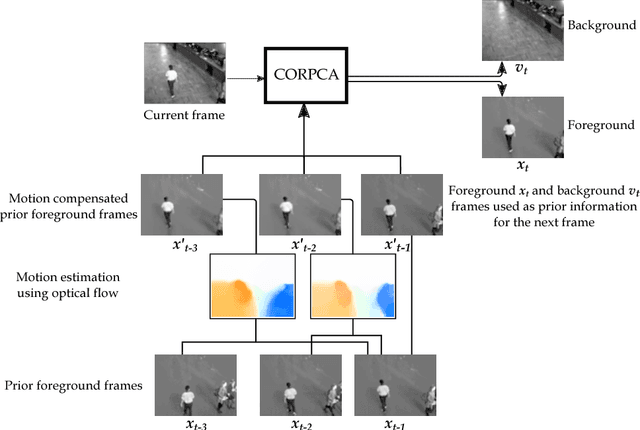
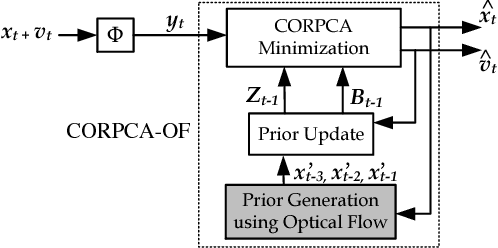
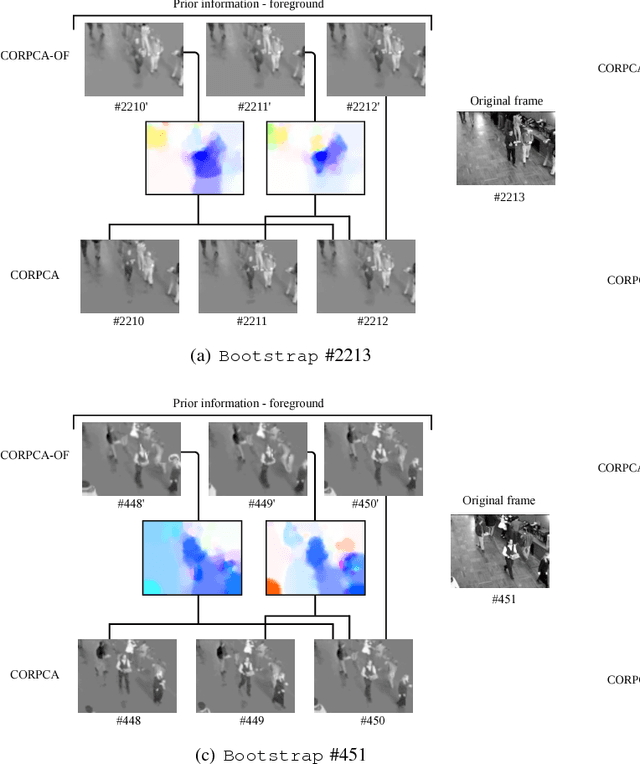
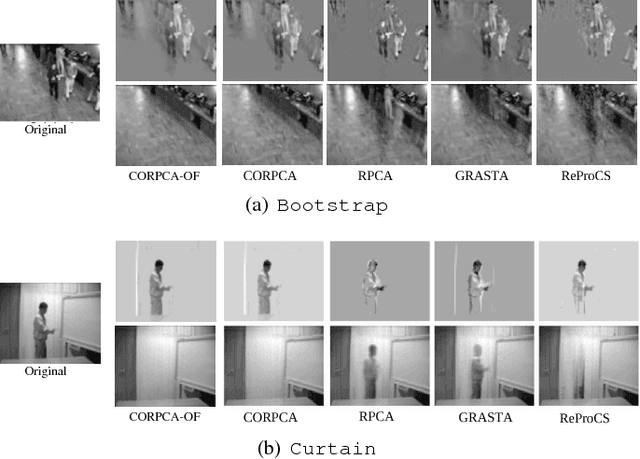
In the context of online Robust Principle Component Analysis (RPCA) for the video foreground-background separation, we propose a compressive online RPCA with optical flow that separates recursively a sequence of frames into sparse (foreground) and low-rank (background) components. Our method considers a small set of measurements taken per data vector (frame), which is different from conventional batch RPCA, processing all the data directly. The proposed method also incorporates multiple prior information, namely previous foreground and background frames, to improve the separation and then updates the prior information for the next frame. Moreover, the foreground prior frames are improved by estimating motions between the previous foreground frames using optical flow and compensating the motions to achieve higher quality foreground prior. The proposed method is applied to online video foreground and background separation from compressive measurements. The visual and quantitative results show that our method outperforms the existing methods.