 Add to Chrome
 Add to Firefox
 Add to Edge
Did William Shakespeare and Thomas Kyd Write Edward III?
Jan 11, 2018


William Shakespeare is believed to be a significant author in the anonymous play, The Reign of King Edward III, published in 1596. However, recently, Thomas Kyd, has been suggested as the primary author. Using a neurolinguistics approach to authorship identification we use a four-feature technique, RPAS, to convert the 19 scenes in Edward III into a multi-dimensional vector. Three complementary analytical techniques are applied to cluster the data and reduce single technique bias before an alternate method, seriation, is used to measure the distances between clusters and test the strength of the connections. We find the multivariate techniques robust and are able to allocate up to 14 scenes to Thomas Kyd, and further question if scenes long believed to be Shakespeare's are not his.
* 13 pages, 5 Figures, 3 Tables

Evolution of Neural Networks to Play the Game of Dots-and-Boxes
Sep 28, 1998

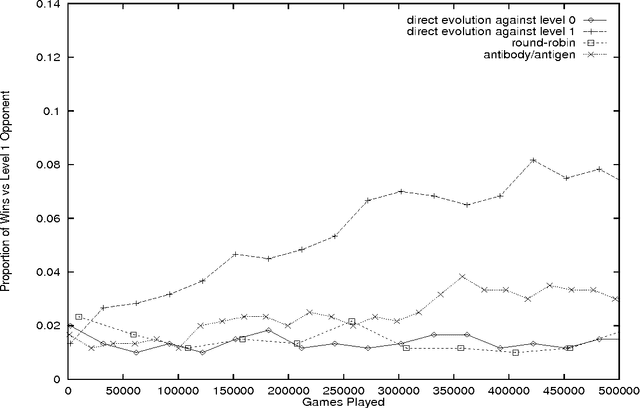

Dots-and-Boxes is a child's game which remains analytically unsolved. We implement and evolve artificial neural networks to play this game, evaluating them against simple heuristic players. Our networks do not evaluate or predict the final outcome of the game, but rather recommend moves at each stage. Superior generalisation of play by co-evolved populations is found, and a comparison made with networks trained by back-propagation using simple heuristics as an oracle.
* 8 pages, 5 figures, LaTeX 2.09 (works with LaTeX2e)