 Add to Chrome
 Add to Firefox
 Add to Edge
Distillation and Interpretability of Ensemble Forecasts of ENSO Phase using Entropic Learning
Feb 15, 2026
This paper introduces a distillation framework for an ensemble of entropy-optimal Sparse Probabilistic Approximation (eSPA) models, trained exclusively on satellite-era observational and reanalysis data to predict ENSO phase up to 24 months in advance. While eSPA ensembles yield state-of-the-art forecast skill, they are harder to interpret than individual eSPA models. We show how to compress the ensemble into a compact set of "distilled" models by aggregating the structure of only those ensemble members that make correct predictions. This process yields a single, diagnostically tractable model for each forecast lead time that preserves forecast performance while also enabling diagnostics that are impractical to implement on the full ensemble. An analysis of the regime persistence of the distilled model "superclusters", as well as cross-lead clustering consistency, shows that the discretised system accurately captures the spatiotemporal dynamics of ENSO. By considering the effective dimension of the feature importance vectors, the complexity of the input space required for correct ENSO phase prediction is shown to peak when forecasts must cross the boreal spring predictability barrier. Spatial importance maps derived from the feature importance vectors are introduced to identify where predictive information resides in each field and are shown to include known physical precursors at certain lead times. Case studies of key events are also presented, showing how fields reconstructed from distilled model centroids trace the evolution from extratropical and inter-basin precursors to the mature ENSO state. Overall, the distillation framework enables a rigorous investigation of long-range ENSO predictability that complements real-time data-driven operational forecasts.

Free-Form Variational Inference for Gaussian Process State-Space Models
Feb 20, 2023
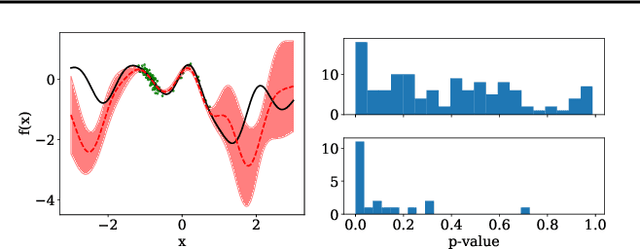
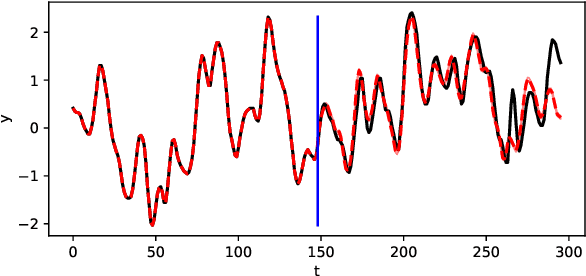
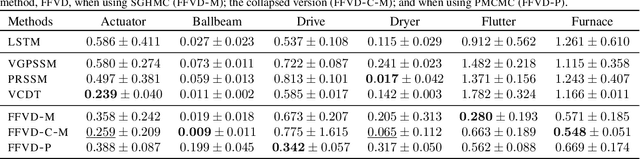
Gaussian process state-space models (GPSSMs) provide a principled and flexible approach to modeling the dynamics of a latent state, which is observed at discrete-time points via a likelihood model. However, inference in GPSSMs is computationally and statistically challenging due to the large number of latent variables in the model and the strong temporal dependencies between them. In this paper, we propose a new method for inference in Bayesian GPSSMs, which overcomes the drawbacks of previous approaches, namely over-simplified assumptions, and high computational requirements. Our method is based on free-form variational inference via stochastic gradient Hamiltonian Monte Carlo within the inducing-variable formalism. Furthermore, by exploiting our proposed variational distribution, we provide a collapsed extension of our method where the inducing variables are marginalized analytically. We also showcase results when combining our framework with particle MCMC methods. We show that, on six real-world datasets, our approach can learn transition dynamics and latent states more accurately than competing methods.