 Add to Chrome
 Add to Firefox
 Add to Edge
PRIME: Evaluating Prompt Resolution Under Incompatible Instructions in LLMs
Jun 21, 2026
Large language models (LLMs) often encounter conflicting prompts, although current instruction following benchmarks assess those meta-instructions in isolation, limiting the insights about how models process conflicting instructions. We introduce a framework \textit{PRIME}(\textit{Prompt Resolution under Incompatible Meta-Instructions Evaluation}) to analyze behavior of LLMs when provided with conflicting instructions. \textit{PRIME} purposefully produces calibrated conflicts across response length, output format, and reasoning; classifying model responses with a deterministic behavioral taxonomy. We are evaluating five instruction tuned open weight LLMs in two distinct settings, balanced and naturally distributed. The conclusion we reach upon analysis is that conflict type is more significant in affecting behavior than model scale, and various failure modes across different categories of conflict. Our findings emphasize the value of developing conflict awareness and suggest ability of LLM to follow instructions cannot be assessed through isolated constraints alone.

Detecting Compliance of Privacy Policies with Data Protection Laws
Feb 21, 2021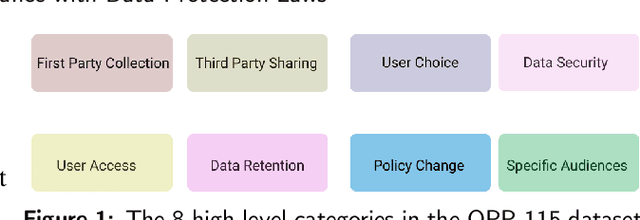
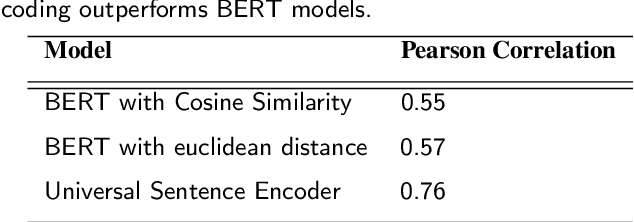
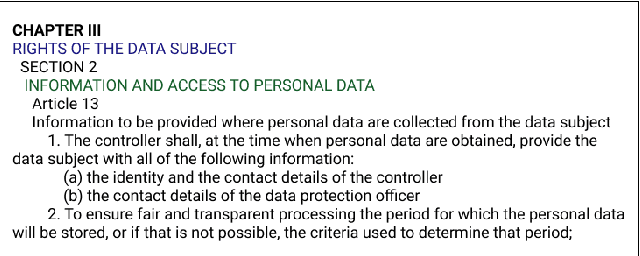
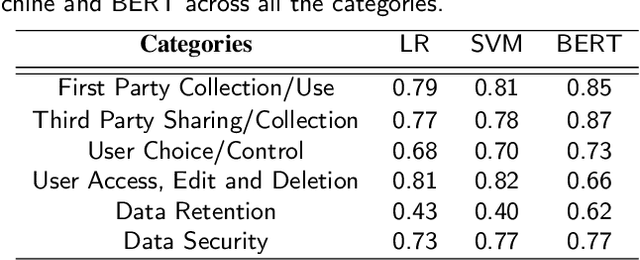
Privacy Policies are the legal documents that describe the practices that an organization or company has adopted in the handling of the personal data of its users. But as policies are a legal document, they are often written in extensive legal jargon that is difficult to understand. Though work has been done on privacy policies but none that caters to the problem of verifying if a given privacy policy adheres to the data protection laws of a given country or state. We aim to bridge that gap by providing a framework that analyzes privacy policies in light of various data protection laws, such as the General Data Protection Regulation (GDPR). To achieve that, firstly we labeled both the privacy policies and laws. Then a correlation scheme is developed to map the contents of a privacy policy to the appropriate segments of law that a policy must conform to. Then we check the compliance of privacy policy's text with the corresponding text of the law using NLP techniques. By using such a tool, users would be better equipped to understand how their personal data is managed. For now, we have provided a mapping for the GDPR and PDPA, but other laws can easily be incorporated in the already built pipeline.