 Add to Chrome
 Add to Firefox
 Add to Edge
Riazi-8B: An Urdu Large Language Model for Mathematical Reasoning
Jun 24, 2026
Recent LLMs demonstrate strong mathematical reasoning capabilities, but existing gains rely heavily on English-centric training resources and benchmarks. As a result, reasoning performance degrades substantially in low-resource languages such as Urdu, where reasoning-oriented datasets and adapted models remain scarce. Urdu lacks both reasoning-oriented resources and models adapted for multi-step mathematical problem solving, limiting the applicability of recent progress to Urdu-speaking users. We address this gap through Riazi-8B, an Urdu mathematical reasoning model developed through a two-step adaptation process comprising continued pre-training on Urdu Wikipedia and supervised fine-tuning on Urdu Chain-of-Thought data derived from GSM8K. We evaluate Riazi-8B on MGSM-Urdu against existing Urdu instruction-tuned models. Our results show consistent improvements in answer correctness, reasoning quality, response completeness, and Urdu generation. Our findings demonstrate that combining Urdu language adaptation with reasoning-focused fine-tuning is an effective strategy for extending mathematical reasoning capabilities to low-resource languages.

Not All Claims Are Equally Risky: FACTOR for Adaptive Verification in Factual Long-Form Generation
Jun 21, 2026Large Language Models (LLMs) generate fluent long-form text, however, often add unsupported factual claims. Existing verification techniques improve factuality by grounding generation in external evidence. However, the same verification policy usually applies to all claims despite being differences in hallucination risks. We propose \textit{FACTOR} (\textit{FACTuality-Oriented Risk-aware Verification}), an inference-time model that adapts verification criteria according to claim-level uncertainty. FACTOR combines uncertainty estimation, adaptive language inference verification, and candidate re-ranking to allocate verification effort where it is most needed. We evaluate \textit{FACTOR} on FactScore benchmark showing that adaptive verification improves factuality while reducing verification cost simultaneously. We further perform different ablation studies to identify the primary driver of these gains. Our results show the effective and model-agnostic performance of \textit{FACTOR} for improving factuality in long-form generation.
PRIME: Evaluating Prompt Resolution Under Incompatible Instructions in LLMs
Jun 21, 2026Large language models (LLMs) often encounter conflicting prompts, although current instruction following benchmarks assess those meta-instructions in isolation, limiting the insights about how models process conflicting instructions. We introduce a framework \textit{PRIME}(\textit{Prompt Resolution under Incompatible Meta-Instructions Evaluation}) to analyze behavior of LLMs when provided with conflicting instructions. \textit{PRIME} purposefully produces calibrated conflicts across response length, output format, and reasoning; classifying model responses with a deterministic behavioral taxonomy. We are evaluating five instruction tuned open weight LLMs in two distinct settings, balanced and naturally distributed. The conclusion we reach upon analysis is that conflict type is more significant in affecting behavior than model scale, and various failure modes across different categories of conflict. Our findings emphasize the value of developing conflict awareness and suggest ability of LLM to follow instructions cannot be assessed through isolated constraints alone.
ROMEVA: Geometry-Preserving Vocabulary Expansion for Roman Urdu Language Models
Jun 21, 2026Multilingual Language Models like mBERT are widely used for low-resource NLP, yet their adaptation to morphologically inconsistent languages such as Roman Urdu remains underexplored. Roman Urdu spelling variation causes severe sub-word fragmentation, averaging 1.50 sub-words per token. We propose \textit{ROMEVA} (Roman Urdu Embedding-preserving Vocabulary Adaptation), which combines sub-word-average initialization and a PCA-guided anchor loss to stabilize embeddings during vocabulary expansion. Using a 36,130-comment Roman Urdu corpus, we add 500 highly fragmented tokens to mBERT and compare naive fine-tuning, sub-word-aware fine-tuning, and \textit{ROMEVA}. While \textit{ROMEVA} most effectively preserves the pretrained embedding space, naive fine-tuning achieves the strongest downstream sentiment classification performance. These findings reveal a disconnect between embedding stability and downstream performance, suggesting that stronger adaptation may be preferable to strict embedding preservation in morphologically inconsistent languages.
From Affect Prediction to Affect Forecasting: Evidence for Distinct Information Sources in Longitudinal Text
Jun 15, 2026Modeling dimensional affect in longitudinal text requires distinguishing current affect estimation from future affective change forecasting. Existing approaches often treat each text as an independent observation and apply similar assumptions to both tasks, without testing whether they rely on different information sources. This paper investigates that distinction using longitudinal self-reported ecological essays and feeling-word entries. We propose the Trait--State Affective Prediction (TSAP) framework and its temporal extension E-TSAP for per-text valence and arousal prediction, evaluated on a held-out prediction test set of 1,737 entries from 91 users. We further propose the Affective Change Forecaster Hybrid (ACF-Hybrid) for next-step affective change forecasting, evaluated on a held-out forecasting test set of 46 users. For prediction, E-TSAP achieves composite Pearson correlations of 0.670 for valence and 0.449 for arousal. For forecasting, textual representations perform worse than compact numeric trajectory baselines: the text-inclusive model achieves only r=0.316 for valence and r=0.284 for arousal, whereas a simple prior-state baseline reaches r=0.615 and r=0.670, respectively. ACF-Hybrid, using dimension-specific numeric trajectory features, achieves r=0.659 for valence and $r=0.658$ for arousal. These results show that textual semantics support current affect prediction, whereas future affective change is better captured through prior numeric trajectory dynamics.
A Multi-Domain Feature Fusion Framework for Generalizable Deepfake Detection Across Different Generators
Jun 12, 2026Deepfakes are artificially generated images, audio, or videos that threaten privacy, security, and information integrity. Detecting such content is crucial for countering disinformation, as the latest models generate highly realistic content. While spatial- or frequency-based approaches achieve good detection rates on Generative Adversarial Networks (GANs)-based generated deepfakes, they often struggle with recent diffusion model-generated images. In particular, existing approaches rarely exploit complementary multi-domain representations or systematically evaluate cross-generator robustness. To address these challenges, we propose a multi-domain deepfake detection framework called SGFF-Net (Spatial-Gradient-Frequency Fusion Network) that integrates spatial, gradient, and DWT (Discrete Wavelet Transform)-based frequency representations within a dual residual learning architecture. Experimental results show that the SGFF-Net achieves 98.95\% accuracy in intra-dataset evaluation and improves performance in both cross-model (70.46\%) and cross-paradigm (69.94\%) settings. Incorporating multi-source training and data augmentation further enhances robustness, increasing accuracy from 70.46\% to 79.80\% in cross-model evaluation, from 69\% to 78\% in cross-paradigm evaluation, and from 61.50\% to 75.80\% on real-world data. Unlike single-domain detectors, the SGFF-Net learns complementary forensic cues across spatial, gradient, and wavelet-frequency domains, resulting in greater robustness under cross-generator and cross-paradigm evaluation. The results further show that combining multi-domain representations with data diversity and augmentation substantially improves generalization, providing practical insights for developing more reliable deepfake detection systems.
Quantifying the Climate Risk of Generative AI: Region-Aware Carbon Accounting with G-TRACE and the AI Sustainability Pyramid
Nov 06, 2025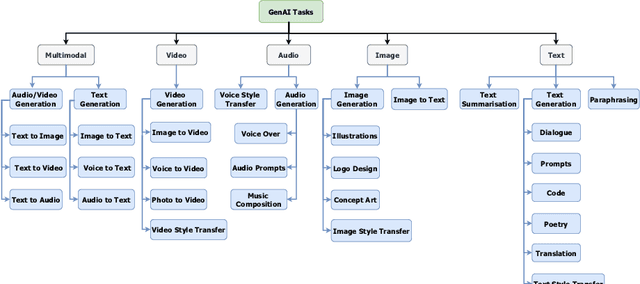
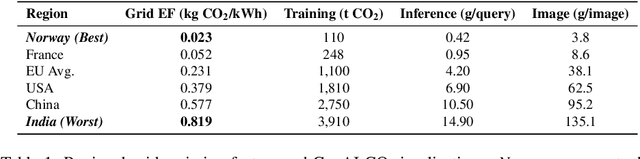
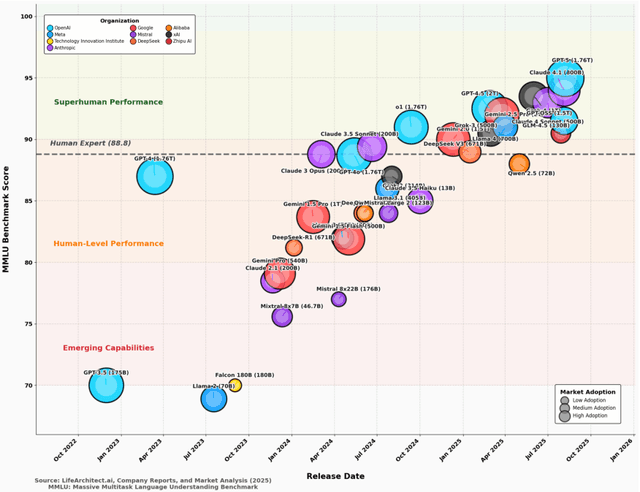
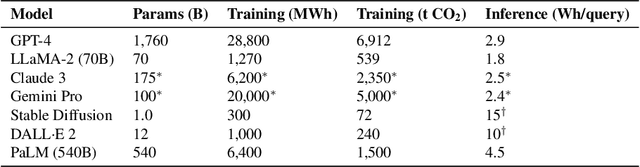
Generative Artificial Intelligence (GenAI) represents a rapidly expanding digital infrastructure whose energy demand and associated CO2 emissions are emerging as a new category of climate risk. This study introduces G-TRACE (GenAI Transformative Carbon Estimator), a cross-modal, region-aware framework that quantifies training- and inference-related emissions across modalities and deployment geographies. Using real-world analytics and microscopic simulation, G-TRACE measures energy use and carbon intensity per output type (text, image, video) and reveals how decentralized inference amplifies small per-query energy costs into system-level impacts. Through the Ghibli-style image generation trend (2024-2025), we estimate 4,309 MWh of energy consumption and 2,068 tCO2 emissions, illustrating how viral participation inflates individual digital actions into tonne-scale consequences. Building on these findings, we propose the AI Sustainability Pyramid, a seven-level governance model linking carbon accounting metrics (L1-L7) with operational readiness, optimization, and stewardship. This framework translates quantitative emission metrics into actionable policy guidance for sustainable AI deployment. The study contributes to the quantitative assessment of emerging digital infrastructures as a novel category of climate risk, supporting adaptive governance for sustainable technology deployment. By situating GenAI within climate-risk frameworks, the work advances data-driven methods for aligning technological innovation with global decarbonization and resilience objectives.
SimCSum: Joint Learning of Simplification and Cross-lingual Summarization for Cross-lingual Science Journalism
Apr 04, 2023Cross-lingual science journalism generates popular science stories of scientific articles different from the source language for a non-expert audience. Hence, a cross-lingual popular summary must contain the salient content of the input document, and the content should be coherent, comprehensible, and in a local language for the targeted audience. We improve these aspects of cross-lingual summary generation by joint training of two high-level NLP tasks, simplification and cross-lingual summarization. The former task reduces linguistic complexity, and the latter focuses on cross-lingual abstractive summarization. We propose a novel multi-task architecture - SimCSum consisting of one shared encoder and two parallel decoders jointly learning simplification and cross-lingual summarization. We empirically investigate the performance of SimCSum by comparing it with several strong baselines over several evaluation metrics and by human evaluation. Overall, SimCSum demonstrates statistically significant improvements over the state-of-the-art on two non-synthetic cross-lingual scientific datasets. Furthermore, we conduct an in-depth investigation into the linguistic properties of generated summaries and an error analysis.