 Add to Chrome
 Add to Firefox
 Add to Edge
Attraction, Repulsion, and Friction: Introducing DMF, a Friction-Augmented Drifting Model
Apr 20, 2026
Drifting Models [Deng et al., 2026] train a one-step generator by evolving samples under a kernel-based drift field, avoiding ODE integration at inference. The original analysis leaves two questions open. The drift-field iteration admits a locally repulsive regime in a two-particle surrogate, and vanishing of the drift ($V_{p,q}\equiv 0$) is not known to force the learned distribution $q$ to match the target $p$. We derive a contraction threshold for the surrogate and show that a linearly-scheduled friction coefficient gives a finite-horizon bound on the error trajectory. Under a Gaussian kernel we prove that the drift-field equilibrium is identifiable: vanishing of $V_{p,q}$ on any open set forces $q=p$, closing the converse of Proposition 3.1 of Deng et al. Our friction-augmented model, DMF (Drifting Model with Friction), matches or exceeds Optimal Flow Matching on FFHQ adult-to-child domain translation at 16x lower training compute.

Geometric Entropy and Retrieval Phase Transitions in Continuous Thermal Dense Associative Memory
Apr 08, 2026We study the thermodynamic memory capacity of modern Hopfield networks (Dense Associative Memory models) with continuous states under geometric constraints, extending classical analyses of pairwise associative memory. We derive thermodynamic phase boundaries for Dense Associative Memory networks with exponential capacity $p = e^{αN}$, comparing Gaussian (LSE) and Epanechnikov (LSR) kernels. For continuous neurons on an $N$-sphere, the geometric entropy depends solely on the spherical geometry, not the kernel. In the sharp-kernel regime, the maximum theoretical capacity $α= 0.5$ is achieved at zero temperature; below this threshold, a critical line separates retrieval from a spin-glass phase. The two kernels differ qualitatively in their phase boundary structure: for LSE, the retrieval region extends to arbitrarily high temperatures as $α\to 0$, but interference from spurious patterns is always present. For LSR, the finite support introduces a threshold $α_{\text{th}}$ below which no spurious patterns contribute to the noise floor, producing a qualitatively different retrieval regime in this sub-threshold region. These results advance the theory of high-capacity associative memory and clarify fundamental limits of retrieval robustness in modern attention-like memory architectures.
Geometric Analysis of Token Selection in Multi-Head Attention
Feb 02, 2026We present a geometric framework for analysing multi-head attention in large language models (LLMs). Without altering the mechanism, we view standard attention through a top-N selection lens and study its behaviour directly in value-state space. We define geometric metrics - Precision, Recall, and F-score - to quantify separability between selected and non-selected tokens, and derive non-asymptotic bounds with explicit dependence on dimension and margin under empirically motivated assumptions (stable value norms with a compressed sink token, exponential similarity decay, and piecewise attention weight profiles). The theory predicts a small-N operating regime of strongest non-trivial separability and clarifies how sequence length and sink similarity shape the metrics. Empirically, across LLaMA-2-7B, Gemma-7B, and Mistral-7B, measurements closely track the theoretical envelopes: top-N selection sharpens separability, sink similarity correlates with Recall. We also found that in LLaMA-2-7B heads specialize into three regimes - Retriever, Mixer, Reset - with distinct geometric signatures. Overall, attention behaves as a structured geometric classifier with measurable criteria for token selection, offering head level interpretability and informing geometry-aware sparsification and design of attention in LLMs.
Limitations of Normalization in Attention Mechanism
Aug 25, 2025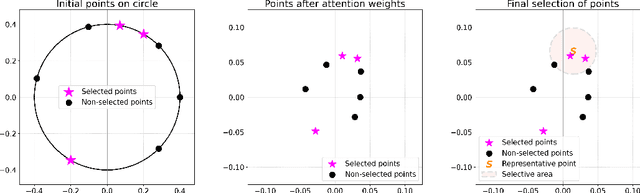
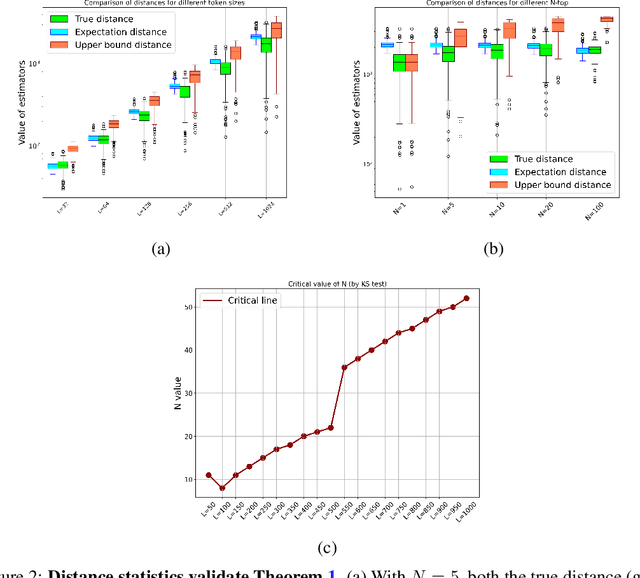
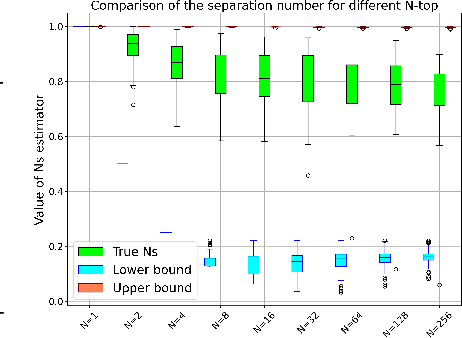
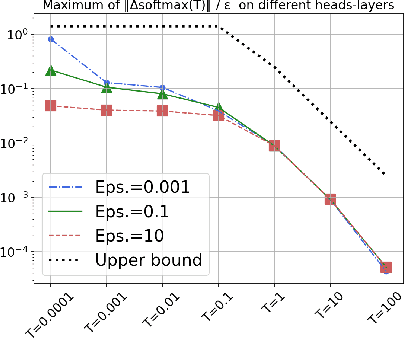
This paper investigates the limitations of the normalization in attention mechanisms. We begin with a theoretical framework that enables the identification of the model's selective ability and the geometric separation involved in token selection. Our analysis includes explicit bounds on distances and separation criteria for token vectors under softmax scaling. Through experiments with pre-trained GPT-2 model, we empirically validate our theoretical results and analyze key behaviors of the attention mechanism. Notably, we demonstrate that as the number of selected tokens increases, the model's ability to distinguish informative tokens declines, often converging toward a uniform selection pattern. We also show that gradient sensitivity under softmax normalization presents challenges during training, especially at low temperature settings. These findings advance current understanding of softmax-based attention mechanism and motivate the need for more robust normalization and selection strategies in future attention architectures.