 Add to Chrome
 Add to Firefox
 Add to Edge
FLAME: Adaptive Mixture-of-Experts for Continual Multimodal Multi-Task Learning
May 10, 2026
Real-world model deployment across multiple domains requires multimodal models to operate under two complementary regimes: (1) multi-task pretraining, tasks are co-available at design time where related tasks could borrow representational strength from one another, (2) continual adaptation, in which new tasks emerge after deployment with previously unseen modality combinations. However, neither regime alone suffices: the pretraining task set is never exhaustive, while bypassing joint training forfeits the transfer gains and efficiency among co-trainable tasks. Sparse Mixture-of-Experts (MoE) is a natural fit for this dual requirement: sparse activation enables modular capacity expansion as new tasks arrive, while routing decouples modality-level computation from task-level composition. In this work, we propose a scalable MoE framework for multitask pretraining and continual learning across flexible modality combinations. The framework is designed to support training on multimodal tasks with diverse modality configurations by leveraging modality-specific routers that process tokens from each modality across tasks. Furthermore, it enables continual learning over sequential multimodal tasks within a fixed-capacity MoE by compressing accumulated expert knowledge into low-rank memory subspaces, while expanding only the lightweight routers. We validate the effectiveness of our method on multiple healthcare multimodal benchmarks. It demonstrates competitive multitask pretraining performance while alleviating catastrophic forgetting and improving parameter efficiency.

The Design of an LLM-powered Unstructured Analytics System
Sep 04, 2024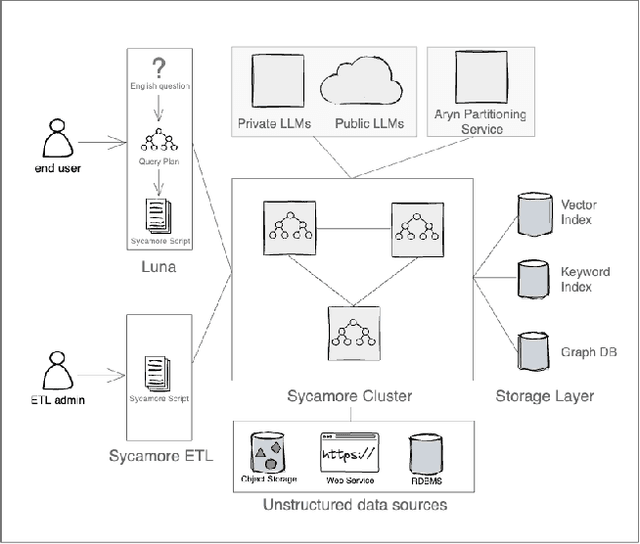
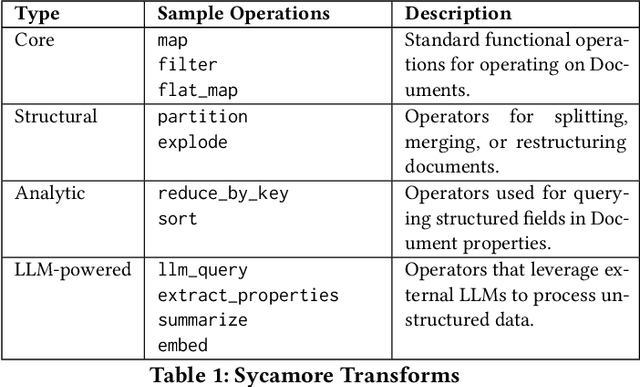
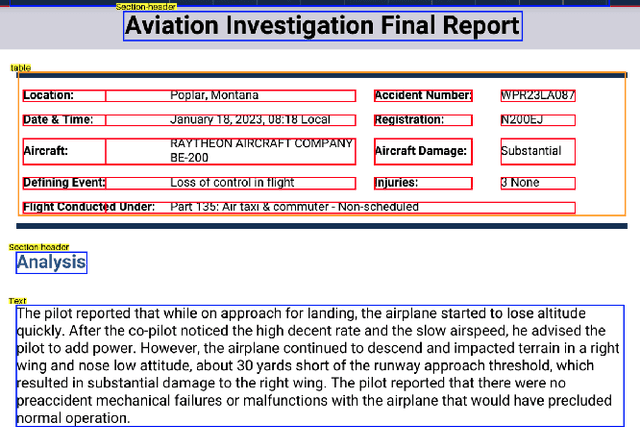
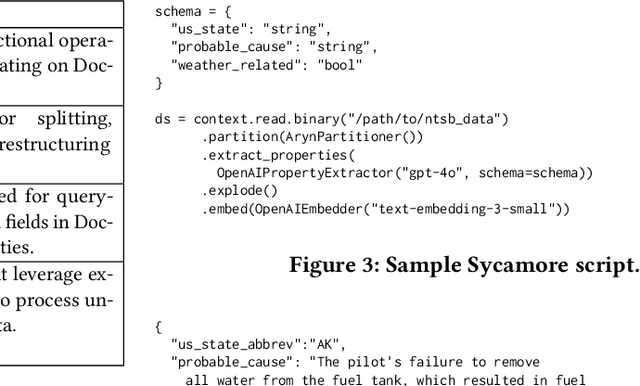
LLMs demonstrate an uncanny ability to process unstructured data, and as such, have the potential to go beyond search and run complex, semantic analyses at scale. We describe the design of an unstructured analytics system, Aryn, and the tenets and use cases that motivate its design. With Aryn, users can specify queries in natural language and the system automatically determines a semantic plan and executes it to compute an answer from a large collection of unstructured documents using LLMs. At the core of Aryn is Sycamore, a declarative document processing engine, built using Ray, that provides a reliable distributed abstraction called DocSets. Sycamore allows users to analyze, enrich, and transform complex documents at scale. Aryn also comprises Luna, a query planner that translates natural language queries to Sycamore scripts, and the Aryn Partitioner, which takes raw PDFs and document images, and converts them to DocSets for downstream processing. Using Aryn, we demonstrate a real world use case for analyzing accident reports from the National Transportation Safety Board (NTSB), and discuss some of the major challenges we encountered in deploying Aryn in the wild.