 Add to Chrome
 Add to Firefox
 Add to Edge
Surveillance Video-Based Traffic Accident Detection Using Transformer Architecture
Dec 12, 2025
Road traffic accidents represent a leading cause of mortality globally, with incidence rates rising due to increasing population, urbanization, and motorization. Rising accident rates raise concerns about traffic surveillance effectiveness. Traditional computer vision methods for accident detection struggle with limited spatiotemporal understanding and poor cross-domain generalization. Recent advances in transformer architectures excel at modeling global spatial-temporal dependencies and parallel computation. However, applying these models to automated traffic accident detection is limited by small, non-diverse datasets, hindering the development of robust, generalizable systems. To address this gap, we curated a comprehensive and balanced dataset that captures a wide spectrum of traffic environments, accident types, and contextual variations. Utilizing the curated dataset, we propose an accident detection model based on a transformer architecture using pre-extracted spatial video features. The architecture employs convolutional layers to extract local correlations across diverse patterns within a frame, while leveraging transformers to capture sequential-temporal dependencies among the retrieved features. Moreover, most existing studies neglect the integration of motion cues, which are essential for understanding dynamic scenes, especially during accidents. These approaches typically rely on static features or coarse temporal information. In this study, multiple methods for incorporating motion cues were evaluated to identify the most effective strategy. Among the tested input approaches, concatenating RGB features with optical flow achieved the highest accuracy at 88.3%. The results were further compared with vision language models (VLM) such as GPT, Gemini, and LLaVA-NeXT-Video to assess the effectiveness of the proposed method.

Evaluation and Comparison of Visual Language Models for Transportation Engineering Problems
Sep 03, 2024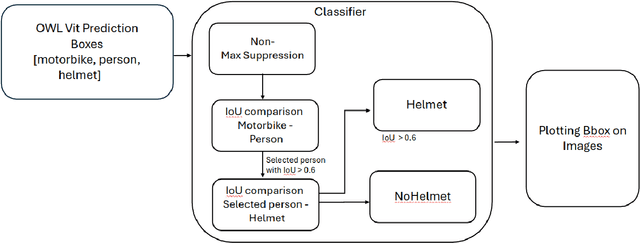
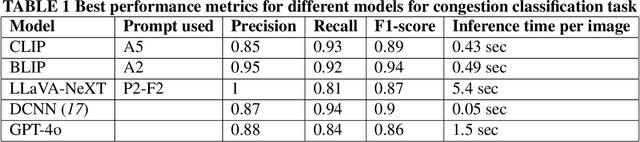
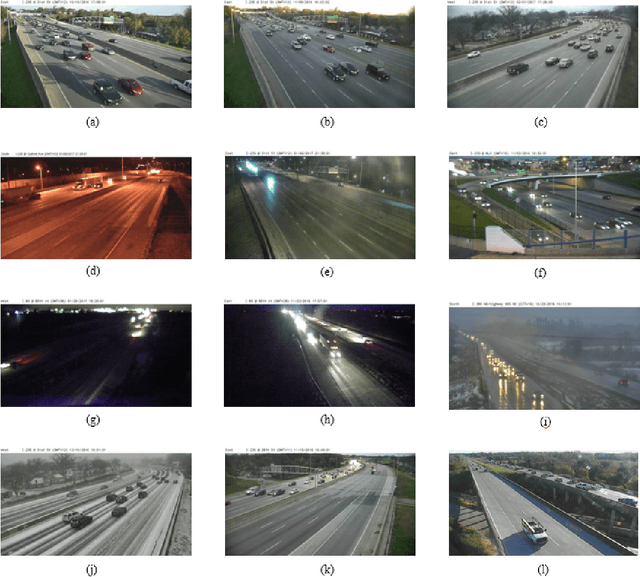
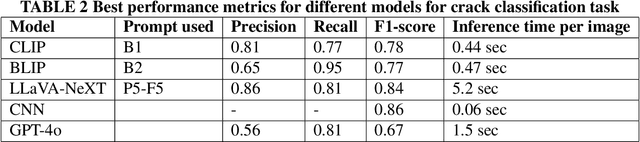
Recent developments in vision language models (VLM) have shown great potential for diverse applications related to image understanding. In this study, we have explored state-of-the-art VLM models for vision-based transportation engineering tasks such as image classification and object detection. The image classification task involves congestion detection and crack identification, whereas, for object detection, helmet violations were identified. We have applied open-source models such as CLIP, BLIP, OWL-ViT, Llava-Next, and closed-source GPT-4o to evaluate the performance of these state-of-the-art VLM models to harness the capabilities of language understanding for vision-based transportation tasks. These tasks were performed by applying zero-shot prompting to the VLM models, as zero-shot prompting involves performing tasks without any training on those tasks. It eliminates the need for annotated datasets or fine-tuning for specific tasks. Though these models gave comparative results with benchmark Convolutional Neural Networks (CNN) models in the image classification tasks, for object localization tasks, it still needs improvement. Therefore, this study provides a comprehensive evaluation of the state-of-the-art VLM models highlighting the advantages and limitations of the models, which can be taken as the baseline for future improvement and wide-scale implementation.