 Add to Chrome
 Add to Firefox
 Add to Edge
Reason Wide, Not Deep: Amortizing the Reasoning Premium into Distilled Skills
Aug 08, 2026
Reasoning modes of language models outperform their non-reasoning counterparts on multi-step agentic tasks, but pay a 3-6x premium in output tokens on every episode -- much of it spent re-deriving procedures that are shared across episodes of the same domain. We show this recurring cost can be amortized: a coding agent analyses a small corpus of existing trajectories from a training split and compiles a compact natural-language skill that is injected into the non-reasoning model's system prompt. Across four agentic benchmarks (ALFWorld, tau$^2$-bench telecom and retail, and SpreadsheetBench-Verified), skills recover 55%-100%+ of the reasoning gap for GPT-5.4-mini on held-out tasks -- exceeding the reasoning mode outright on two of four -- while emitting 2.7-6x fewer output tokens and zero reasoning tokens. Notably, reasoning traces are not a prerequisite: skills distilled from non-reasoning trajectories alone remain competitive with skills distilled from paired reasoning/non-reasoning corpora, with domain-dependent differences between the two sources. We interpret these results through a search lens: test-time reasoning is deep search inside a single episode, re-paid at every deployment, while corpus distillation is wide search across episodes, paid once. The two recover overlapping procedural knowledge, and width over cheap trajectories is often the better buy -- with the residual gap on some domains (telecom, SpreadsheetBench) delineating where genuinely per-instance deep search remains necessary.

Transforming NLU with Babylon: A Case Study in Development of Real-time, Edge-Efficient, Multi-Intent Translation System for Automated Drive-Thru Ordering
Nov 22, 2024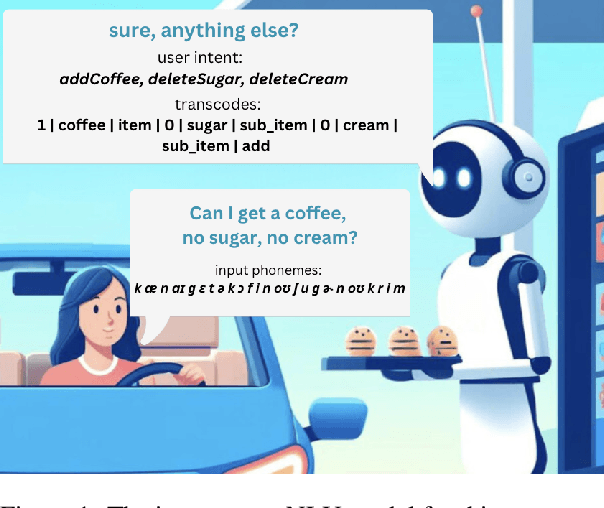
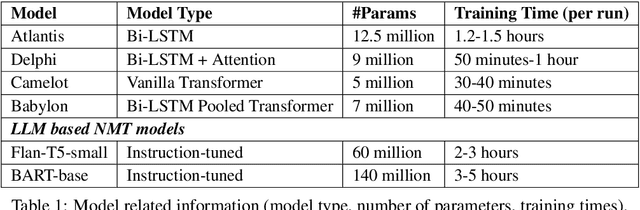
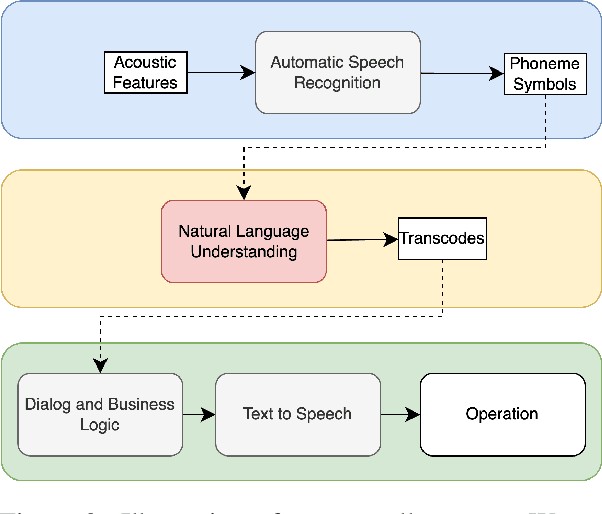
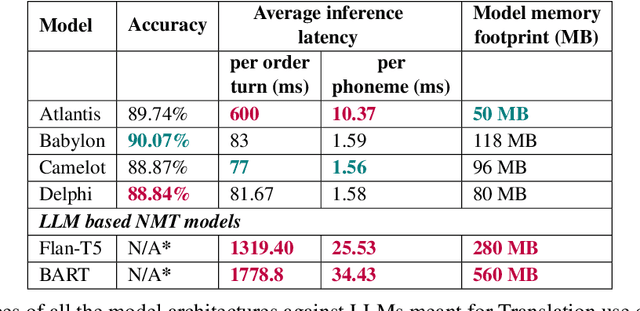
Real-time conversational AI agents face challenges in performing Natural Language Understanding (NLU) in dynamic, outdoor environments like automated drive-thru systems. These settings require NLU models to handle background noise, diverse accents, and multi-intent queries while operating under strict latency and memory constraints on edge devices. Additionally, robustness to errors from upstream Automatic Speech Recognition (ASR) is crucial, as ASR outputs in these environments are often noisy. We introduce Babylon, a transformer-based architecture that tackles NLU as an intent translation task, converting natural language inputs into sequences of regular language units ('transcodes') that encode both intents and slot information. This formulation allows Babylon to manage multi-intent scenarios in a single dialogue turn. Furthermore, Babylon incorporates an LSTM-based token pooling mechanism to preprocess phoneme sequences, reducing input length and optimizing for low-latency, low-memory edge deployment. This also helps mitigate inaccuracies in ASR outputs, enhancing system robustness. While this work focuses on drive-thru ordering, Babylon's design extends to similar noise-prone scenarios, for e.g. ticketing kiosks. Our experiments show that Babylon achieves significantly better accuracy-latency-memory footprint trade-offs over typically employed NMT models like Flan-T5 and BART, demonstrating its effectiveness for real-time NLU in edge deployment settings.