 Add to Chrome
 Add to Firefox
 Add to Edge
Multi-Tag Collision Recovery in UHF-RFID Using Self-Attention Decoding
Aug 17, 2026
Passive ultra high frequency (UHF) radio frequency identification (RFID) enables battery-free tags to communicate with a reader through backscatter. When multiple tags respond in the same time slot, their waveforms overlap at the reader, and a conventional reader that follows framed slotted ALOHA (FSA) discards the resulting collided slot. This limits the throughput of the overall protocol even though the received signal still contains recoverable information about the responding tags. To address this limitation, we propose Self-Attention Tag Recovery (SATR), a transformer-based decoding algorithm that operates directly on the baseband in-phase and quadrature (I/Q) samples received during a standard tag response. SATR uses self-attention to model the temporal structure of the modulated waveform and learns candidate tag representations. It jointly estimates the number of responding tags and, more importantly, decodes the bit sequence of each detected tag. We numerically evaluate the decoding and throughput performance of SATR over a range of collision sizes and recovery configurations, and validate it with measurements of commercial UHF-RFID tags. The results show that, with proper design and training, SATR can reliably decode collisions of up to four tags. It achieves a throughput of approximately $0.815$ tags per slot under single acknowledgment and $1.87$ tags per slot under full recovery, corresponding to $2.2$ and $5.1$ times the conventional FSA limit of $1/e \approx 0.368$ tags per slot, while approaching optimal decoding performance and outperforming existing collision recovery methods.

Cost-Aware Neural Early Stopping for Local Constraint OSD Decoders
Mar 20, 2026Local constraint ordered statistics decoding (LC-OSD) provides strong soft decision performance for short block length linear codes, but its practical cost is dominated by the number of tested error patterns (TEPs). This paper proposes a neural early stopping (NES) protocol for LC-OSD with explicit cost control through one trade-off parameter balancing frame error risk and search effort. The proposed approach is trained with frame error rate (FER)-aligned supervision at predefined checkpoints, and learns if additional search is still likely to improve the current best candidate. Later, stopping is decided by comparing predicted continuation need with a cost measured in TEPs. Experimental results across multiple code families show that the proposed protocol significantly reduces average TEP count with only marginal FER degradation, using a single global model for the range of all operating signal-to-noise ratios (SNRs).
Deep Reinforcement Learning-Aided Strategies for Big Data Offloading in Vehicular Networks
Dec 19, 2025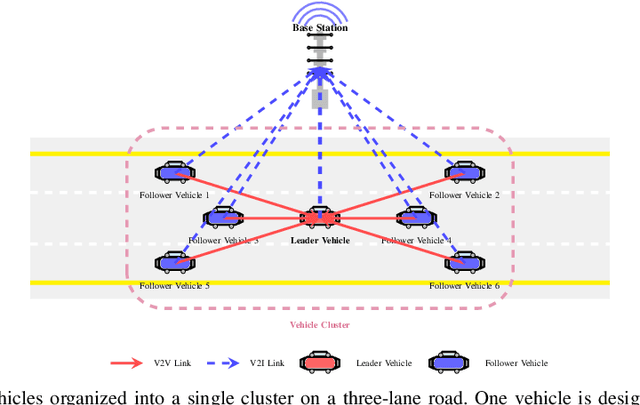
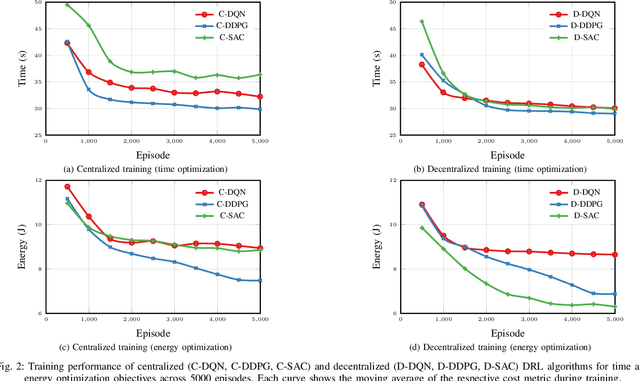
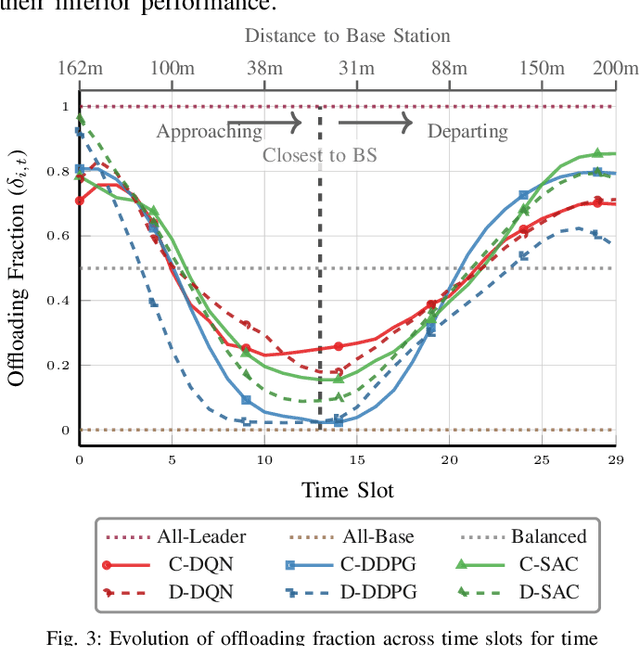

We consider vehicular networking scenarios where existing vehicle-to-vehicle (V2V) links can be leveraged for an effective uploading of large-size data to the network. In particular, we consider a group of vehicles where one vehicle can be designated as the \textit{leader} and other \textit{follower} vehicles can offload their data to the leader vehicle or directly upload it to the base station (or a combination of the two). In our proposed framework, the leader vehicle is responsible for receiving the data from other vehicles and processing it in order to remove the redundancy (deduplication) before uploading it to the base station. We present a mathematical framework of the considered network and formulate two separate optimization problems for minimizing (i) total time and (ii) total energy consumption by vehicles for uploading their data to the base station. We employ deep reinforcement learning (DRL) tools to obtain solutions in a dynamic vehicular network where network parameters (e.g., vehicle locations and channel coefficients) vary over time. Our results demonstrate that the application of DRL is highly beneficial, and data offloading with deduplication can significantly reduce the time and energy consumption. Furthermore, we present comprehensive numerical results to validate our findings and compare them with alternative approaches to show the benefits of the proposed DRL methods.
Deep Learning-Enabled Multi-Tag Detection in Ambient Backscatter Communications
Dec 18, 2025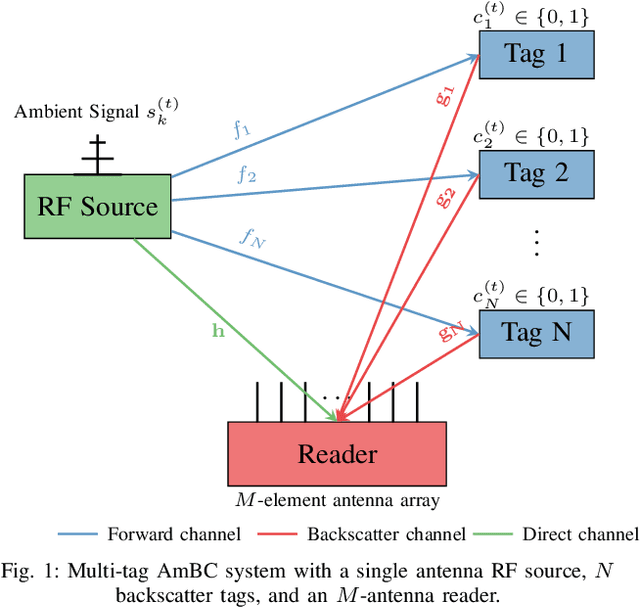
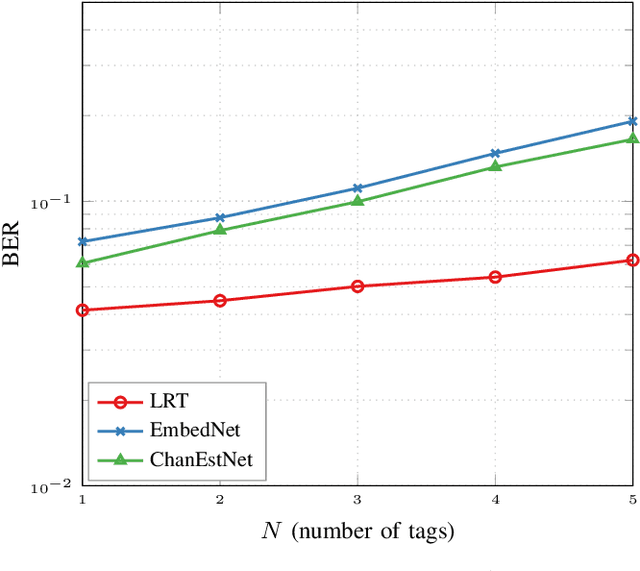
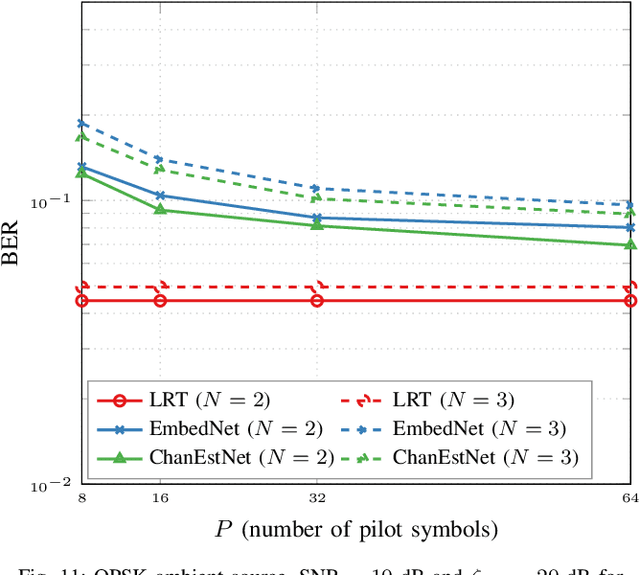
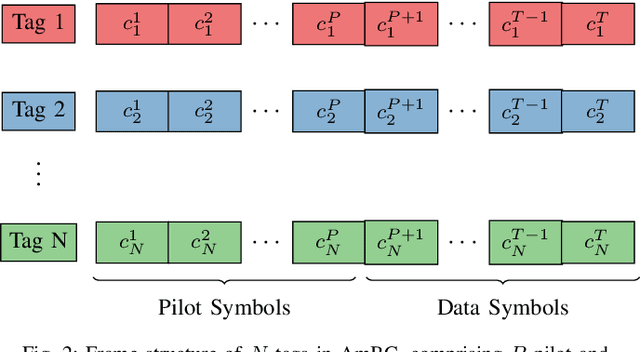
Ambient backscatter communication (AmBC) enables battery-free connectivity by letting passive tags modulate existing RF signals, but reliable detection of multiple tags is challenging due to strong direct link interference, very weak backscatter signals, and an exponentially large joint state space. Classical multi-hypothesis likelihood ratio tests (LRTs) are optimal for this task when perfect channel state information (CSI) is available, yet in AmBC such CSI is difficult to obtain and track because the RF source is uncooperative and the tags are low-power passive devices. We first derive analytical performance bounds for an LRT receiver with perfect CSI to serve as a benchmark. We then propose two complementary deep learning frameworks that relax the CSI requirement while remaining modulation-agnostic. EmbedNet is an end-to-end prototypical network that maps covariance features of the received signal directly to multi-tag states. ChanEstNet is a hybrid scheme in which a convolutional neural network estimates effective channel coefficients from pilot symbols and passes them to a conventional LRT for interpretable multi-hypothesis detection. Simulations over diverse ambient sources and system configurations show that the proposed methods substantially reduce bit error rate, closely track the LRT benchmark, and significantly outperform energy detection baselines, especially as the number of tags increases.