 Add to Chrome
 Add to Firefox
 Add to Edge
Deep Learning-Enabled Multi-Tag Detection in Ambient Backscatter Communications
Paper and Code
Dec 18, 2025
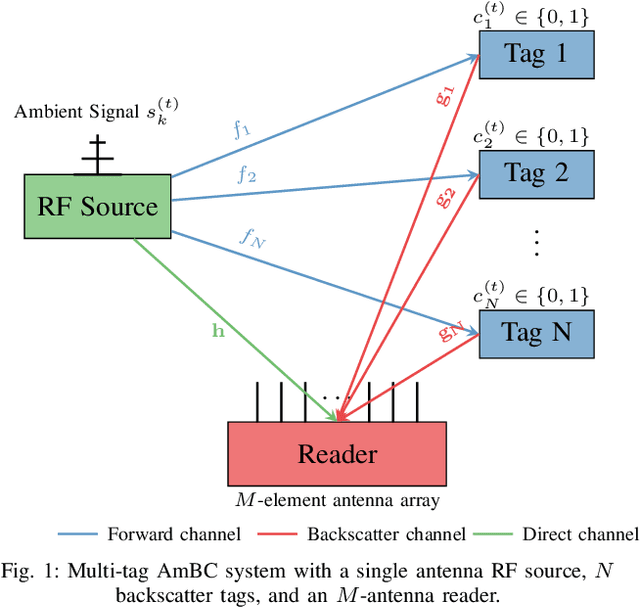
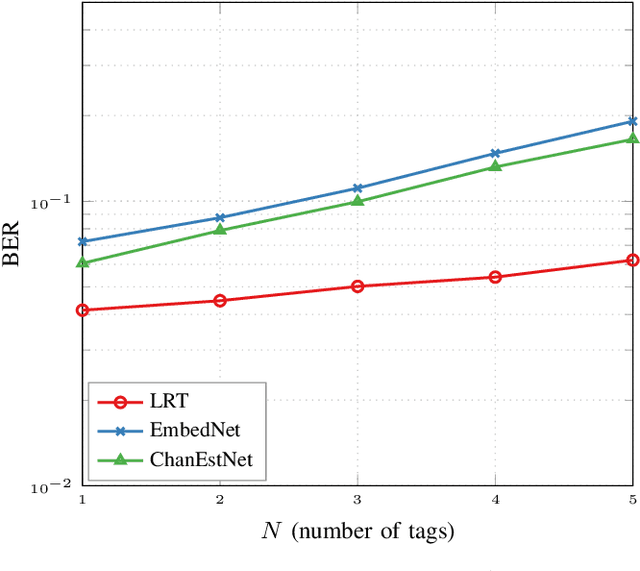
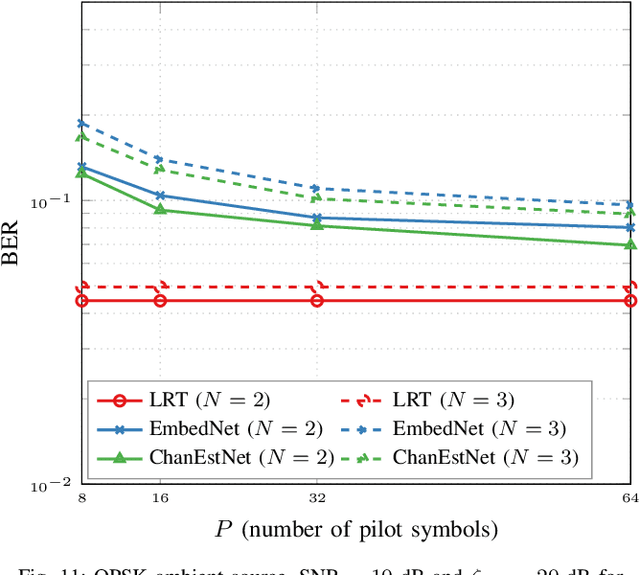
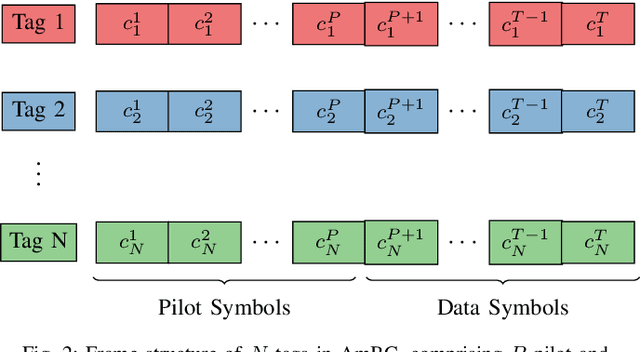
Ambient backscatter communication (AmBC) enables battery-free connectivity by letting passive tags modulate existing RF signals, but reliable detection of multiple tags is challenging due to strong direct link interference, very weak backscatter signals, and an exponentially large joint state space. Classical multi-hypothesis likelihood ratio tests (LRTs) are optimal for this task when perfect channel state information (CSI) is available, yet in AmBC such CSI is difficult to obtain and track because the RF source is uncooperative and the tags are low-power passive devices. We first derive analytical performance bounds for an LRT receiver with perfect CSI to serve as a benchmark. We then propose two complementary deep learning frameworks that relax the CSI requirement while remaining modulation-agnostic. EmbedNet is an end-to-end prototypical network that maps covariance features of the received signal directly to multi-tag states. ChanEstNet is a hybrid scheme in which a convolutional neural network estimates effective channel coefficients from pilot symbols and passes them to a conventional LRT for interpretable multi-hypothesis detection. Simulations over diverse ambient sources and system configurations show that the proposed methods substantially reduce bit error rate, closely track the LRT benchmark, and significantly outperform energy detection baselines, especially as the number of tags increases.
