 Add to Chrome
 Add to Firefox
 Add to Edge
BBQ-to-Image: Numeric Bounding Box and Qolor Control in Large-Scale Text-to-Image Models
Feb 24, 2026
Text-to-image models have rapidly advanced in realism and controllability, with recent approaches leveraging long, detailed captions to support fine-grained generation. However, a fundamental parametric gap remains: existing models rely on descriptive language, whereas professional workflows require precise numeric control over object location, size, and color. In this work, we introduce BBQ, a large-scale text-to-image model that directly conditions on numeric bounding boxes and RGB triplets within a unified structured-text framework. We obtain precise spatial and chromatic control by training on captions enriched with parametric annotations, without architectural modifications or inference-time optimization. This also enables intuitive user interfaces such as object dragging and color pickers, replacing ambiguous iterative prompting with precise, familiar controls. Across comprehensive evaluations, BBQ achieves strong box alignment and improves RGB color fidelity over state-of-the-art baselines. More broadly, our results support a new paradigm in which user intent is translated into an intermediate structured language, consumed by a flow-based transformer acting as a renderer and naturally accommodating numeric parameters.

Generating an Image From 1,000 Words: Enhancing Text-to-Image With Structured Captions
Nov 10, 2025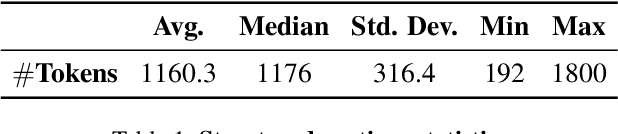
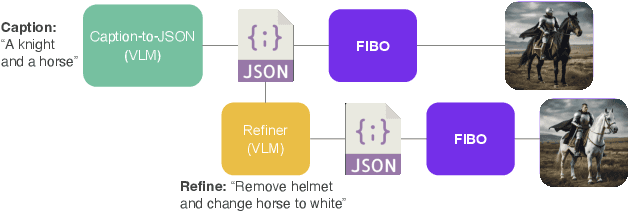

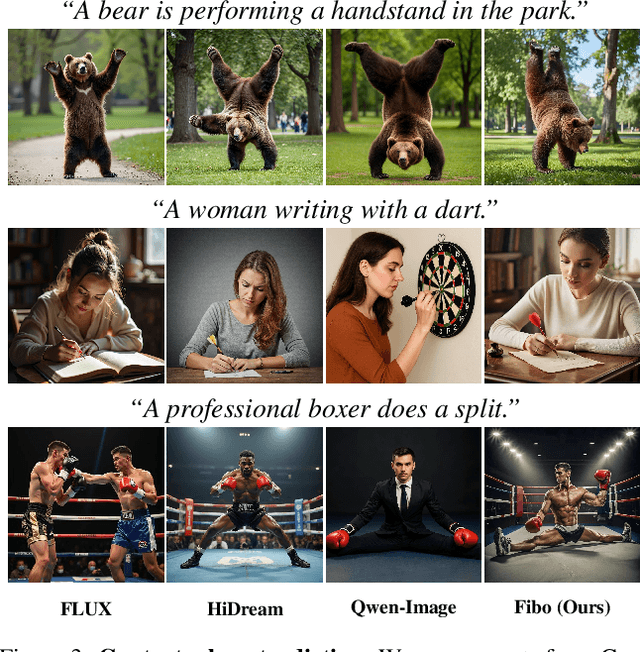
Text-to-image models have rapidly evolved from casual creative tools to professional-grade systems, achieving unprecedented levels of image quality and realism. Yet, most models are trained to map short prompts into detailed images, creating a gap between sparse textual input and rich visual outputs. This mismatch reduces controllability, as models often fill in missing details arbitrarily, biasing toward average user preferences and limiting precision for professional use. We address this limitation by training the first open-source text-to-image model on long structured captions, where every training sample is annotated with the same set of fine-grained attributes. This design maximizes expressive coverage and enables disentangled control over visual factors. To process long captions efficiently, we propose DimFusion, a fusion mechanism that integrates intermediate tokens from a lightweight LLM without increasing token length. We also introduce the Text-as-a-Bottleneck Reconstruction (TaBR) evaluation protocol. By assessing how well real images can be reconstructed through a captioning-generation loop, TaBR directly measures controllability and expressiveness, even for very long captions where existing evaluation methods fail. Finally, we demonstrate our contributions by training the large-scale model FIBO, achieving state-of-the-art prompt alignment among open-source models. Model weights are publicly available at https://huggingface.co/briaai/FIBO