 Add to Chrome
 Add to Firefox
 Add to Edge
What Do Language Priors Contribute to Darcy-Flow Inversion? A Mechanistic Audit
Jun 23, 2026
In ill-posed inverse problems, the recovered solution depends as much on the prior as on the data, yet much of the engineering knowledge that could serve as that prior is recorded qualitatively rather than in formal mathematical form. Here we test whether sentence embeddings can act as an inference-time interface for injecting geological descriptions into a learned Darcy-flow inverse solver. Across six synthetic geological classes and an exploratory transfer to a benchmark reservoir model (SPE10), we vary only the conditioning representation and find that text conditioning reduces reconstruction error by 81 % relative to a no-text counterfactual. Most of this gain comes from a categorical, class-level constraint whose value concentrates where the hydraulic head leaves the conductivity field underdetermined, while within-class geometric detail is secondary and pattern-dependent. Compared with a discrete class label, sentence embeddings add little dense-observation accuracy but improve training stability and enable paraphrase-based sensitivity analysis and open-vocabulary inputs. These results show that language priors can serve as an engineering-informatics interface for injecting geological knowledge into learned inverse solvers, while clarifying when they help and what signal they actually carry.

TabPFN Extensions for Interpretable Geotechnical Modelling
Mar 22, 2026Geotechnical site characterisation relies on sparse, heterogeneous borehole data where uncertainty quantification and model interpretability are as critical as predictive accuracy for reliable engineering decisions. This paper presents an exploratory investigation into the use of TabPFN, a transformer-based tabular foundation model using in-context learning, and its extension library tabpfn-extensions for two geotechnical inference tasks: (1) soil-type classification using N-value and shear-wave velocity data from a synthetic geotechnical dataset, and (2) iterative imputation of five missing mechanical parameters ($s_\mathrm{u}$, $E_{\mathrm{u}}$, ${σ'}_\mathrm{p}$, $C_\mathrm{c}$, $C_\mathrm{v}$) in benchmark problem BM/AirportSoilProperties/2/2025. We apply cosine-similarity analysis to TabPFN-derived embeddings, visualise full posterior distributions from an iterative inference procedure, and compute SHAP-based feature importance, all without model retraining. Learned embeddings clearly separate Clay and Sand samples without explicit soil-type supervision; iterative imputation improves predictions for four of five target parameters, with posterior widths that reflect physically reasonable parameter-specific uncertainty; and SHAP analysis reveals the inter-parameter dependency structure, recovering established geotechnical relationships including the Skempton compression index correlation and the inverse dependence of preconsolidation pressure on water content. These results suggest the potential of foundation-model-based tools to support interpretable, uncertainty-aware parameter inference in data-scarce geotechnical practice.
Future-proofing geotechnics workflows: accelerating problem-solving with large language models
Dec 14, 2023


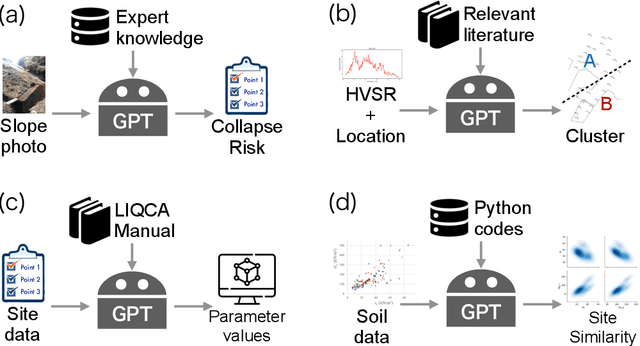
The integration of Large Language Models (LLMs) like ChatGPT into the workflows of geotechnical engineering has a high potential to transform how the discipline approaches problem-solving and decision-making. This paper delves into the innovative application of LLMs in geotechnical engineering, as explored in a hands-on workshop held in Tokyo, Japan. The event brought together a diverse group of 20 participants, including students, researchers, and professionals from academia, industry, and government sectors, to investigate practical uses of LLMs in addressing specific geotechnical challenges. The workshop facilitated the creation of solutions for four different practical geotechnical problems as illustrative examples, culminating in the development of an academic paper. The paper discusses the potential of LLMs to transform geotechnical engineering practices, highlighting their proficiency in handling a range of tasks from basic data analysis to complex, multimodal problem-solving. It also addresses the challenges in implementing LLMs, particularly in achieving high precision and accuracy in specialized tasks, and underscores the need for expert oversight. The findings demonstrate LLMs' effectiveness in enhancing efficiency, data processing, and decision-making in geotechnical engineering, suggesting a paradigm shift towards more integrated, data-driven approaches in this field. This study not only showcases the potential of LLMs in a specific engineering domain, but also sets a precedent for their broader application in interdisciplinary research and practice, where the synergy of human expertise and artificial intelligence redefines the boundaries of problem-solving.