 Add to Chrome
 Add to Firefox
 Add to Edge
On the Structure of Address in Multi-Party Dialogue: From Discrete Labels to Continuous Levels
Jul 17, 2026
In multi-party dialogues between a dialogue system and multiple users, identifying to whom an utterance is addressed is a key challenge. Prior work has typically treated addressee detection as a multi-class classification task, selecting a single label representing an individual participant or the group. This formulation assumes that address is inherently discrete and has primarily been used for predicting turn-taking. In this paper, we revisit this assumption by analyzing address as a continuous phenomenon. Using a multi-party human dialogue corpus annotated by multiple annotators, we construct both binary address labels derived from majority-vote addressee labels and continuous address levels inferred from annotator judgments using a latent-variable model. We then examine how these representations relate to turn-taking as well as listener behaviors, including gaze and backchannels. Our results show that, in addition to turn-taking, both gaze and backchannels are associated with address. Furthermore, models using continuous address levels achieve better predictive fit than those using discrete labels, suggesting that address may exhibit graded structure. Finally, we discuss the future directions of addressee detection research based on the findings of this study.

Multilingual and Continuous Backchannel Prediction: A Cross-lingual Study
Dec 16, 2025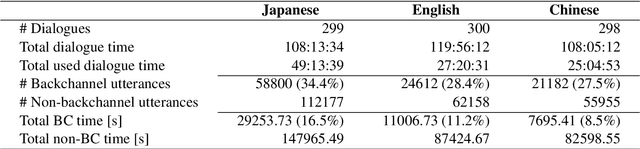
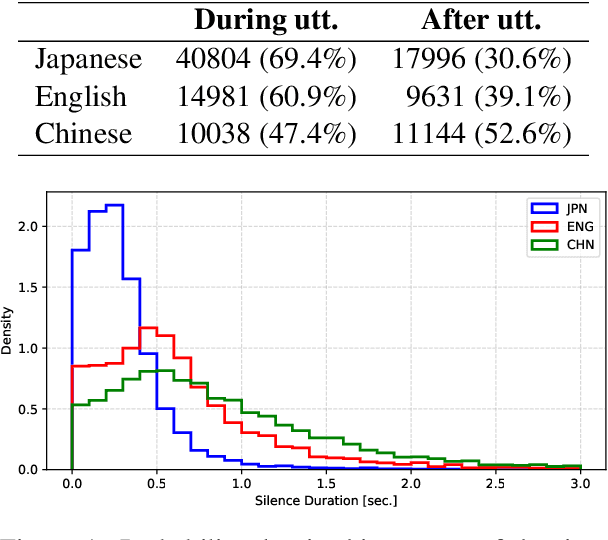
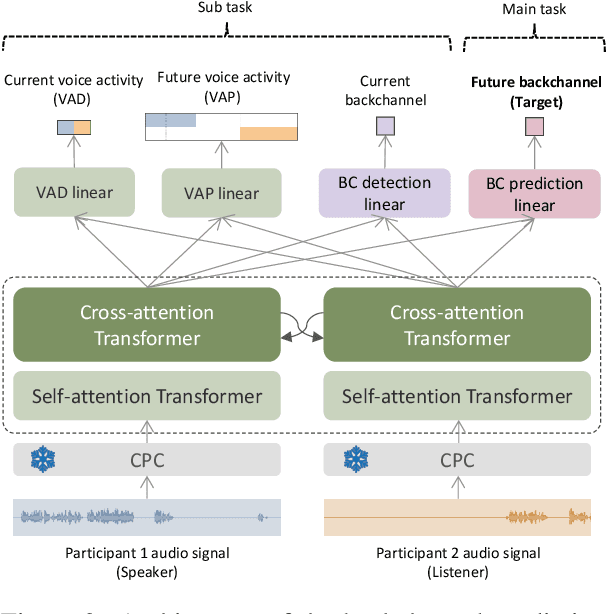
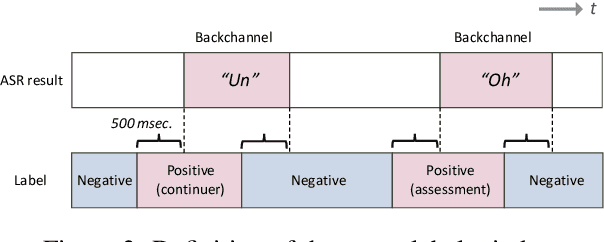
We present a multilingual, continuous backchannel prediction model for Japanese, English, and Chinese, and use it to investigate cross-linguistic timing behavior. The model is Transformer-based and operates at the frame level, jointly trained with auxiliary tasks on approximately 300 hours of dyadic conversations. Across all three languages, the multilingual model matches or surpasses monolingual baselines, indicating that it learns both language-universal cues and language-specific timing patterns. Zero-shot transfer with two-language training remains limited, underscoring substantive cross-lingual differences. Perturbation analyses reveal distinct cue usage: Japanese relies more on short-term linguistic information, whereas English and Chinese are more sensitive to silence duration and prosodic variation; multilingual training encourages shared yet adaptable representations and reduces overreliance on pitch in Chinese. A context-length study further shows that Japanese is relatively robust to shorter contexts, while Chinese benefits markedly from longer contexts. Finally, we integrate the trained model into a real-time processing software, demonstrating CPU-only inference. Together, these findings provide a unified model and empirical evidence for how backchannel timing differs across languages, informing the design of more natural, culturally-aware spoken dialogue systems.
Towards Harnessing Large Language Models for Comprehension of Conversational Grounding
Jun 03, 2024Conversational grounding is a collaborative mechanism for establishing mutual knowledge among participants engaged in a dialogue. This experimental study analyzes information-seeking conversations to investigate the capabilities of large language models in classifying dialogue turns related to explicit or implicit grounding and predicting grounded knowledge elements. Our experimental results reveal challenges encountered by large language models in the two tasks and discuss ongoing research efforts to enhance large language model-based conversational grounding comprehension through pipeline architectures and knowledge bases. These initiatives aim to develop more effective dialogue systems that are better equipped to handle the intricacies of grounded knowledge in conversations.