 Add to Chrome
 Add to Firefox
 Add to Edge
Revolutionizing Long-Term Memory in AI: New Horizons with High-Capacity and High-Speed Storage
Feb 18, 2026
Driven by our mission of "uplifting the world with memory," this paper explores the design concept of "memory" that is essential for achieving artificial superintelligence (ASI). Rather than proposing novel methods, we focus on several alternative approaches whose potential benefits are widely imaginable, yet have remained largely unexplored. The currently dominant paradigm, which can be termed "extract then store," involves extracting information judged to be useful from experiences and saving only the extracted content. However, this approach inherently risks the loss of information, as some valuable knowledge particularly for different tasks may be discarded in the extraction process. In contrast, we emphasize the "store then on-demand extract" approach, which seeks to retain raw experiences and flexibly apply them to various tasks as needed, thus avoiding such information loss. In addition, we highlight two further approaches: discovering deeper insights from large collections of probabilistic experiences, and improving experience collection efficiency by sharing stored experiences. While these approaches seem intuitively effective, our simple experiments demonstrate that this is indeed the case. Finally, we discuss major challenges that have limited investigation into these promising directions and propose research topics to address them.

AiSAQ: All-in-Storage ANNS with Product Quantization for DRAM-free Information Retrieval
Apr 09, 2024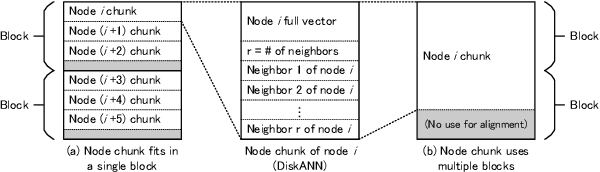
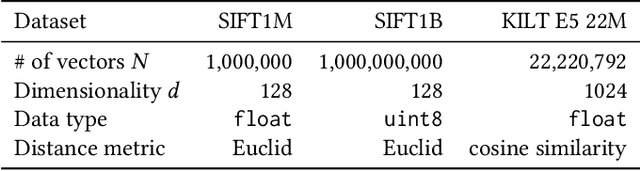
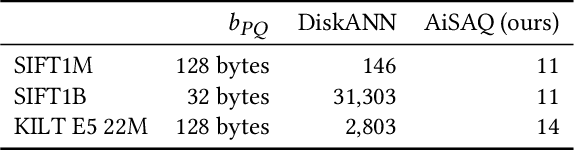

In approximate nearest neighbor search (ANNS) methods based on approximate proximity graphs, DiskANN achieves good recall-speed balance for large-scale datasets using both of RAM and storage. Despite it claims to save memory usage by loading compressed vectors by product quantization (PQ), its memory usage increases in proportion to the scale of datasets. In this paper, we propose All-in-Storage ANNS with Product Quantization (AiSAQ), which offloads the compressed vectors to storage. Our method achieves $\sim$10 MB memory usage in query search even with billion-scale datasets with minor performance degradation. AiSAQ also reduces the index load time before query search, which enables the index switch between muitiple billion-scale datasets and significantly enhances the flexibility of retrieval-augmented generation (RAG). This method is applicable to all graph-based ANNS algorithms and can be combined with higher-spec ANNS methods in the future.