 Add to Chrome
 Add to Firefox
 Add to Edge
Reference-Induced Consensus for Selective Posed-Reference Visual Localization
Jul 06, 2026
We present RIC-Loc (Reference-Induced Consensus localization), a scene-training-free posed-reference localizer that is SfM-point-map-free in its main estimator: it uses known reference poses, but not precomputed SfM 3D map points, query-to-map 2D-3D matches, or query-to-map PnP. A frozen VGGT pass predicts local camera poses, depth, and query-reference tracks for a query and selected references. Each reference induces one map-frame SE(3) query-pose hypothesis, robust consensus estimates the pose, and the preserved hypothesis structure yields two reliability scores: spatial dispersion and a track-conditioned covariance score. On the covariance-eligible set, the two scores are complementary for held-out, ground-truth-free failure detection across indoor, outdoor, and large-scale low-texture benchmarks: the joint policy is strongest in textured scenes and the covariance score in the low-texture regime, and the hypothesis-derived scores consistently outperform the standard retrieval-score gap and random rankings. Without per-scene training the consensus estimator remains accurate -- competitive with structure-based localization indoors and improving over a comparable feed-forward baseline -- giving an effective selective operating regime for posed-reference localization. Code is available at https://github.com/SNU-DLLAB/ric_loc.

Sequential Testing for Descriptor-Agnostic LiDAR Loop Closure in Repetitive Environments
Dec 10, 2025We propose a descriptor-agnostic, multi-frame loop closure verification method that formulates LiDAR loop closure as a truncated Sequential Probability Ratio Test (SPRT). Instead of deciding from a single descriptor comparison or using fixed thresholds with late-stage Iterative Closest Point (ICP) vetting, the verifier accumulates a short temporal stream of descriptor similarities between a query and each candidate. It then issues an accept/reject decision adaptively once sufficient multi-frame evidence has been observed, according to user-specified Type-I/II error design targets. This precision-first policy is designed to suppress false positives in structurally repetitive indoor environments. We evaluate the verifier on a five-sequence library dataset, using a fixed retrieval front-end with several representative LiDAR global descriptors. Performance is assessed via segment-level K-hit precision-recall and absolute trajectory error (ATE) and relative pose error (RPE) after pose graph optimization. Across descriptors, the sequential verifier consistently improves precision and reduces the impact of aliased loops compared with single-frame and heuristic multi-frame baselines. Our implementation and dataset will be released at: https://github.com/wanderingcar/snu_library_dataset.
GraphCompliance: Aligning Policy and Context Graphs for LLM-Based Regulatory Compliance
Oct 30, 2025Compliance at web scale poses practical challenges: each request may require a regulatory assessment. Regulatory texts (e.g., the General Data Protection Regulation, GDPR) are cross-referential and normative, while runtime contexts are expressed in unstructured natural language. This setting motivates us to align semantic information in unstructured text with the structured, normative elements of regulations. To this end, we introduce GraphCompliance, a framework that represents regulatory texts as a Policy Graph and runtime contexts as a Context Graph, and aligns them. In this formulation, the policy graph encodes normative structure and cross-references, whereas the context graph formalizes events as subject-action-object (SAO) and entity-relation triples. This alignment anchors the reasoning of a judge large language model (LLM) in structured information and helps reduce the burden of regulatory interpretation and event parsing, enabling a focus on the core reasoning step. In experiments on 300 GDPR-derived real-world scenarios spanning five evaluation tasks, GraphCompliance yields 4.1-7.2 percentage points (pp) higher micro-F1 than LLM-only and RAG baselines, with fewer under- and over-predictions, resulting in higher recall and lower false positive rates. Ablation studies indicate contributions from each graph component, suggesting that structured representations and a judge LLM are complementary for normative reasoning.
Statistical Uncertainty Learning for Robust Visual-Inertial State Estimation
Oct 02, 2025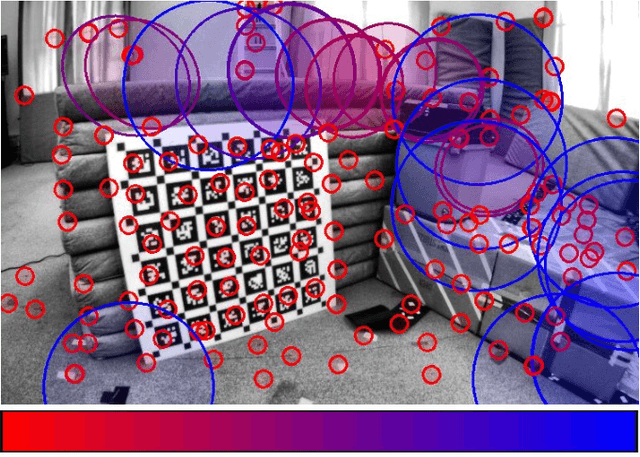
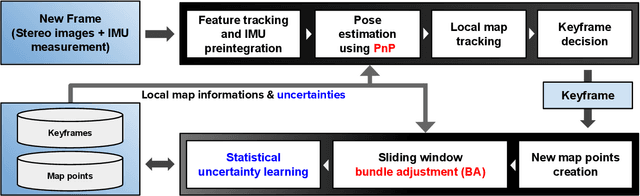
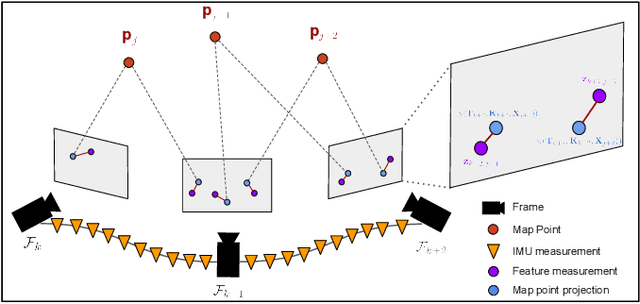
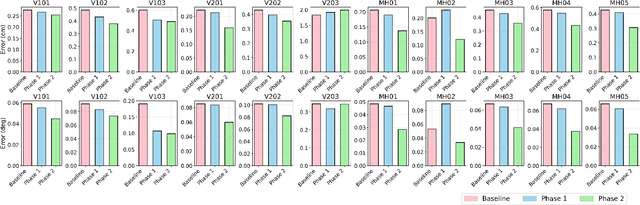
A fundamental challenge in robust visual-inertial odometry (VIO) is to dynamically assess the reliability of sensor measurements. This assessment is crucial for properly weighting the contribution of each measurement to the state estimate. Conventional methods often simplify this by assuming a static, uniform uncertainty for all measurements. This heuristic, however, may be limited in its ability to capture the dynamic error characteristics inherent in real-world data. To improve this limitation, we present a statistical framework that learns measurement reliability assessment online, directly from sensor data and optimization results. Our approach leverages multi-view geometric consistency as a form of self-supervision. This enables the system to infer landmark uncertainty and adaptively weight visual measurements during optimization. We evaluated our method on the public EuRoC dataset, demonstrating improvements in tracking accuracy with average reductions of approximately 24\% in translation error and 42\% in rotation error compared to baseline methods with fixed uncertainty parameters. The resulting framework operates in real time while showing enhanced accuracy and robustness. To facilitate reproducibility and encourage further research, the source code will be made publicly available.