 Add to Chrome
 Add to Firefox
 Add to Edge
UHDRes: Ultra-High-Definition Image Restoration via Dual-Domain Decoupled Spectral Modulation
Nov 07, 2025
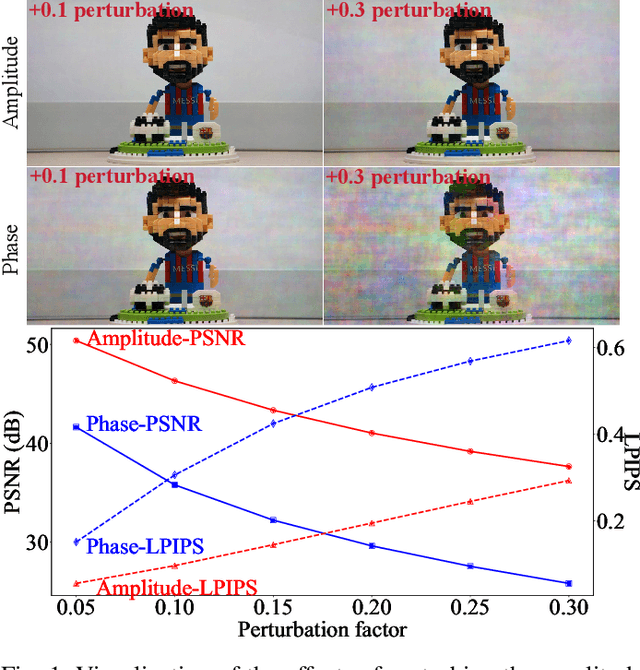



Ultra-high-definition (UHD) images often suffer from severe degradations such as blur, haze, rain, or low-light conditions, which pose significant challenges for image restoration due to their high resolution and computational demands. In this paper, we propose UHDRes, a novel lightweight dual-domain decoupled spectral modulation framework for UHD image restoration. It explicitly models the amplitude spectrum via lightweight spectrum-domain modulation, while restoring phase implicitly through spatial-domain refinement. We introduce the spatio-spectral fusion mechanism, which first employs a multi-scale context aggregator to extract local and global spatial features, and then performs spectral modulation in a decoupled manner. It explicitly enhances amplitude features in the frequency domain while implicitly restoring phase information through spatial refinement. Additionally, a shared gated feed-forward network is designed to efficiently promote feature interaction through shared-parameter convolutions and adaptive gating mechanisms. Extensive experimental comparisons on five public UHD benchmarks demonstrate that our UHDRes achieves the state-of-the-art restoration performance with only 400K parameters, while significantly reducing inference latency and memory usage. The codes and models are available at https://github.com/Zhao0100/UHDRes.

DeepSeek-V3 Technical Report
Dec 27, 2024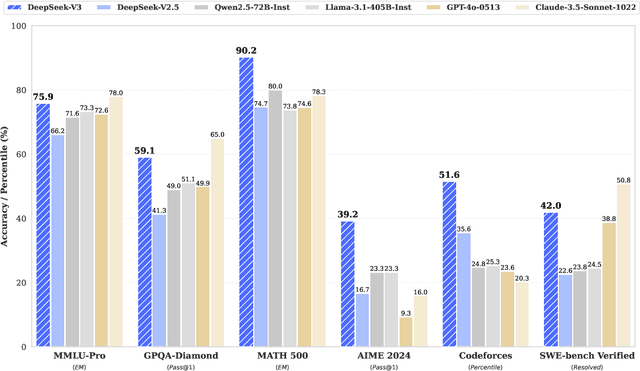


We present DeepSeek-V3, a strong Mixture-of-Experts (MoE) language model with 671B total parameters with 37B activated for each token. To achieve efficient inference and cost-effective training, DeepSeek-V3 adopts Multi-head Latent Attention (MLA) and DeepSeekMoE architectures, which were thoroughly validated in DeepSeek-V2. Furthermore, DeepSeek-V3 pioneers an auxiliary-loss-free strategy for load balancing and sets a multi-token prediction training objective for stronger performance. We pre-train DeepSeek-V3 on 14.8 trillion diverse and high-quality tokens, followed by Supervised Fine-Tuning and Reinforcement Learning stages to fully harness its capabilities. Comprehensive evaluations reveal that DeepSeek-V3 outperforms other open-source models and achieves performance comparable to leading closed-source models. Despite its excellent performance, DeepSeek-V3 requires only 2.788M H800 GPU hours for its full training. In addition, its training process is remarkably stable. Throughout the entire training process, we did not experience any irrecoverable loss spikes or perform any rollbacks. The model checkpoints are available at https://github.com/deepseek-ai/DeepSeek-V3.
AI-Assisted Detector Design for the EIC E)
May 28, 2024Artificial Intelligence is poised to transform the design of complex, large-scale detectors like the ePIC at the future Electron Ion Collider. Featuring a central detector with additional detecting systems in the far forward and far backward regions, the ePIC experiment incorporates numerous design parameters and objectives, including performance, physics reach, and cost, constrained by mechanical and geometric limits. This project aims to develop a scalable, distributed AI-assisted detector design for the EIC (AID(2)E), employing state-of-the-art multiobjective optimization to tackle complex designs. Supported by the ePIC software stack and using Geant4 simulations, our approach benefits from transparent parameterization and advanced AI features. The workflow leverages the PanDA and iDDS systems, used in major experiments such as ATLAS at CERN LHC, the Rubin Observatory, and sPHENIX at RHIC, to manage the compute intensive demands of ePIC detector simulations. Tailored enhancements to the PanDA system focus on usability, scalability, automation, and monitoring. Ultimately, this project aims to establish a robust design capability, apply a distributed AI-assisted workflow to the ePIC detector, and extend its applications to the design of the second detector (Detector-2) in the EIC, as well as to calibration and alignment tasks. Additionally, we are developing advanced data science tools to efficiently navigate the complex, multidimensional trade-offs identified through this optimization process.
Densifying MIMO: Channel Modeling, Physical Constraints, and Performance Evaluation for Holographic Communications
Dec 06, 2023As the backbone of the fifth-generation (5G) cellular network, massive multiple-input multiple-output (MIMO) encounters a significant challenge in practical applications: how to deploy a large number of antenna elements within limited spaces. Recently, holographic communication has emerged as a potential solution to this issue. It employs dense antenna arrays and provides a tractable model. Nevertheless, some challenges must be addressed to actualize this innovative concept. One is the mutual coupling among antenna elements within an array. When the element spacing is small, near-field coupling becomes the dominant factor that strongly restricts the array performance. Another is the polarization of electromagnetic waves. As an intrinsic property, it was not fully considered in the previous channel modeling of holographic communication. The third is the lack of real-world experiments to show the potential and possible defects of a holographic communication system. In this paper, we propose an electromagnetic channel model based on the characteristics of electromagnetic waves. This model encompasses the impact of mutual coupling in the transceiver sides and the depolarization in the propagation environment. Furthermore, by approximating an infinite array, the performance restrictions of large-scale dense antenna arrays are also studied theoretically to exploit the potential of the proposed channel. In addition, numerical simulations and a channel measurement experiment are conducted. The findings reveal that within limited spaces, the coupling effect, particularly for element spacing smaller than half of the wavelength, is the primary factor leading to the inflection point for the performance of holographic communications.