 Add to Chrome
 Add to Firefox
 Add to Edge
Respiratory Rate Estimation Based on WiFi Frame Capture
Aug 05, 2021
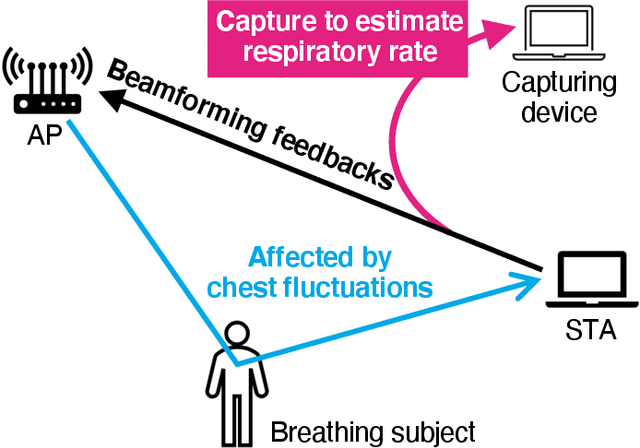
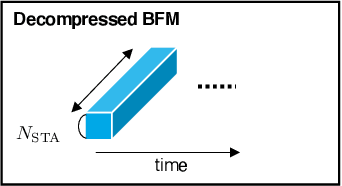
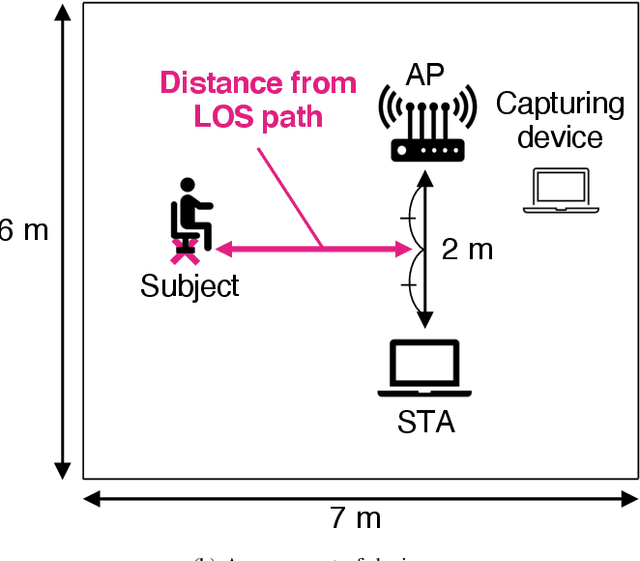
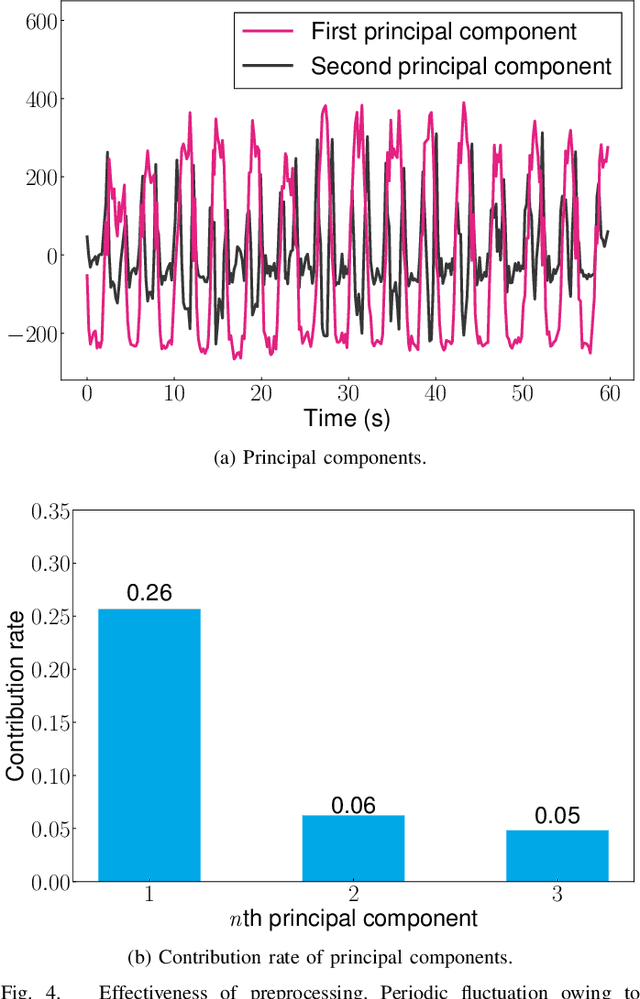
This paper presents a method that estimates the respiratory rate based on the frame capturing of wireless local area networks. The method uses beamforming feedback matrices (BFMs) contained in the captured frames, which is a rotation matrix of channel state information (CSI). BFMs are transmitted unencrypted and easily obtained using frame capturing, requiring no specific firmware or WiFi chipsets, unlike the methods that use CSI. Such properties of BFMs allow us to apply frame capturing to various sensing tasks, e.g., vital sensing. In the proposed method, principal component analysis is applied to BFMs to isolate the effect of the chest movement of the subject, and then, discrete Fourier transform is performed to extract respiratory rates in a frequency domain. Experimental evaluation results confirm that the frame-capture-based respiratory rate estimation can achieve estimation error lower than 3.2 breaths/minute.

Parameter Learning of Logic Programs for Symbolic-Statistical Modeling
Jun 09, 2011
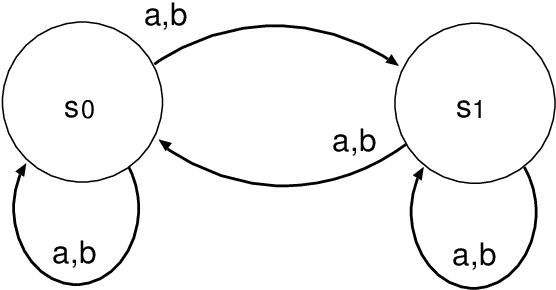
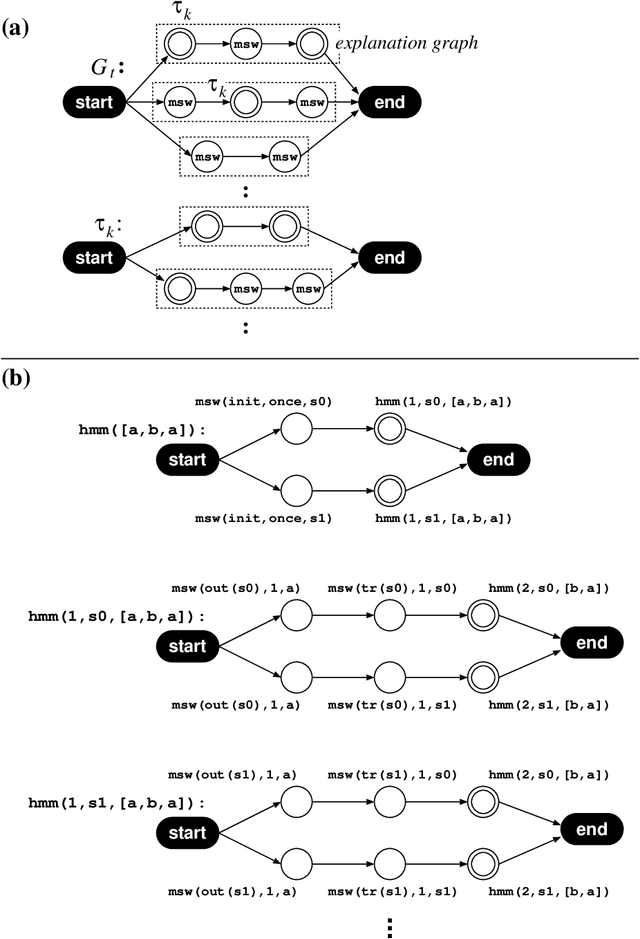
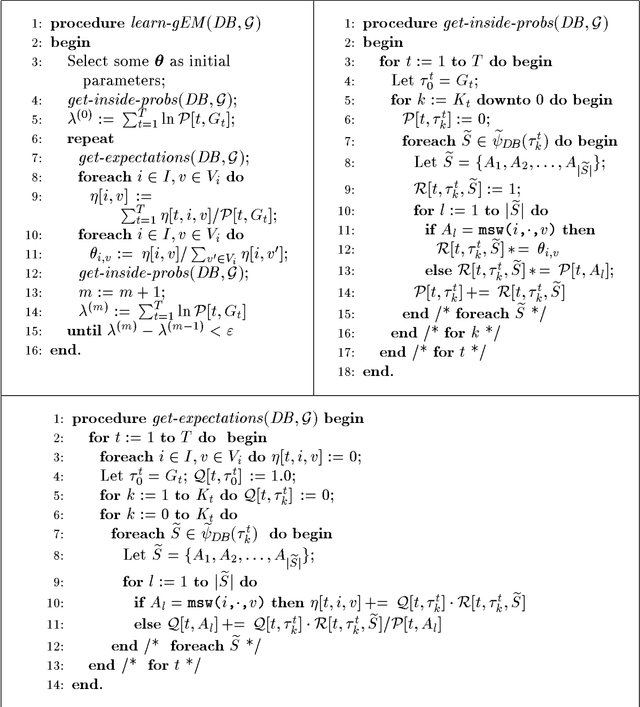
We propose a logical/mathematical framework for statistical parameter learning of parameterized logic programs, i.e. definite clause programs containing probabilistic facts with a parameterized distribution. It extends the traditional least Herbrand model semantics in logic programming to distribution semantics, possible world semantics with a probability distribution which is unconditionally applicable to arbitrary logic programs including ones for HMMs, PCFGs and Bayesian networks. We also propose a new EM algorithm, the graphical EM algorithm, that runs for a class of parameterized logic programs representing sequential decision processes where each decision is exclusive and independent. It runs on a new data structure called support graphs describing the logical relationship between observations and their explanations, and learns parameters by computing inside and outside probability generalized for logic programs. The complexity analysis shows that when combined with OLDT search for all explanations for observations, the graphical EM algorithm, despite its generality, has the same time complexity as existing EM algorithms, i.e. the Baum-Welch algorithm for HMMs, the Inside-Outside algorithm for PCFGs, and the one for singly connected Bayesian networks that have been developed independently in each research field. Learning experiments with PCFGs using two corpora of moderate size indicate that the graphical EM algorithm can significantly outperform the Inside-Outside algorithm.