 Add to Chrome
 Add to Firefox
 Add to Edge
Automated segmenta-on of pediatric neuroblastoma on multi-modal MRI: Results of the SPPIN challenge at MICCAI 2023
May 01, 2025
Surgery plays an important role within the treatment for neuroblastoma, a common pediatric cancer. This requires careful planning, often via magnetic resonance imaging (MRI)-based anatomical 3D models. However, creating these models is often time-consuming and user dependent. We organized the Surgical Planning in Pediatric Neuroblastoma (SPPIN) challenge, to stimulate developments on this topic, and set a benchmark for fully automatic segmentation of neuroblastoma on multi-model MRI. The challenge started with a training phase, where teams received 78 sets of MRI scans from 34 patients, consisting of both diagnostic and post-chemotherapy MRI scans. The final test phase, consisting of 18 MRI sets from 9 patients, determined the ranking of the teams. Ranking was based on the Dice similarity coefficient (Dice score), the 95th percentile of the Hausdorff distance (HD95) and the volumetric similarity (VS). The SPPIN challenge was hosted at MICCAI 2023. The final leaderboard consisted of 9 teams. The highest-ranking team achieved a median Dice score 0.82, a median HD95 of 7.69 mm and a VS of 0.91, utilizing a large, pretrained network called STU-Net. A significant difference for the segmentation results between diagnostic and post-chemotherapy MRI scans was observed (Dice = 0.89 vs Dice = 0.59, P = 0.01) for the highest-ranking team. SPPIN is the first medical segmentation challenge in extracranial pediatric oncology. The highest-ranking team used a large pre-trained network, suggesting that pretraining can be of use in small, heterogenous datasets. Although the results of the highest-ranking team were high for most patients, segmentation especially in small, pre-treated tumors were insufficient. Therefore, more reliable segmentation methods are needed to create clinically applicable models to aid surgical planning in pediatric neuroblastoma.

Bi-directional Beamforming Feedback-based Firmware-agnostic WiFi Sensing
Dec 13, 2021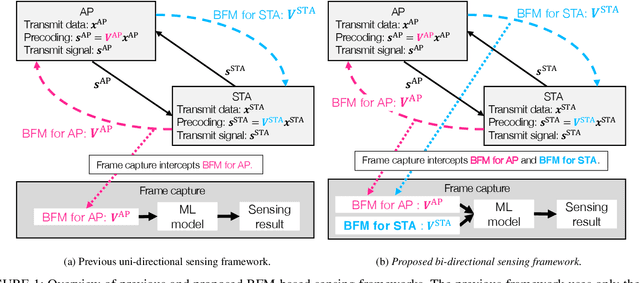
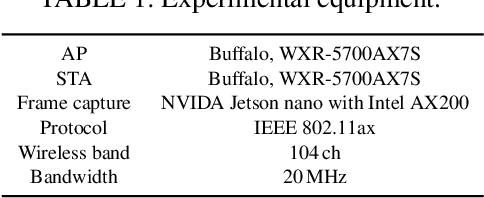
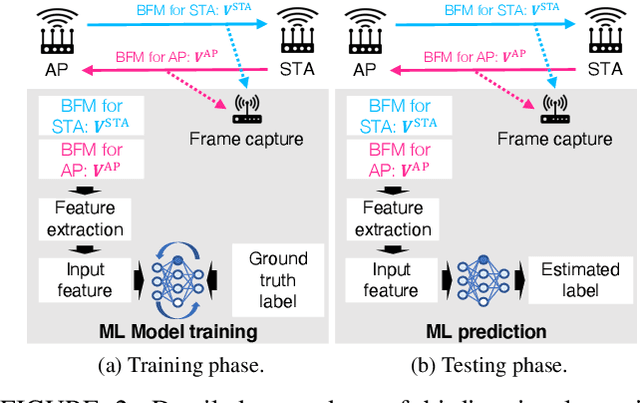
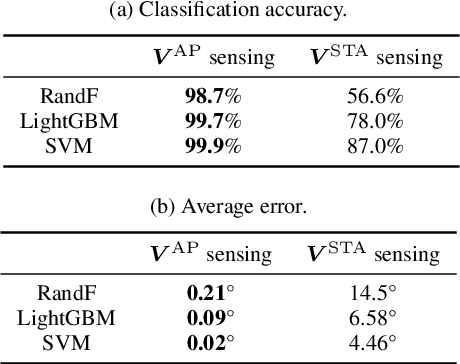
In the field of WiFi sensing, as an alternative sensing source of the channel state information (CSI) matrix, the use of a beamforming feedback matrix (BFM)that is a right singular matrix of the CSI matrix has attracted significant interest owing to its wide availability regarding the underlying WiFi systems. In the IEEE 802.11ac/ax standard, the station (STA) transmits a BFM to an access point (AP), which uses the BFM for precoded multiple-input and multiple-output communications. In addition, in the same way, the AP transmits a BFM to the STA, and the STA uses the received BFM. Regarding BFM-based sensing, extensive real-world experiments were conducted as part of this study, and two key insights were reported: Firstly, this report identified a potential issue related to accuracy in existing uni-directional BFM-based sensing frameworks that leverage only BFMs transmitted for the AP or STA. Such uni-directionality introduces accuracy concerns when there is a sensing capability gap between the uni-directional BFMs for the AP and STA. Thus, this report experimentally evaluates the sensing ability disparity between the uni-directional BFMs, and shows that the BFMs transmitted for an AP achieve higher sensing accuracy compared to the BFMs transmitted from the STA when the sensing target values are estimated depending on the angle of departure of the AP. Secondly, to complement the sensing gap, this paper proposes a bi-directional sensing framework, which simultaneously leverages the BFMs transmitted from the AP and STA. The experimental evaluations reveal that bi-directional sensing achieves higher accuracy than uni-directional sensing in terms of the human localization task.
Respiratory Rate Estimation Based on WiFi Frame Capture
Aug 05, 2021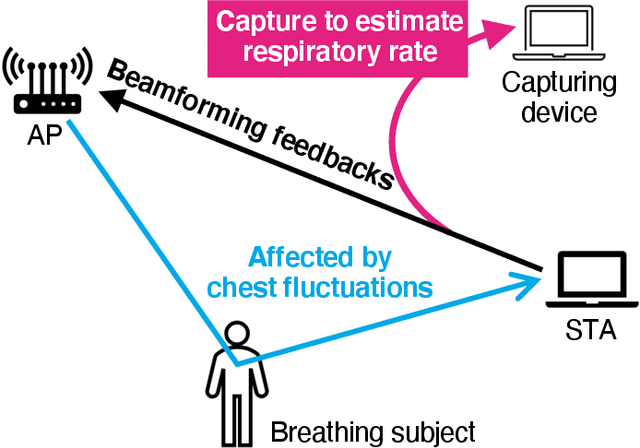
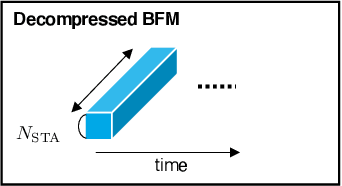
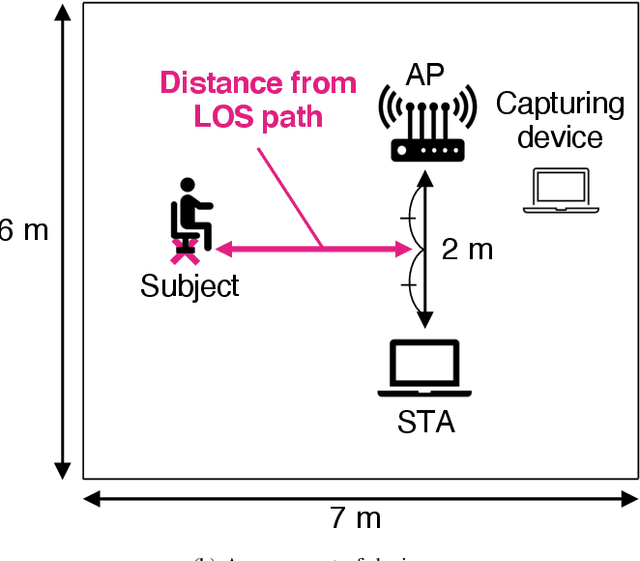
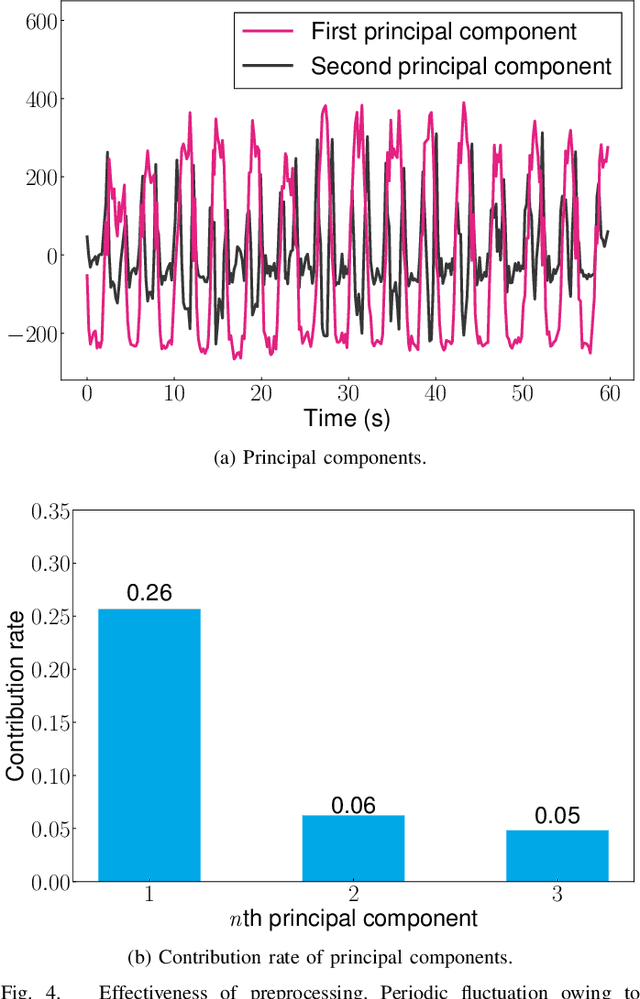
This paper presents a method that estimates the respiratory rate based on the frame capturing of wireless local area networks. The method uses beamforming feedback matrices (BFMs) contained in the captured frames, which is a rotation matrix of channel state information (CSI). BFMs are transmitted unencrypted and easily obtained using frame capturing, requiring no specific firmware or WiFi chipsets, unlike the methods that use CSI. Such properties of BFMs allow us to apply frame capturing to various sensing tasks, e.g., vital sensing. In the proposed method, principal component analysis is applied to BFMs to isolate the effect of the chest movement of the subject, and then, discrete Fourier transform is performed to extract respiratory rates in a frequency domain. Experimental evaluation results confirm that the frame-capture-based respiratory rate estimation can achieve estimation error lower than 3.2 breaths/minute.