 Add to Chrome
 Add to Firefox
 Add to Edge
FM4WiFi: Flow Matching for Multi-AP Coordination in Dense Deployments of Beyond Wi-Fi 8 Networks
Aug 04, 2026
Wi-Fi networks are moving beyond random channel access toward tightly coordinated operation across access points (APs), a shift reflected in Wi-Fi 8's multi-AP coordination (MAPC). However, the current MAPC specification restricts cooperation to AP pairs, fundamentally limiting the gains achievable in dense deployments and calling for scalable, network-wide coordination in beyond Wi-Fi 8 systems. We target coordinated spatial reuse (Co-SR), where APs transmit concurrently at reduced power. Effective Co-SR demands joint selection and configuration of AP-station transmissions, yet existing approaches simply do not scale: they rely on heavy signaling, slow convergence, unrealistic assumptions, and often require computation time that explodes with network size. We introduce FM4WiFi, a generative ML pipeline that addresses these limitations by producing high-quality Co-SR configurations in a single inference step. FM4WiFi integrates (i) an autoencoder that learns compact latent representations of network states, (ii) a flow-matching generative model that synthesizes feasible Co-SR configurations (including rate control, absent from prior work), and (iii) a surrogate rate predictor that allows rapid, large-scale Co-SR candidate evaluation without dependence on a live system or digital twin. Across extensive evaluations (including experimental validation), FM4WiFi matches or exceeds state-of-the-art baselines at medium-to-large scales and scales to 30+ APs with sub-second inference. Extensive ablation studies validate each modeling and optimization choice.

KISS: Keeping it Simple and Slotted when Learning to Communicate over Wireless
May 29, 2026A long-standing challenge in distributed wireless systems is ensuring efficient and fair random channel access. Existing solutions often address specific constraints related to timing, periodicity, or centralization, but they typically rely on fixed heuristics. Motivated by recent advances in machine learning (ML), we investigate whether ML agents can autonomously learn efficient and fair access strategies, and whether such learning can offer new insights into medium access control (MAC) design. Rather than proposing a deployable protocol, our aim is to examine whether decentralized learning can rediscover or approximate theoretically efficient random-access mechanisms under minimal assumptions. To this end, we deploy an off-policy Double Deep Q-Network (DDQN) with Bayesian inference to train agents operating over a slotted channel. The resulting method is fully online (no pre-training), fully distributed (independent multi-agent learners), stochastic (non-periodic), and requires no coordination or explicit communication. Extensive simulations show that the learned strategy adapts to varying network conditions and achieves near-theoretical efficiency while maintaining fairness. Ablation studies further reveal that the learned behavior resembles slotted ALOHA with a dynamically adjusted transmission probability, leading us to refer to the method as KISS: Keeping It Simple and Slotted.
Coordinated Multi-Armed Bandits for Improved Spatial Reuse in Wi-Fi
Dec 04, 2024


Multi-Access Point Coordination (MAPC) and Artificial Intelligence and Machine Learning (AI/ML) are expected to be key features in future Wi-Fi, such as the forthcoming IEEE 802.11bn (Wi-Fi 8) and beyond. In this paper, we explore a coordinated solution based on online learning to drive the optimization of Spatial Reuse (SR), a method that allows multiple devices to perform simultaneous transmissions by controlling interference through Packet Detect (PD) adjustment and transmit power control. In particular, we focus on a Multi-Agent Multi-Armed Bandit (MA-MAB) setting, where multiple decision-making agents concurrently configure SR parameters from coexisting networks by leveraging the MAPC framework, and study various algorithms and reward-sharing mechanisms. We evaluate different MA-MAB implementations using Komondor, a well-adopted Wi-Fi simulator, and demonstrate that AI-native SR enabled by coordinated MABs can improve the network performance over current Wi-Fi operation: mean throughput increases by 15%, fairness is improved by increasing the minimum throughput across the network by 210%, while the maximum access delay is kept below 3 ms.
Machine Learning & Wi-Fi: Unveiling the Path Towards AI/ML-Native IEEE 802.11 Networks
May 19, 2024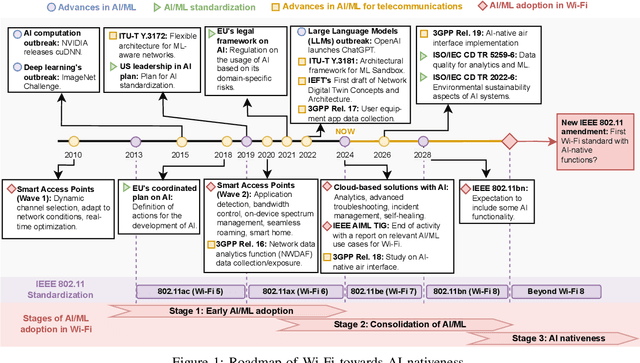

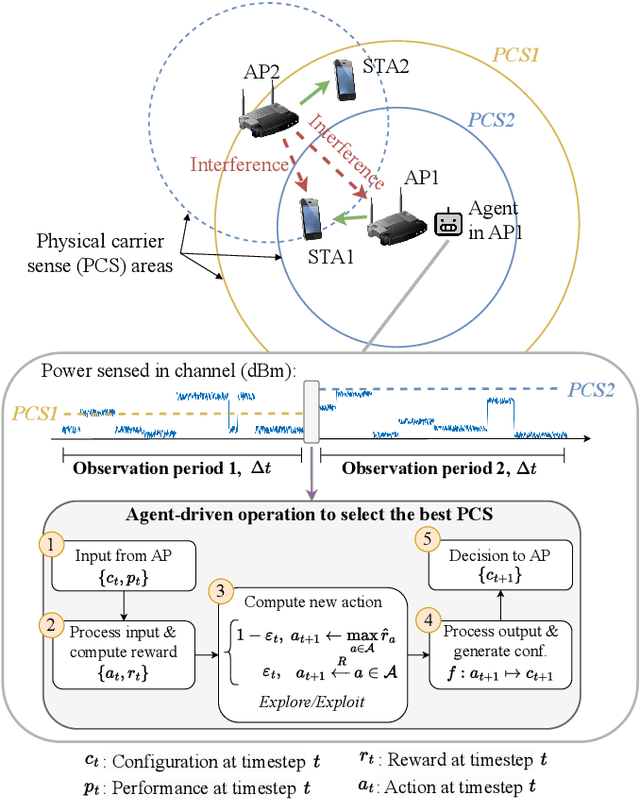
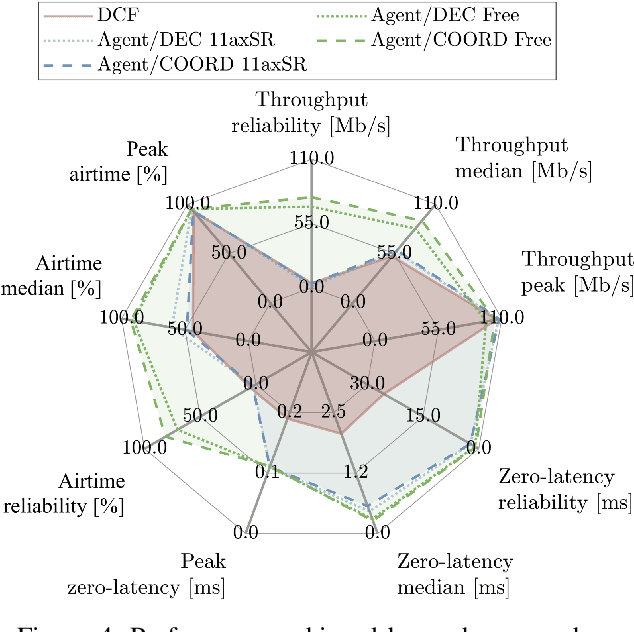
Artificial intelligence (AI) and machine learning (ML) are nowadays mature technologies considered essential for driving the evolution of future communications systems. Simultaneously, Wi-Fi technology has constantly evolved over the past three decades and incorporated new features generation after generation, thus gaining in complexity. As such, researchers have observed that AI/ML functionalities may be required to address the upcoming Wi-Fi challenges that will be otherwise difficult to solve with traditional approaches. This paper discusses the role of AI/ML in current and future Wi-Fi networks and depicts the ways forward. A roadmap towards AI/ML-native Wi-Fi, key challenges, standardization efforts, and major enablers are also discussed. An exemplary use case is provided to showcase the potential of AI/ML in Wi-Fi at different adoption stages.
Contention Window Optimization in IEEE 802.11ax Networks with Deep Reinforcement Learning
Mar 03, 2020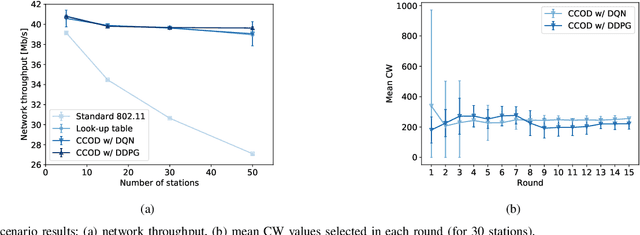
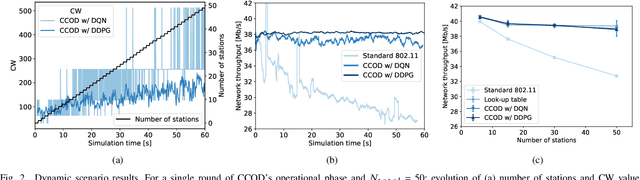
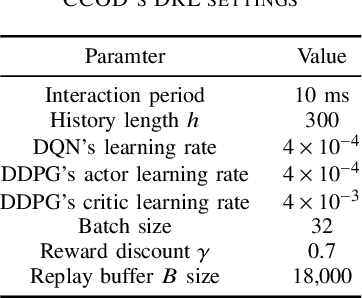
The proper setting of contention window (CW) values has a significant impact on the efficiency of Wi-Fi networks. Unfortunately, the standard method used by 802.11 networks is not scalable enough to maintain stable throughput for an increasing number of stations, despite 802.11ax being designed to improve Wi-Fi performance in dense scenarios. To this end we propose a new method of CW control which leverages deep reinforcement learning principles to learn the correct settings under different network conditions. Our method supports two trainable control algorithms, which, as we demonstrate through simulations, offer efficiency close to optimal while keeping computational cost low.