 Add to Chrome
 Add to Firefox
 Add to Edge
CSPO: Constraint-Sensitive Policy Optimization for Safe Reinforcement Learning
Jun 12, 2026
Safe reinforcement learning (Safe RL) aims to maximize expected return while satisfying safety constraints, typically modeled as Constrained Markov Decision Processes (CMDPs). While primal-dual methods scale well to deep RL, they often suffer from delayed constraint correction, leading to oscillatory behavior and prolonged safety violations. In this paper, we propose Constraint-Sensitive Policy Optimization (CSPO), a first-order primal-dual method that incorporates local constraint sensitivity into policy updates. CSPO augments the primal objective with a constraint-sensitive correction derived from the shortest signed distance to the safety boundary, enabling smarter recovery steps back to safety, compensating for delayed Lagrange multiplier updates, reducing oscillations near the boundary, and preserving the KKT solutions of the original constrained problem. Experiments on navigation and locomotion benchmarks demonstrate that CSPO achieves faster safety recovery and high reward preservation, resulting in higher constrained returns compared to state-of-the-art primal-dual and penalty-based methods

Optimized Federated Knowledge Distillation with Distributed Neural Architecture Search
May 20, 2026Federated Learning (FL) enables collaborative model training without centralizing data. However, real-world deployments must simultaneously address statistical heterogeneity across client data (non-IID), system heterogeneity in device capabilities, and communication efficiency. Existing FL approaches mitigate these challenges through improved aggregation, personalization, or knowledge distillation, but they almost universally assume a fixed client architecture, limiting adaptability to heterogeneous data complexity and hardware constraints. This architectural constraint often leads to suboptimal trade-offs between accuracy and efficiency in real-world FL systems. This work introduces FedKDNAS, a distillation-driven FL framework that combines client-side neural architecture selection with distillation of server-coordinated knowledge. Each client autonomously selects a lightweight model under accuracy-resource constraints. It then trains it locally using a hybrid objective combining supervised learning and knowledge distillation and shares only predictions on a public reference set. The server then aggregates and smooths these predictions, optionally combining them with a teacher model, to produce stable distillation targets for the next round. Extensive evaluation on six datasets against six representative FL baselines (FedAvg, Ditto, FedMD, FedDF, FedDistill, Local-KD) demonstrates that FedKDNAS consistently achieves superior Pareto efficiency, improving accuracy by up to 15\% under non-IID conditions, reducing client CPU usage by approximately 28\%, and decreasing communication overhead by up to 44 times while maintaining lightweight logit-based communication.
Counterfactual Explainable AI (XAI) Method for Deep Learning-Based Multivariate Time Series Classification
Nov 17, 2025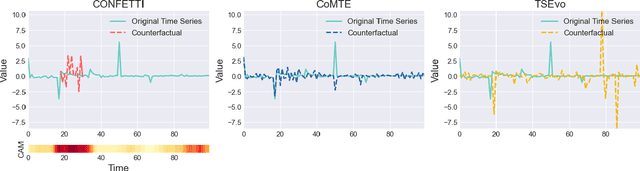
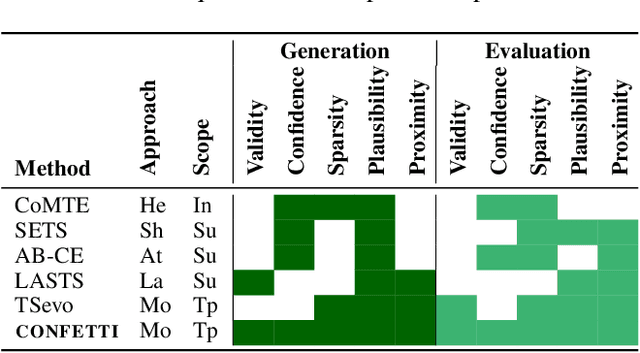
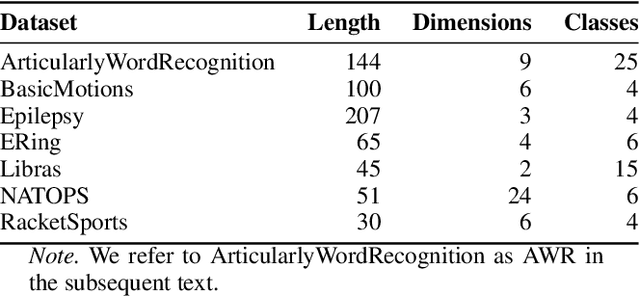
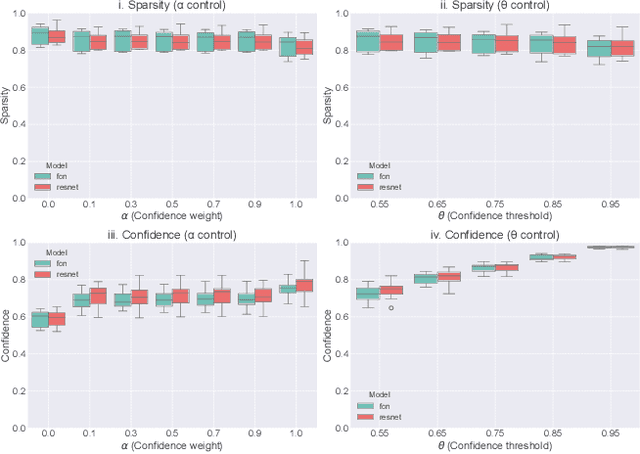
Recent advances in deep learning have improved multivariate time series (MTS) classification and regression by capturing complex patterns, but their lack of transparency hinders decision-making. Explainable AI (XAI) methods offer partial insights, yet often fall short of conveying the full decision space. Counterfactual Explanations (CE) provide a promising alternative, but current approaches typically prioritize either accuracy, proximity or sparsity -- rarely all -- limiting their practical value. To address this, we propose CONFETTI, a novel multi-objective CE method for MTS. CONFETTI identifies key MTS subsequences, locates a counterfactual target, and optimally modifies the time series to balance prediction confidence, proximity and sparsity. This method provides actionable insights with minimal changes, improving interpretability, and decision support. CONFETTI is evaluated on seven MTS datasets from the UEA archive, demonstrating its effectiveness in various domains. CONFETTI consistently outperforms state-of-the-art CE methods in its optimization objectives, and in six other metrics from the literature, achieving $\geq10\%$ higher confidence while improving sparsity in $\geq40\%$.