 Add to Chrome
 Add to Firefox
 Add to Edge
Reliable News or Propagandist News? A Neurosymbolic Model Using Genre, Topic, and Persuasion Techniques to Improve Robustness in Classification
Apr 02, 2026
Among news disorders, propagandist news are particularly insidious, because they tend to mix oriented messages with factual reports intended to look like reliable news. To detect propaganda, extant approaches based on Language Models such as BERT are promising but often overfit their training datasets, due to biases in data collection. To enhance classification robustness and improve generalization to new sources, we propose a neurosymbolic approach combining non-contextual text embeddings (fastText) with symbolic conceptual features such as genre, topic, and persuasion techniques. Results show improvements over equivalent text-only methods, and ablation studies as well as explainability analyses confirm the benefits of the added features. Keywords: Information disorder, Fake news, Propaganda, Classification, Topic modeling, Hybrid method, Neurosymbolic model, Ablation, Robustness

TEGRA: Text Encoding With Graph and Retrieval Augmentation for Misinformation Detection
Feb 12, 2026Misinformation detection is a critical task that can benefit significantly from the integration of external knowledge, much like manual fact-checking. In this work, we propose a novel method for representing textual documents that facilitates the incorporation of information from a knowledge base. Our approach, Text Encoding with Graph (TEG), processes documents by extracting structured information in the form of a graph and encoding both the text and the graph for classification purposes. Through extensive experiments, we demonstrate that this hybrid representation enhances misinformation detection performance compared to using language models alone. Furthermore, we introduce TEGRA, an extension of our framework that integrates domain-specific knowledge, further enhancing classification accuracy in most cases.
Combining Vagueness Detection with Deep Learning to Identify Fake News
Oct 31, 2021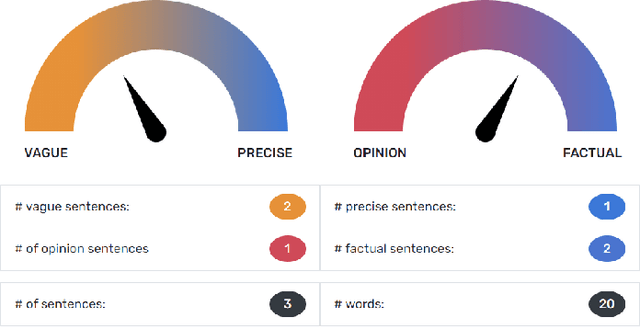
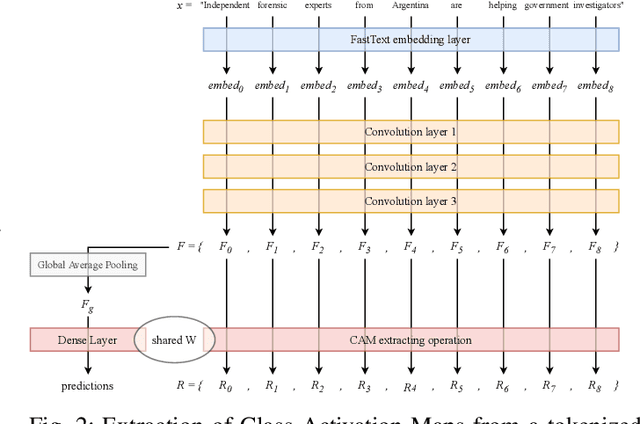
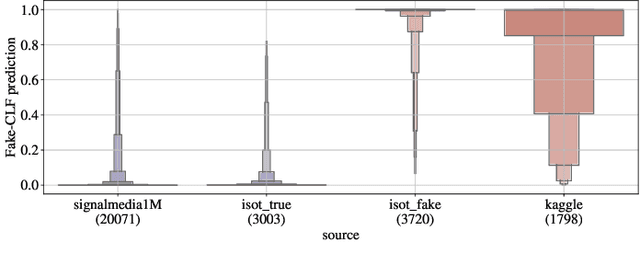
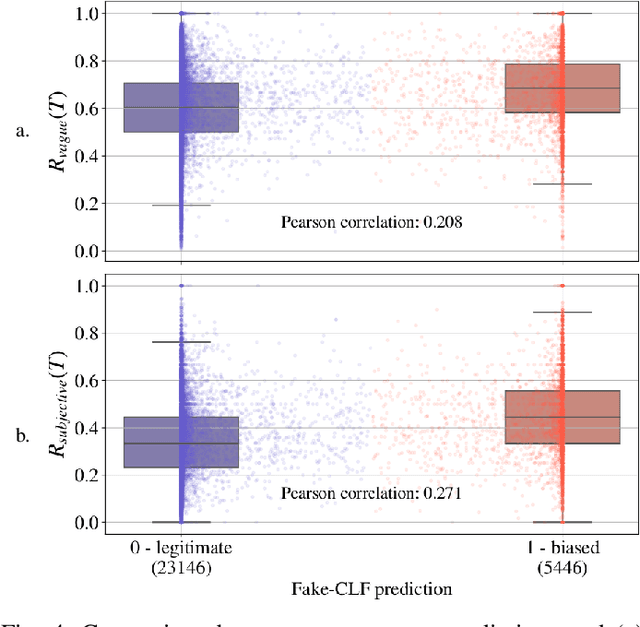
In this paper, we combine two independent detection methods for identifying fake news: the algorithm VAGO uses semantic rules combined with NLP techniques to measure vagueness and subjectivity in texts, while the classifier FAKE-CLF relies on Convolutional Neural Network classification and supervised deep learning to classify texts as biased or legitimate. We compare the results of the two methods on four corpora. We find a positive correlation between the vagueness and subjectivity measures obtained by VAGO, and the classification of text as biased by FAKE-CLF. The comparison yields mutual benefits: VAGO helps explain the results of FAKE-CLF. Conversely FAKE-CLF helps us corroborate and expand VAGO's database. The use of two complementary techniques (rule-based vs data-driven) proves a fruitful approach for the challenging problem of identifying fake news.
Uncertainty in Ontologies: Dempster-Shafer Theory for Data Fusion Applications
Jun 20, 2011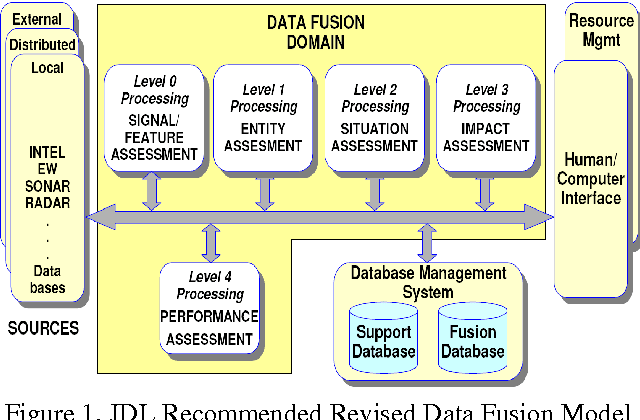
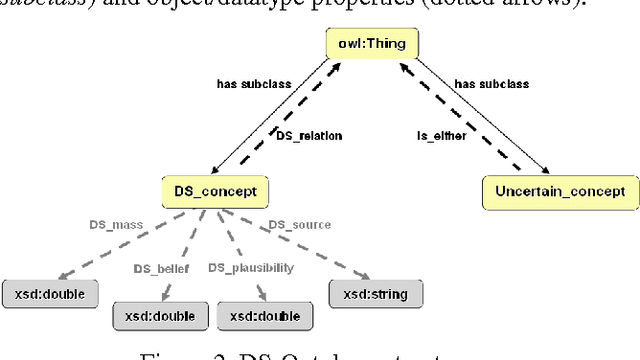
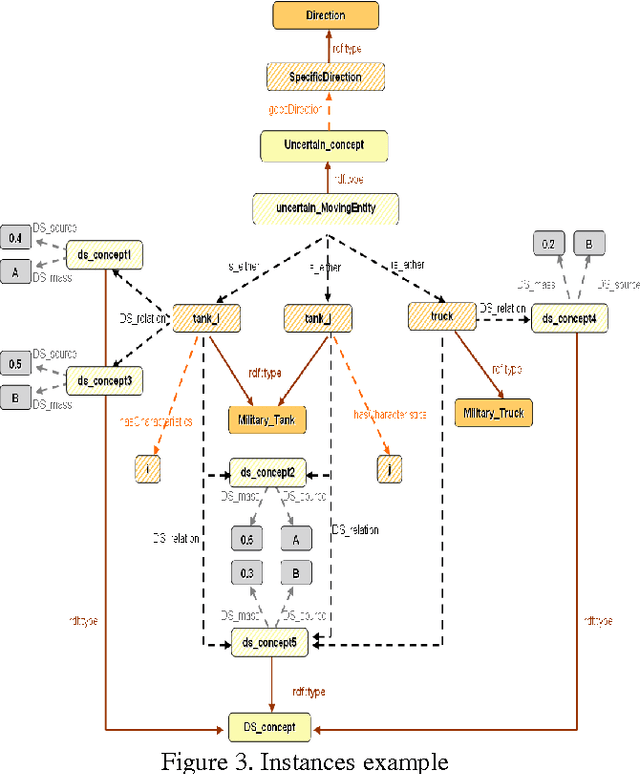
Nowadays ontologies present a growing interest in Data Fusion applications. As a matter of fact, the ontologies are seen as a semantic tool for describing and reasoning about sensor data, objects, relations and general domain theories. In addition, uncertainty is perhaps one of the most important characteristics of the data and information handled by Data Fusion. However, the fundamental nature of ontologies implies that ontologies describe only asserted and veracious facts of the world. Different probabilistic, fuzzy and evidential approaches already exist to fill this gap; this paper recaps the most popular tools. However none of the tools meets exactly our purposes. Therefore, we constructed a Dempster-Shafer ontology that can be imported into any specific domain ontology and that enables us to instantiate it in an uncertain manner. We also developed a Java application that enables reasoning about these uncertain ontological instances.