 Add to Chrome
 Add to Firefox
 Add to Edge
A Checklist for Deploying Robots in Public: Articulating Tacit Knowledge in the HRI Community
Feb 22, 2026
Many of the challenges encountered in in-the-wild public deployments of robots remain undocumented despite sharing many common pitfalls. This creates a high barrier of entry and results in repetition of avoidable mistakes. To articulate the tacit knowledge in the HRI community, this paper presents a guideline in the form of a checklist to support researchers in preparing for robot deployments in public. Drawing on their own experience with public robot deployments, the research team collected essential topics to consider in public HRI research. These topics are represented as modular flip cards in a hierarchical table, structured into deployment phases and important domains. We interviewed six interdisciplinary researchers with expertise in public HRI and show how including community input refines the checklist. We further show the checklist in action in context of real public studies. Finally, we contribute the checklist as an open-source, customizable community resource that both collects joint expertise for continual evolution and is usable as a list, set of cards, and an interactive web tool.

Shutter, the Robot Photographer: Leveraging Behavior Trees for Public, In-the-Wild Human-Robot Interactions
Feb 01, 2023
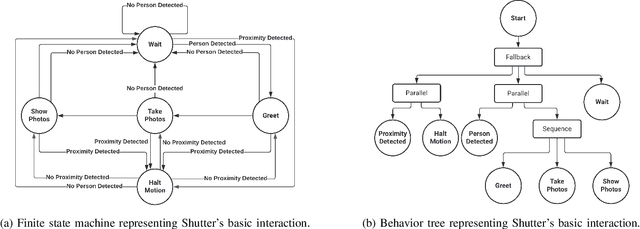
Deploying interactive systems in-the-wild requires adaptability to situations not encountered in lab environments. Our work details our experience about the impact of architecture choice on behavior reusability and reactivity while deploying a public interactive system. In particular, we introduce Shutter, a robot photographer and a platform for public interaction. In designing Shutter's architecture, we focused on adaptability for in-the-wild deployment, while developing a reusable platform to facilitate future research in public human-robot interaction. We find that behavior trees allow reactivity, especially in group settings, and encourage designing reusable behaviors.