 Add to Chrome
 Add to Firefox
 Add to Edge
Shallow-circuit Supervised Learning on a Quantum Processor
Jan 06, 2026
Quantum computing has long promised transformative advances in data analysis, yet practical quantum machine learning has remained elusive due to fundamental obstacles such as a steep quantum cost for the loading of classical data and poor trainability of many quantum machine learning algorithms designed for near-term quantum hardware. In this work, we show that one can overcome these obstacles by using a linear Hamiltonian-based machine learning method which provides a compact quantum representation of classical data via ground state problems for k-local Hamiltonians. We use the recent sample-based Krylov quantum diagonalization method to compute low-energy states of the data Hamiltonians, whose parameters are trained to express classical datasets through local gradients. We demonstrate the efficacy and scalability of the methods by performing experiments on benchmark datasets using up to 50 qubits of an IBM Heron quantum processor.

Demonstration of Robust and Efficient Quantum Property Learning with Shallow Shadows
Feb 27, 2024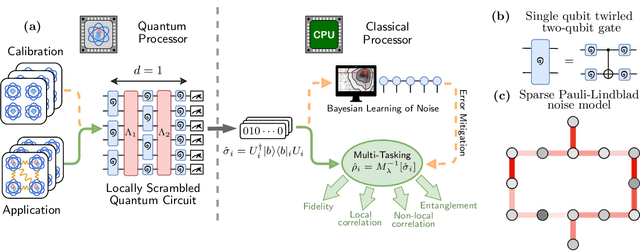


Extracting information efficiently from quantum systems is a major component of quantum information processing tasks. Randomized measurements, or classical shadows, enable predicting many properties of arbitrary quantum states using few measurements. While random single qubit measurements are experimentally friendly and suitable for learning low-weight Pauli observables, they perform poorly for nonlocal observables. Prepending a shallow random quantum circuit before measurements maintains this experimental friendliness, but also has favorable sample complexities for observables beyond low-weight Paulis, including high-weight Paulis and global low-rank properties such as fidelity. However, in realistic scenarios, quantum noise accumulated with each additional layer of the shallow circuit biases the results. To address these challenges, we propose the robust shallow shadows protocol. Our protocol uses Bayesian inference to learn the experimentally relevant noise model and mitigate it in postprocessing. This mitigation introduces a bias-variance trade-off: correcting for noise-induced bias comes at the cost of a larger estimator variance. Despite this increased variance, as we demonstrate on a superconducting quantum processor, our protocol correctly recovers state properties such as expectation values, fidelity, and entanglement entropy, while maintaining a lower sample complexity compared to the random single qubit measurement scheme. We also theoretically analyze the effects of noise on sample complexity and show how the optimal choice of the shallow shadow depth varies with noise strength. This combined theoretical and experimental analysis positions the robust shallow shadow protocol as a scalable, robust, and sample-efficient protocol for characterizing quantum states on current quantum computing platforms.