 Add to Chrome
 Add to Firefox
 Add to Edge
Towards Data-Efficient Video Pre-training with Frozen Image Foundation Models
May 18, 2026
Video foundation models achieve strong performance across many video understanding tasks, but typically require large-scale pre-training on massive video datasets, resulting in substantial data and compute costs. In contrast, modern image foundation models already provide powerful spatial representations. This raises an important question: can competitive video models be built by reusing these spatial representations and pre-training only for temporal reasoning? We take initial steps toward exploring a lightweight training paradigm that freezes a pre-trained image foundation model and trains only a recurrent temporal module to process streaming video. By reusing an image foundation model as a spatial encoder, this approach could significantly reduce the amount of video data and compute required compared to end-to-end video pre-training. In this work, we explore the feasibility of this approach before investing in computing for video pre-training. Our empirical findings across multiple video understanding tasks suggest that strong temporal performance can emerge without large-scale video pre-training, motivating future work on recurrent video foundation models obtained by pre-training a temporal module on top of a frozen image foundation model. Code: https://github.com/tue-mps/towards-video-image-frozen .

ALGM: Adaptive Local-then-Global Token Merging for Efficient Semantic Segmentation with Plain Vision Transformers
Jun 14, 2024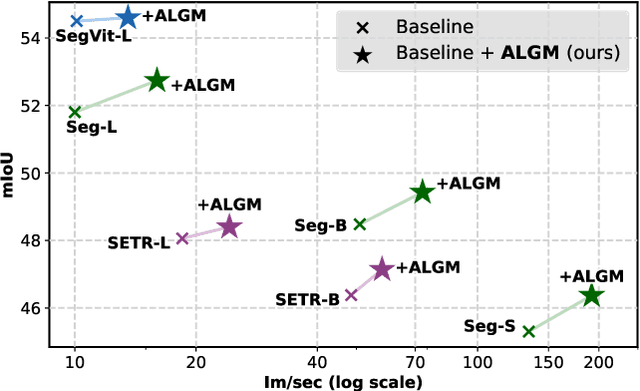
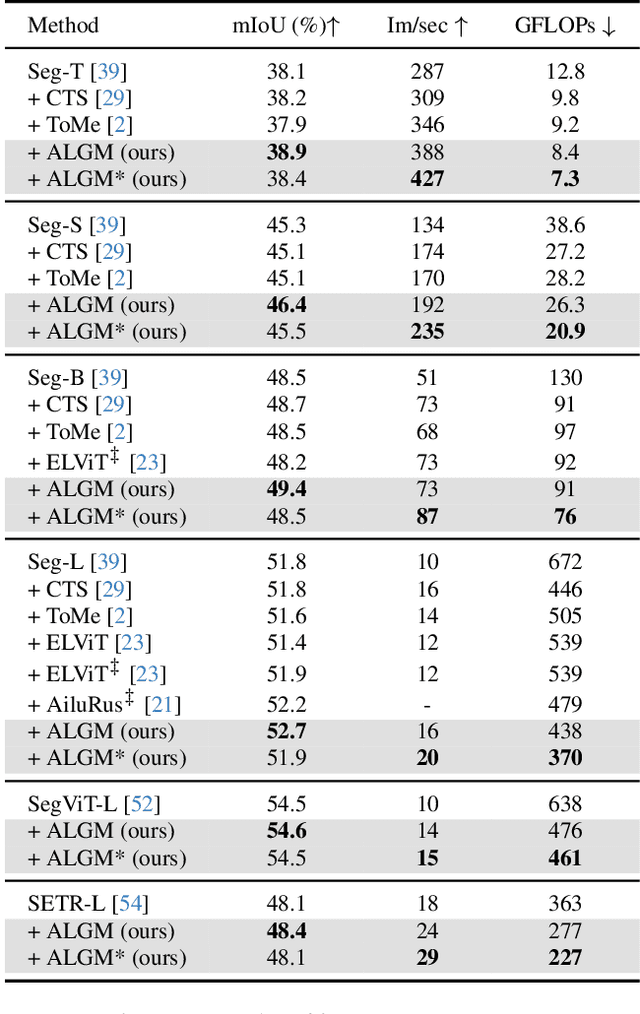


This work presents Adaptive Local-then-Global Merging (ALGM), a token reduction method for semantic segmentation networks that use plain Vision Transformers. ALGM merges tokens in two stages: (1) In the first network layer, it merges similar tokens within a small local window and (2) halfway through the network, it merges similar tokens across the entire image. This is motivated by an analysis in which we found that, in those situations, tokens with a high cosine similarity can likely be merged without a drop in segmentation quality. With extensive experiments across multiple datasets and network configurations, we show that ALGM not only significantly improves the throughput by up to 100%, but can also enhance the mean IoU by up to +1.1, thereby achieving a better trade-off between segmentation quality and efficiency than existing methods. Moreover, our approach is adaptive during inference, meaning that the same model can be used for optimal efficiency or accuracy, depending on the application. Code is available at https://tue-mps.github.io/ALGM.