 Add to Chrome
 Add to Firefox
 Add to Edge
rSDNet: Unified Robust Neural Learning against Label Noise and Adversarial Attacks
Mar 18, 2026
Neural networks are central to modern artificial intelligence, yet their training remains highly sensitive to data contamination. Standard neural classifiers are trained by minimizing the categorical cross-entropy loss, corresponding to maximum likelihood estimation under a multinomial model. While statistically efficient under ideal conditions, this approach is highly vulnerable to contaminated observations including label noises corrupting supervision in the output space, and adversarial perturbations inducing worst-case deviations in the input space. In this paper, we propose a unified and statistically grounded framework for robust neural classification that addresses both forms of contamination within a single learning objective. We formulate neural network training as a minimum-divergence estimation problem and introduce rSDNet, a robust learning algorithm based on the general class of $S$-divergences. The resulting training objective inherits robustness properties from classical statistical estimation, automatically down-weighting aberrant observations through model probabilities. We establish essential population-level properties of rSDNet, including Fisher consistency, classification calibration implying Bayes optimality, and robustness guarantees under uniform label noise and infinitesimal feature contamination. Experiments on three benchmark image classification datasets show that rSDNet improves robustness to label corruption and adversarial attacks while maintaining competitive accuracy on clean data, Our results highlight minimum-divergence learning as a principled and effective framework for robust neural classification under heterogeneous data contamination.

Provably robust learning of regression neural networks using $β$-divergences
Feb 09, 2026Regression neural networks (NNs) are most commonly trained by minimizing the mean squared prediction error, which is highly sensitive to outliers and data contamination. Existing robust training methods for regression NNs are often limited in scope and rely primarily on empirical validation, with only a few offering partial theoretical guarantees. In this paper, we propose a new robust learning framework for regression NNs based on the $β$-divergence (also known as the density power divergence) which we call `rRNet'. It applies to a broad class of regression NNs, including models with non-smooth activation functions and error densities, and recovers the classical maximum likelihood learning as a special case. The rRNet is implemented via an alternating optimization scheme, for which we establish convergence guarantees to stationary points under mild, verifiable conditions. The (local) robustness of rRNet is theoretically characterized through the influence functions of both the parameter estimates and the resulting rRNet predictor, which are shown to be bounded for suitable choices of the tuning parameter $β$, depending on the error density. We further prove that rRNet attains the optimal 50\% asymptotic breakdown point at the assumed model for all $β\in(0, 1]$, providing a strong global robustness guarantee that is largely absent for existing NN learning methods. Our theoretical results are complemented by simulation experiments and real-data analyses, illustrating practical advantages of rRNet over existing approaches in both function approximation problems and prediction tasks with noisy observations.
Asymptotic breakdown point analysis of the minimum density power divergence estimator under independent non-homogeneous setups
Aug 17, 2025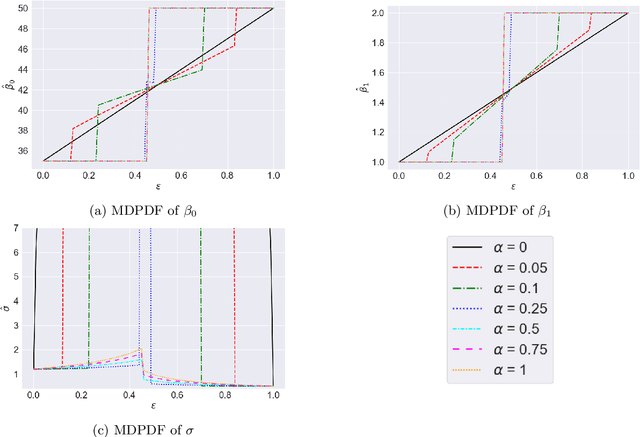
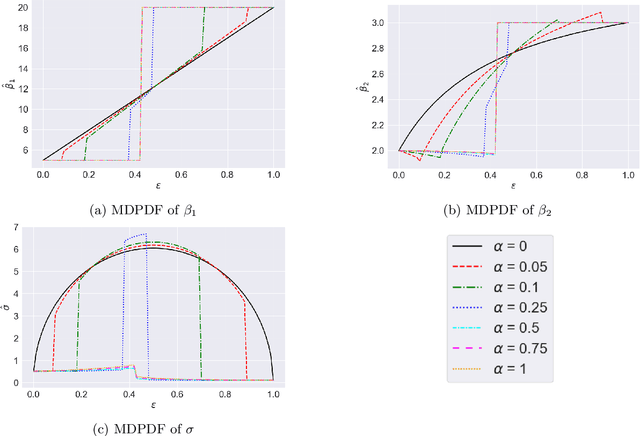
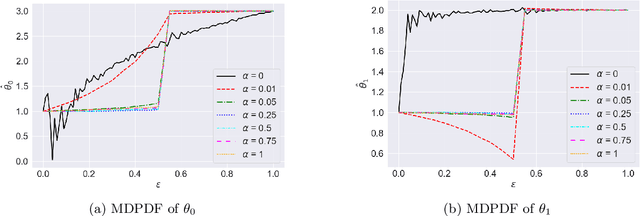
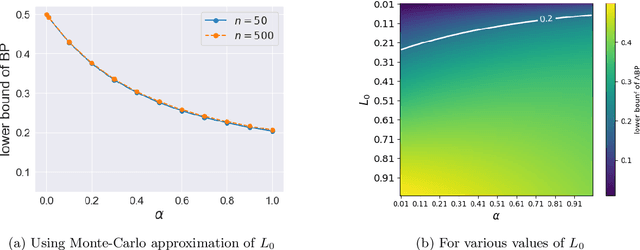
The minimum density power divergence estimator (MDPDE) has gained significant attention in the literature of robust inference due to its strong robustness properties and high asymptotic efficiency; it is relatively easy to compute and can be interpreted as a generalization of the classical maximum likelihood estimator. It has been successfully applied in various setups, including the case of independent and non-homogeneous (INH) observations that cover both classification and regression-type problems with a fixed design. While the local robustness of this estimator has been theoretically validated through the bounded influence function, no general result is known about the global reliability or the breakdown behavior of this estimator under the INH setup, except for the specific case of location-type models. In this paper, we extend the notion of asymptotic breakdown point from the case of independent and identically distributed data to the INH setup and derive a theoretical lower bound for the asymptotic breakdown point of the MDPDE, under some easily verifiable assumptions. These results are further illustrated with applications to some fixed design regression models and corroborated through extensive simulation studies.