 Add to Chrome
 Add to Firefox
 Add to Edge
One-Step Generalization Ratio Guided Optimization for Domain Generalization
Jun 15, 2026
Domain Generalization (DG) aims to train models that generalize to unseen target domains but often overfit to domain-specific features, known as undesired correlations. Gradient-based DG methods typically guide gradients in a dominant direction but often inadvertently reinforce spurious correlations. Recent work has employed dropout to regularize overconfident parameters, but has not explicitly adjusted gradient alignment or ensured balanced parameter updates. We propose GENIE (Generalization-ENhancing Iterative Equalizer), a novel optimizer that leverages the One-Step Generalization Ratio (OSGR) to quantify each parameter's contribution to loss reduction and assess gradient alignment. By dynamically equalizing OSGR via a preconditioning factor, GENIE prevents a small subset of parameters from dominating optimization, thereby promoting domain-invariant feature learning. Theoretically, GENIE balances convergence contribution and gradient alignment among parameters, achieving higher OSGR while retaining SGD's convergence rate. Empirically, it outperforms existing optimizers and enhances performance when integrated with various DG and single-DG methods.

ConTEXTure: Consistent Multiview Images to Texture
Jul 15, 2024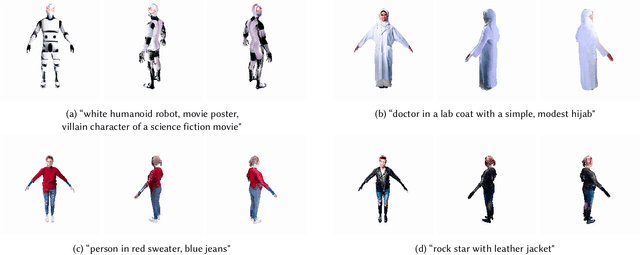
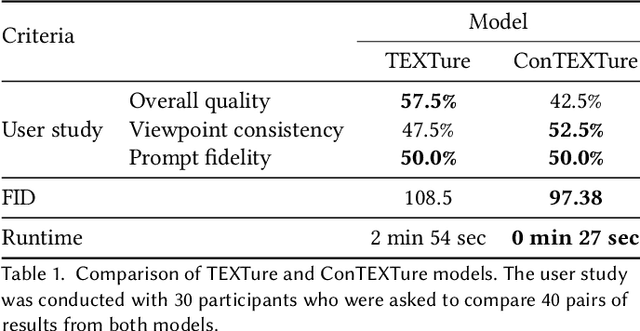
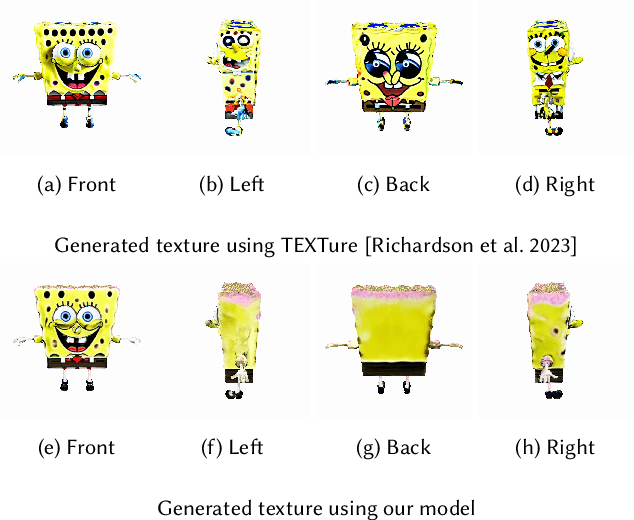
We introduce ConTEXTure, a generative network designed to create a texture map/atlas for a given 3D mesh using images from multiple viewpoints. The process begins with generating a front-view image from a text prompt, such as 'Napoleon, front view', describing the 3D mesh. Additional images from different viewpoints are derived from this front-view image and camera poses relative to it. ConTEXTure builds upon the TEXTure network, which uses text prompts for six viewpoints (e.g., 'Napoleon, front view', 'Napoleon, left view', etc.). However, TEXTure often generates images for non-front viewpoints that do not accurately represent those viewpoints.To address this issue, we employ Zero123++, which generates multiple view-consistent images for the six specified viewpoints simultaneously, conditioned on the initial front-view image and the depth maps of the mesh for the six viewpoints. By utilizing these view-consistent images, ConTEXTure learns the texture atlas from all viewpoint images concurrently, unlike previous methods that do so sequentially. This approach ensures that the rendered images from various viewpoints, including back, side, bottom, and top, are free from viewpoint irregularities.