 Add to Chrome
 Add to Firefox
 Add to Edge
Symbolic Machine Learning for Vapor-Liquid Equilibrium Prediction in Cx-N2 Binary Mixtures
Aug 06, 2026
Accurate prediction of vapor--liquid equilibrium (VLE) for hydrocarbon-nitrogen mixtures remains challenging for cubic equations of state, particularly across broad ranges of composition and hydrocarbon chain length. While deep learning models can provide accurate predictions, they often lack interpretability and explicit analytical expressions. In this work, we propose a symbolic machine learning approach to discover interpretable symbolic corrections to Peng-Robinson equation-of-state (PR-EOS) predictions from experimental data. The proposed approach adopts a two-level strategy: symbolic expressions are first identified for individual hydrocarbon systems, after which their coefficients are represented as functions of carbon number to enable accurate prediction across different hydrocarbon systems. The results demonstrate significantly improved prediction accuracy over the original PR-EOS across all hydrocarbon-nitrogen systems. Overall, the proposed approach provides an interpretable symbolic correction framework for improving PR-EOS predictions of hydrocarbon-nitrogen VLE.

Droplet-LNO: Physics-Informed Laplace Neural Operators for Accurate Prediction of Droplet Spreading Dynamics on Complex Surfaces
Apr 22, 2026Spreading of liquid droplets on solid substrates constitutes a classic multiphysics problem with widespread applications ranging from inkjet printing, spray cooling, to biomedical microfluidic systems. Yet, accurate computational fluid dynamic (CFD) simulations are prohibitively expensive, taking more than 18 to 24 hours for each transient computation. In this paper, Physics-Informed Laplace Operator Neural Network (PI-LNO) is introduced, representing a novel architecture where the Laplace integral transform function serves as a learned physics-informed functional basis. Extensive comparative benchmark studies were performed against five other state-of-the-art approaches: UNet, UNet with attention modules (UNet-AM), DeepONet, Physics-Informed UNet (PI-UNet), and Laplace Neural Operator (LNO). Through complex Laplace transforms, PI-LNO natively models the exponential transient dynamics of the spreading process. A TensorFlow-based PI-LNO is trained on multi-surface CFD data spanning contact angles $θ_s ε[20,160]$, employing a physics-regularized composite loss combining data fidelity (MSE, MAE, RMSE) with Navier-Stokes, Cahn-Hilliard, and causality constraints.
Machine learning for prediction of dose-volume histograms of organs-at-risk in prostate cancer from simple structure volume parameters
Nov 08, 2024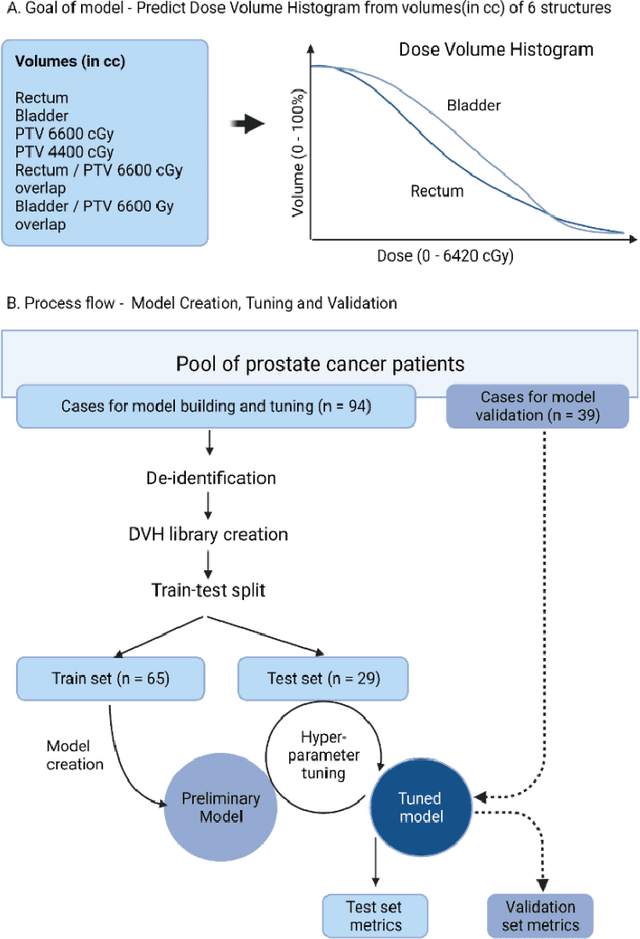
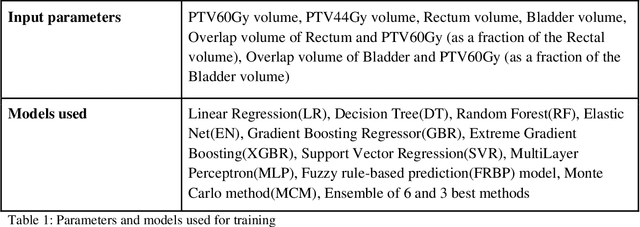

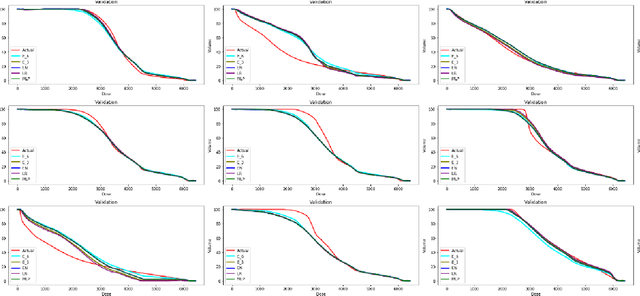
Dose prediction is an area of ongoing research that facilitates radiotherapy planning. Most commercial models utilise imaging data and intense computing resources. This study aimed to predict the dose-volume of rectum and bladder from volumes of target, at-risk structure organs and their overlap regions using machine learning. Dose-volume information of 94 patients with prostate cancer planned for 6000cGy in 20 fractions was exported from the treatment planning system as text files and mined to create a training dataset. Several statistical modelling, machine learning methods, and a new fuzzy rule-based prediction (FRBP) model were explored and validated on an independent dataset of 39 patients. The median absolute error was 2.0%-3.7% for bladder and 1.7-2.4% for rectum in the 4000-6420cGy range. For 5300cGy, 5600cGy and 6000cGy, the median difference was less than 2.5% for rectum and 3.8% for bladder. The FRBP model produced errors of 1.2%, 1.3%, 0.9% and 1.6%, 1.2%, 0.1% for the rectum and bladder respectively at these dose levels. These findings indicate feasibility of obtaining accurate predictions of the clinically important dose-volume parameters for rectum and bladder using just the volumes of these structures.