 Add to Chrome
 Add to Firefox
 Add to Edge
Scalable Amortized Variational Inference for Non-Poisson Buy-'Til-You-Die Models
Aug 19, 2026
Despite the wide variety of existing Buy-`Til-You-Die (BTYD) models, nearly all rely upon the convenient assumption of transactions following a Poisson process. As modern customer bases grow larger and more diverse, a major gap in the marketing literature is BTYD models that can account for heterogeneity in timing patterns across millions of customers. This paper addresses that gap, introducing a family of models that assume transactions follow a Weibull renewal process and developing a highly scalable scheme for parameter estimation based on an amortized variational inference procedure. The proposed model fits to a proprietary dataset of 5 million online retail customers in 8 minutes which would take the current state-of-the-art an estimated 3-4 days. We show both theoretically and empirically that this dramatic improvement in computational performance comes with no appreciable change to either model interpretation or predictive performance. Beyond scalability, gradient-based variational inference also makes it easy to extend the model to covariates, which we illustrate on a public dataset of 4 million political donors during the 2020 US General election cycle. More generally, this paper demonstrates how to blend recent advances in approximate Bayesian inference and the tools of modern machine learning to dramatically improve the efficiency and expressivity of probabilistic models for customer base analysis.

Stein's unbiased risk estimate and Hyvärinen's score matching
Feb 27, 2025
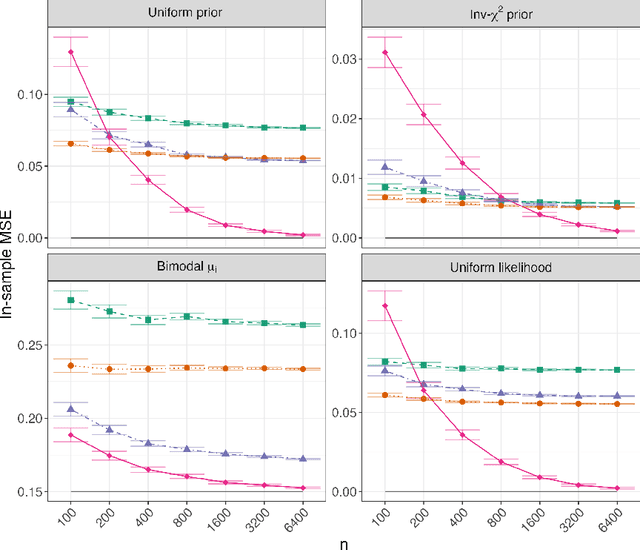
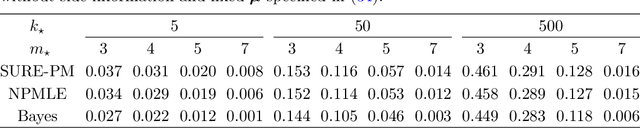
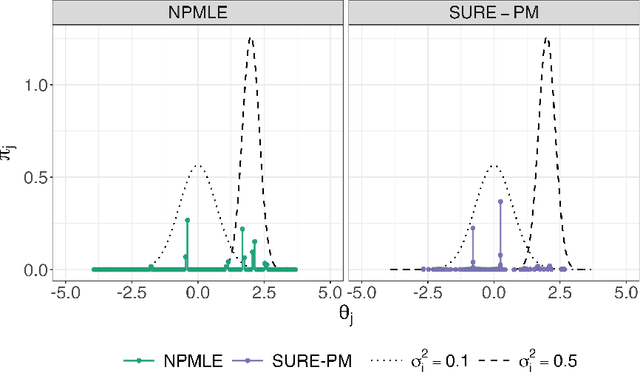
We study two G-modeling strategies for estimating the signal distribution (the empirical Bayesian's prior) from observations corrupted with normal noise. First, we choose the signal distribution by minimizing Stein's unbiased risk estimate (SURE) of the implied Eddington/Tweedie Bayes denoiser, an approach motivated by optimal empirical Bayesian shrinkage estimation of the signals. Second, we select the signal distribution by minimizing Hyv\"arinen's score matching objective for the implied score (derivative of log-marginal density), targeting minimal Fisher divergence between estimated and true marginal densities. While these strategies appear distinct, they are known to be mathematically equivalent. We provide a unified analysis of SURE and score matching under both well-specified signal distribution classes and misspecification. In the classical well-specified setting with homoscedastic noise and compactly supported signal distribution, we establish nearly parametric rates of convergence of the empirical Bayes regret and the Fisher divergence. In a commonly studied misspecified model, we establish fast rates of convergence to the oracle denoiser and corresponding oracle inequalities. Our empirical results demonstrate competitiveness with nonparametric maximum likelihood in well-specified settings, while showing superior performance under misspecification, particularly in settings involving heteroscedasticity and side information.