 Add to Chrome
 Add to Firefox
 Add to Edge
How Do Inpainting Artifacts Propagate to Language?
Feb 24, 2026
We study how visual artifacts introduced by diffusion-based inpainting affect language generation in vision-language models. We use a two-stage diagnostic setup in which masked image regions are reconstructed and then provided to captioning models, enabling controlled comparisons between captions generated from original and reconstructed inputs. Across multiple datasets, we analyze the relationship between reconstruction fidelity and downstream caption quality. We observe consistent associations between pixel-level and perceptual reconstruction metrics and both lexical and semantic captioning performance. Additional analysis of intermediate visual representations and attention patterns shows that inpainting artifacts lead to systematic, layer-dependent changes in model behavior. Together, these results provide a practical diagnostic framework for examining how visual reconstruction quality influences language generation in multimodal systems.

Learning Social Fairness Preferences from Non-Expert Stakeholder Opinions in Kidney Placement
Apr 04, 2024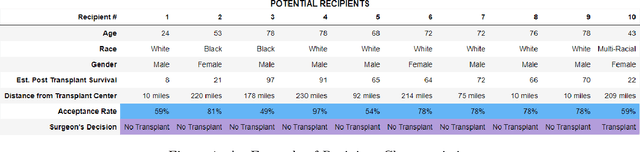
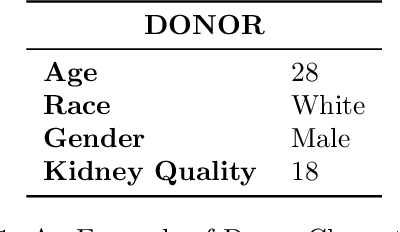
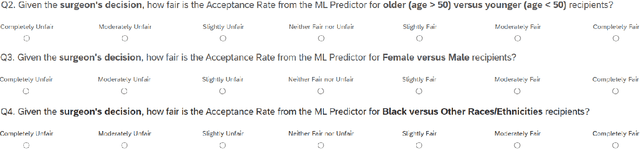
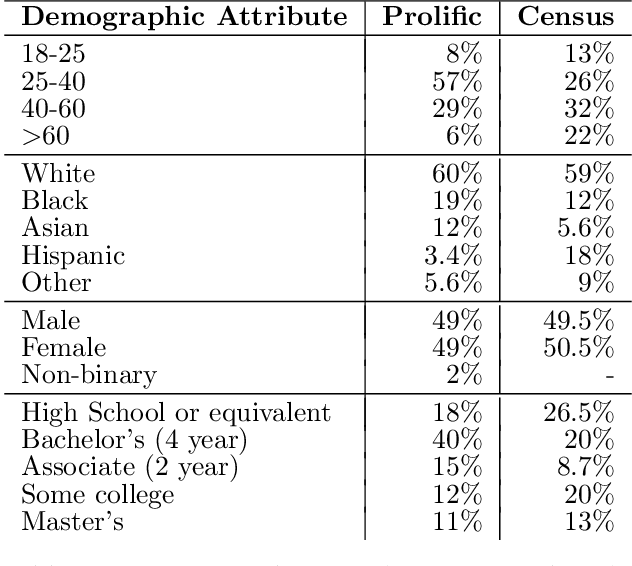
Modern kidney placement incorporates several intelligent recommendation systems which exhibit social discrimination due to biases inherited from training data. Although initial attempts were made in the literature to study algorithmic fairness in kidney placement, these methods replace true outcomes with surgeons' decisions due to the long delays involved in recording such outcomes reliably. However, the replacement of true outcomes with surgeons' decisions disregards expert stakeholders' biases as well as social opinions of other stakeholders who do not possess medical expertise. This paper alleviates the latter concern and designs a novel fairness feedback survey to evaluate an acceptance rate predictor (ARP) that predicts a kidney's acceptance rate in a given kidney-match pair. The survey is launched on Prolific, a crowdsourcing platform, and public opinions are collected from 85 anonymous crowd participants. A novel social fairness preference learning algorithm is proposed based on minimizing social feedback regret computed using a novel logit-based fairness feedback model. The proposed model and learning algorithm are both validated using simulation experiments as well as Prolific data. Public preferences towards group fairness notions in the context of kidney placement have been estimated and discussed in detail. The specific ARP tested in the Prolific survey has been deemed fair by the participants.