 Add to Chrome
 Add to Firefox
 Add to Edge
Rethinking Layer Redundancy in Large Language Models: Calibration Objectives and Search for Depth Pruning
Apr 27, 2026
Depth pruning improves the inference efficiency of large language models by removing Transformer blocks. Prior work has focused on importance criteria and search algorithms, often treating layer redundancy as an inherent structural property of pretrained networks. In contrast, we adopt a \emph{functional perspective}, where redundancy is jointly influenced by the model and the evaluation objective, suggesting that a universal ranking may not be sufficient. Through an empirical study across three LLM families, two calibration objectives, and seven search algorithms, we observe that different objectives yield qualitatively different redundant layers, and that perplexity and downstream accuracy rankings do not consistently align. Under a fixed objective, however, search algorithms tend to produce similar solutions. Overall, our results suggest that the calibration objective may play a more influential role than the choice of search algorithm, indicating that further attention to objective design could be beneficial.

MedCLM: Learning to Localize and Reason via a CoT-Curriculum in Medical Vision-Language Models
Oct 06, 2025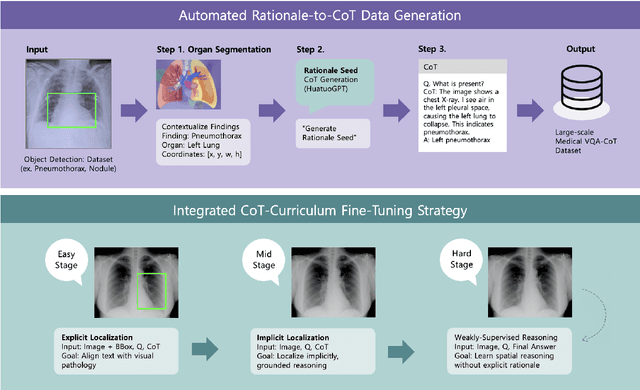
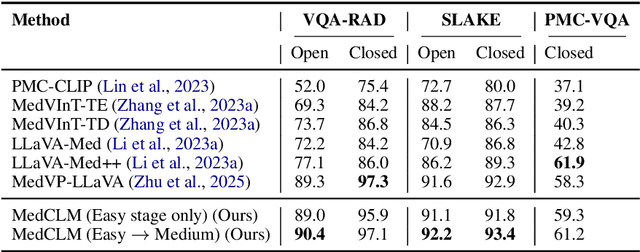
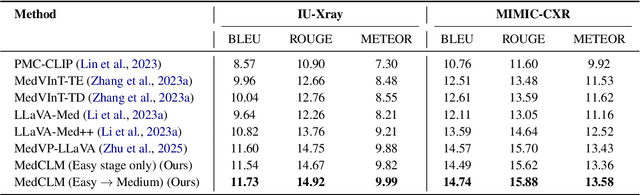
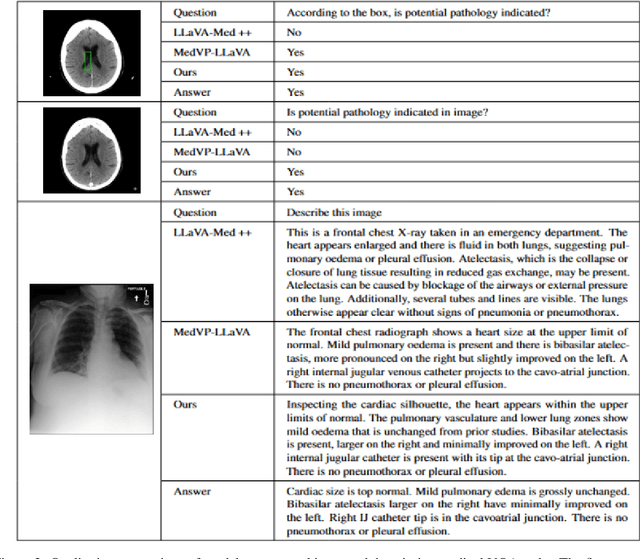
Bridging clinical diagnostic reasoning with AI remains a central challenge in medical imaging. We introduce MedCLM, an automated pipeline that converts detection datasets into large-scale medical visual question answering (VQA) data with Chain-of-Thought (CoT) reasoning by linking lesion boxes to organ segmentation and structured rationales. These contextual signals enable medical vision-language models to generate question-answer pairs with step-by-step reasoning. To utilize this data effectively, we propose an Integrated CoT-Curriculum Strategy composed of an Easy stage with explicit lesion boxes for visual grounding, a Medium stage that encourages implicit localization, and a Hard stage for weakly supervised reasoning. Experimental results demonstrate that MedCLM attains state-of-the-art performance on several medical VQA benchmarks, providing a scalable framework for developing clinically aligned medical vision-language models.
ZNorm: Z-Score Gradient Normalization for Accelerating Neural Network Training
Aug 02, 2024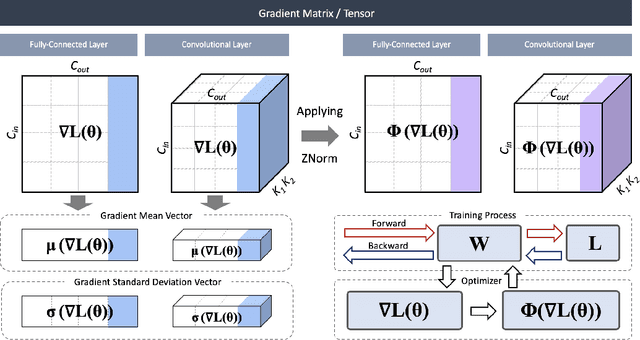
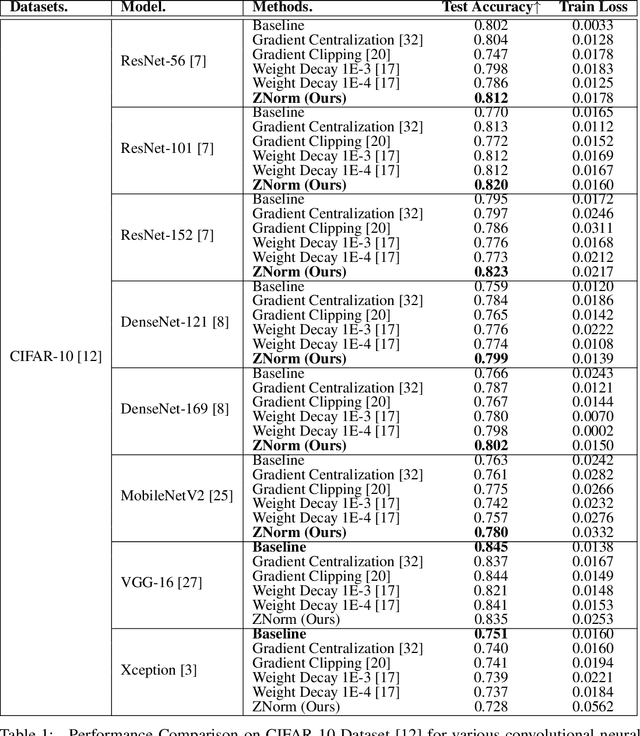
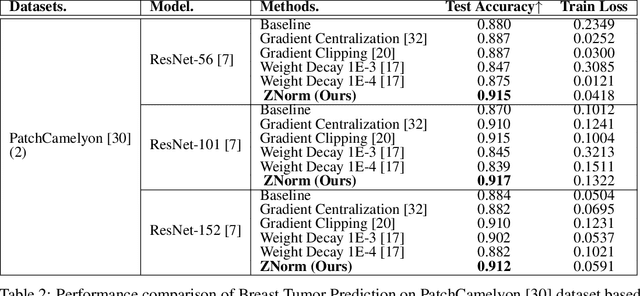
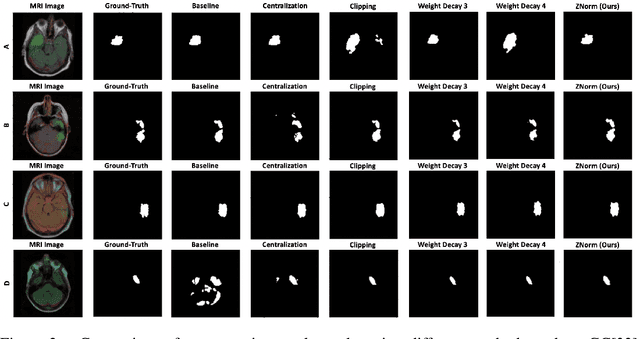
The rapid advancements in deep learning necessitate efficient training methods for deep neural networks (DNNs). As models grow in complexity, vanishing and exploding gradients impede convergence and performance. We propose Z-Score Normalization for Gradient Descent (ZNorm), an innovative technique that adjusts only the gradients to enhance training efficiency and improve model performance. ZNorm normalizes the overall gradients, providing consistent gradient scaling across layers, thereby reducing the risks of vanishing and exploding gradients. Our extensive experiments on CIFAR-10 and medical datasets demonstrate that ZNorm not only accelerates convergence but also enhances performance metrics. ZNorm consistently outperforms existing methods, achieving superior results using the same computational settings. In medical imaging applications, ZNorm improves tumor prediction and segmentation performances, underscoring its practical utility. These findings highlight ZNorm's potential as a robust and versatile tool for improving the efficiency and effectiveness of deep neural network training across a wide range of architectures and applications.