 Add to Chrome
 Add to Firefox
 Add to Edge
Machine Learning for Detection and Severity Estimation of Sweetpotato Weevil Damage in Field and Lab Conditions
Feb 06, 2026
Sweetpotato weevils (Cylas spp.) are considered among the most destructive pests impacting sweetpotato production, particularly in sub-Saharan Africa. Traditional methods for assessing weevil damage, predominantly relying on manual scoring, are labour-intensive, subjective, and often yield inconsistent results. These challenges significantly hinder breeding programs aimed at developing resilient sweetpotato varieties. This study introduces a computer vision-based approach for the automated evaluation of weevil damage in both field and laboratory contexts. In the field settings, we collected data to train classification models to predict root-damage severity levels, achieving a test accuracy of 71.43%. Additionally, we established a laboratory dataset and designed an object detection pipeline employing YOLO12, a leading real-time detection model. This methodology incorporated a two-stage laboratory pipeline that combined root segmentation with a tiling strategy to improve the detectability of small objects. The resulting model demonstrated a mean average precision of 77.7% in identifying minute weevil feeding holes. Our findings indicate that computer vision technologies can provide efficient, objective, and scalable assessment tools that align seamlessly with contemporary breeding workflows. These advancements represent a significant improvement in enhancing phenotyping efficiency within sweetpotato breeding programs and play a crucial role in mitigating the detrimental effects of weevils on food security.

Intelligent Traffic Surveillance for Real-Time Vehicle Detection, License Plate Recognition, and Speed Estimation
Jan 01, 2026Speeding is a major contributor to road fatalities, particularly in developing countries such as Uganda, where road safety infrastructure is limited. This study proposes a real-time intelligent traffic surveillance system tailored to such regions, using computer vision techniques to address vehicle detection, license plate recognition, and speed estimation. The study collected a rich dataset using a speed gun, a Canon Camera, and a mobile phone to train the models. License plate detection using YOLOv8 achieved a mean average precision (mAP) of 97.9%. For character recognition of the detected license plate, the CNN model got a character error rate (CER) of 3.85%, while the transformer model significantly reduced the CER to 1.79%. Speed estimation used source and target regions of interest, yielding a good performance of 10 km/h margin of error. Additionally, a database was established to correlate user information with vehicle detection data, enabling automated ticket issuance via SMS via Africa's Talking API. This system addresses critical traffic management needs in resource-constrained environments and shows potential to reduce road accidents through automated traffic enforcement in developing countries where such interventions are urgently needed.
Enhanced Infield Agriculture with Interpretable Machine Learning Approaches for Crop Classification
Aug 22, 2024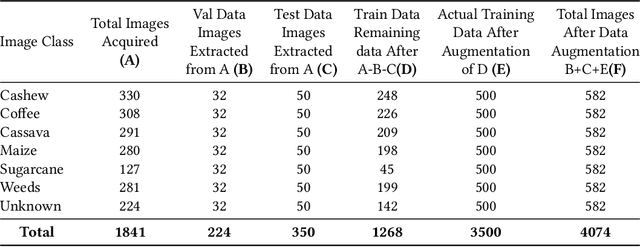

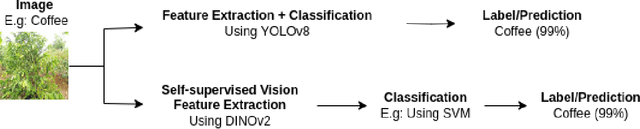

The increasing popularity of Artificial Intelligence in recent years has led to a surge in interest in image classification, especially in the agricultural sector. With the help of Computer Vision, Machine Learning, and Deep Learning, the sector has undergone a significant transformation, leading to the development of new techniques for crop classification in the field. Despite the extensive research on various image classification techniques, most have limitations such as low accuracy, limited use of data, and a lack of reporting model size and prediction. The most significant limitation of all is the need for model explainability. This research evaluates four different approaches for crop classification, namely traditional ML with handcrafted feature extraction methods like SIFT, ORB, and Color Histogram; Custom Designed CNN and established DL architecture like AlexNet; transfer learning on five models pre-trained using ImageNet such as EfficientNetV2, ResNet152V2, Xception, Inception-ResNetV2, MobileNetV3; and cutting-edge foundation models like YOLOv8 and DINOv2, a self-supervised Vision Transformer Model. All models performed well, but Xception outperformed all of them in terms of generalization, achieving 98% accuracy on the test data, with a model size of 80.03 MB and a prediction time of 0.0633 seconds. A key aspect of this research was the application of Explainable AI to provide the explainability of all the models. This journal presents the explainability of Xception model with LIME, SHAP, and GradCAM, ensuring transparency and trustworthiness in the models' predictions. This study highlights the importance of selecting the right model according to task-specific needs. It also underscores the important role of explainability in deploying AI in agriculture, providing insightful information to help enhance AI-driven crop management strategies.