 Add to Chrome
 Add to Firefox
 Add to Edge
Graph Neural Operator Towards Edge Deployability and Portability for Sparse-to-Dense, Real-Time Virtual Sensing on Irregular Grids
Apr 02, 2026
Accurate sensing of spatially distributed physical fields typically requires dense instrumentation, which is often infeasible in real-world systems due to cost, accessibility, and environmental constraints. Physics-based solvers address this through direct numerical integration of governing equations, but their computational latency and power requirements preclude real-time use in resource-constrained monitoring and control systems. Here we introduce VIRSO (Virtual Irregular Real-Time Sparse Operator), a graph-based neural operator for sparse-to-dense reconstruction on irregular geometries, and a variable-connectivity algorithm, Variable KNN (V-KNN), for mesh-informed graph construction. Unlike prior neural operators that treat hardware deployability as secondary, VIRSO reframes inference as measurement: the combination of both spectral and spatial analysis provides accurate reconstruction without the high latency and power consumption of previous graph-based methodologies with poor scalability, presenting VIRSO as a potential candidate for edge-constrained, real-time virtual sensing. We evaluate VIRSO on three nuclear thermal-hydraulic benchmarks of increasing geometric and multiphysics complexity, across reconstruction ratios from 47:1 to 156:1. VIRSO achieves mean relative $L_2$ errors below 1%, outperforming other benchmark operators while using fewer parameters. The full 10-layer configuration reduces the energy-delay product (EDP) from ${\approx}206$ J$\cdot$ms for the graph operator baseline to $10.1$ J$\cdot$ms on an NVIDIA H200. Implemented on an NVIDIA Jetson Orin Nano, all configurations of VIRSO provide sub-10 W power consumption and sub-second latency. These results establish the edge-feasibility and hardware-portability of VIRSO and present compute-aware operator learning as a new paradigm for real-time sensing in inaccessible and resource-constrained environments.

Spatio-spectral graph neural operator for solving computational mechanics problems on irregular domain and unstructured grid
Sep 01, 2024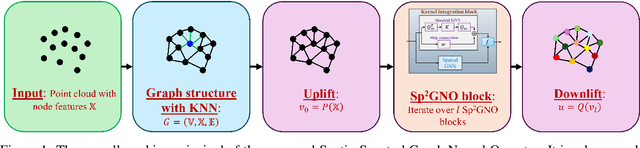
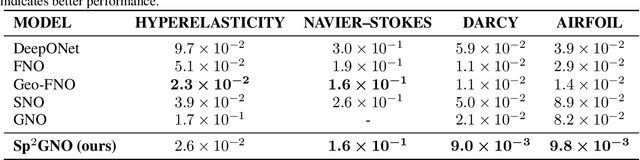
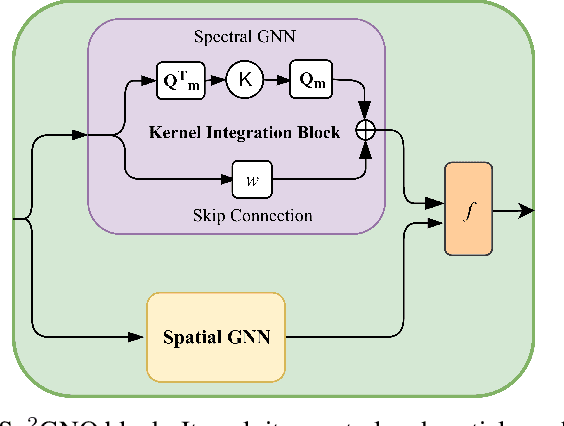
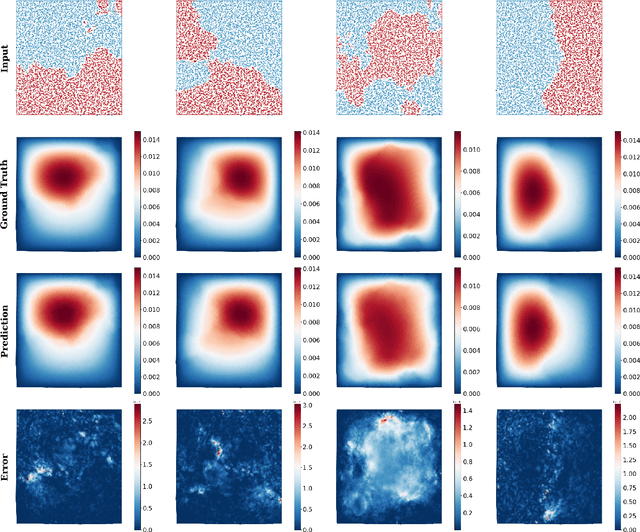
Scientific machine learning has seen significant progress with the emergence of operator learning. However, existing methods encounter difficulties when applied to problems on unstructured grids and irregular domains. Spatial graph neural networks utilize local convolution in a neighborhood to potentially address these challenges, yet they often suffer from issues such as over-smoothing and over-squashing in deep architectures. Conversely, spectral graph neural networks leverage global convolution to capture extensive features and long-range dependencies in domain graphs, albeit at a high computational cost due to Eigenvalue decomposition. In this paper, we introduce a novel approach, referred to as Spatio-Spectral Graph Neural Operator (Sp$^2$GNO) that integrates spatial and spectral GNNs effectively. This framework mitigates the limitations of individual methods and enables the learning of solution operators across arbitrary geometries, thus catering to a wide range of real-world problems. Sp$^2$GNO demonstrates exceptional performance in solving both time-dependent and time-independent partial differential equations on regular and irregular domains. Our approach is validated through comprehensive benchmarks and practical applications drawn from computational mechanics and scientific computing literature.